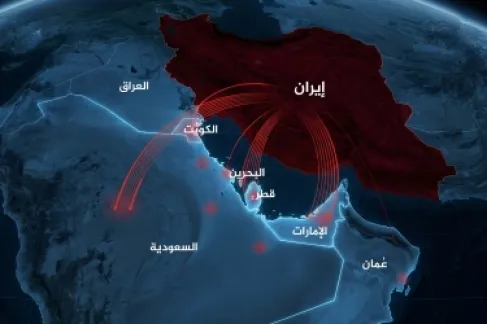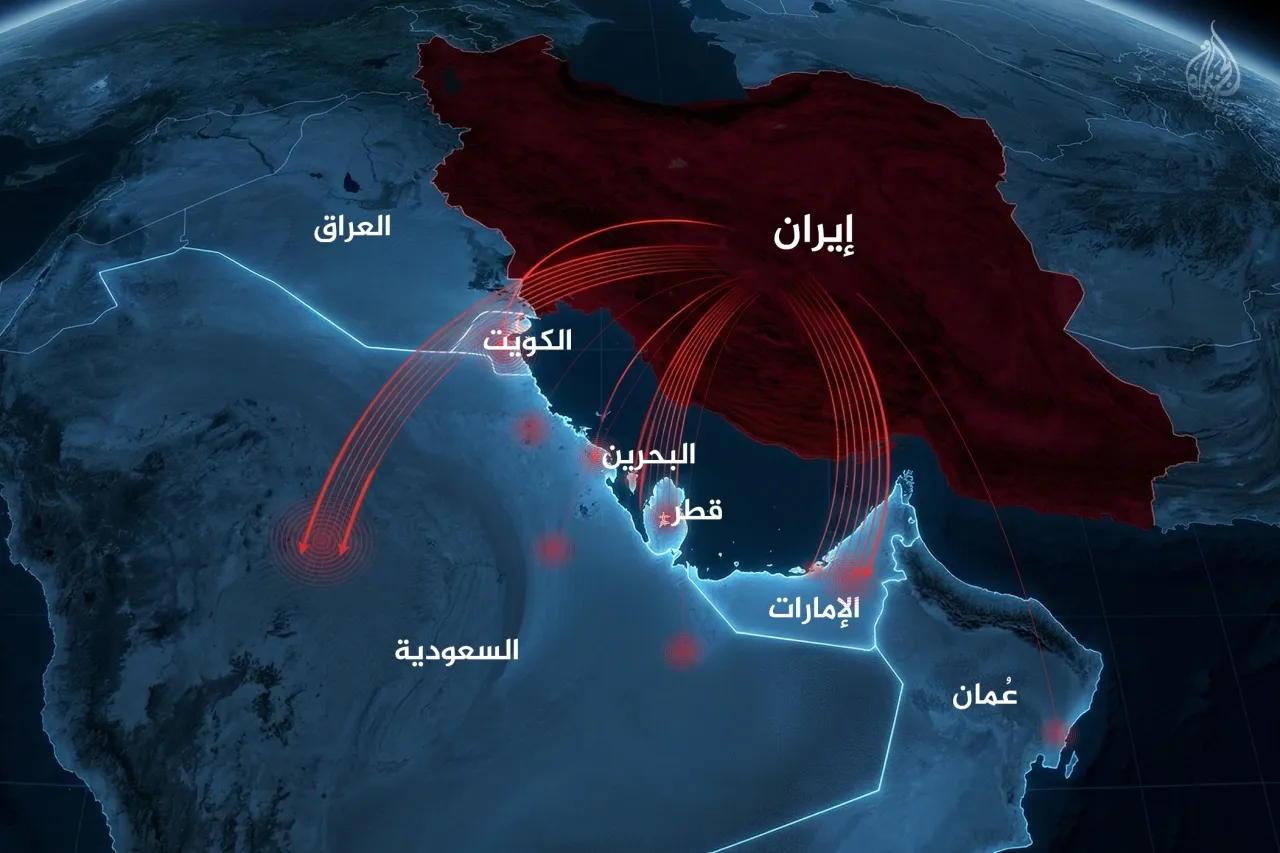
Khaberni - Over the span of 30 days of escalation, Iran has targeted the Gulf states with more than 5200 missile and drone attacks, in addition to an attack with two fighter jets.
Tehran asserts it does not specifically target countries, but "American bases and interests," although the pattern of strikes and their wide distribution reveal extensions to civilian facilities and vital infrastructure, resulting in deaths, injuries, and damage to airports, ports, and economic facilities in the Gulf states.
This comes in the context of data showing that about 80 percent of the Iranian attacks were directed at the Gulf states, with only 20 percent directed at Israel according to statistics from Anadolu Agency, reflecting a shift in the geography of targeting.
Iranian Targeting in Gulf States
Official data during the first month of the war reveal a diversity of attack tools and their wide scope, from ballistic missiles and drones to even fighter jets.
In Saudi Arabia, official data indicated that 57 missiles and at least 1006 drones were intercepted. In Kuwait, the number of aerial threats amounted to 309 ballistic missiles and 616 drones.
These figures reflect a clear reliance on drones as a primary tool in attacks, as part of what could be described as a strategy of quantitative flooding to disperse air defense systems, compared to the use of missiles in more concentrated and impactful strikes.
Despite the broad defense carried out by air defense systems in the Gulf states, which succeeded in intercepting the majority of Iranian missiles and drones and neutralizing their threat, Tehran continued its attacks, ignoring Arab and Islamic calls to cease escalation.
The impact of these strikes extended to vital energy facilities, directly affecting the stability of supplies and the lifeblood of the global economy.
Targeting Energy Resources
The Iranian strikes notably concentrated on the energy sector, indicating an attempt to influence global oil and gas markets.
In Saudi Arabia, the attacks hit Ras Tanura and SAMREF refineries, with recurring targeting in the Eastern Region and the Shaybah oil field.
In Kuwait, the Mina Abdullah refinery and the Mina Al-Ahmadi refinery were targeted, along with power generation stations, six power transmission lines, and a fuel tank at Kuwait airport.
In the UAE, the oil industry area in Fujairah was targeted, in addition to attempts to hit gas and oil fields in Habshan, leading to the temporary closure of some facilities.
In Qatar, the attacks targeted the industrial city of Ras Laffan, a major gas industry hub, causing damage. Doha stated that the Iranian attacks disrupted about 17% of the country's capacity to export liquefied natural gas.
Bahrain witnessed targeting of a fuel depot in Muharraq and a fire near a refinery in Manama.
In Oman, fuel tanks at Salalah port were set ablaze, and a tank at the Duqm port was targeted.
This pattern indicates a clear attempt to exert cross-border economic pressure, considering the centrality of the Gulf in global energy supplies.
Ports and Airports
The targeting extended to include ports and airports, reflecting an orientation to disrupt the logistic arteries of the region.
In Saudi Arabia, Yanbu port on the Red Sea was targeted in an attempt to obstruct oil export routes.
In the UAE, authorities reported controlling a fire at the old Abu Dhabi airport, and repeated attacks on Dubai airport, with targeting of Jebel Ali and Fujairah ports, resulting in the outbreak of fires.
In Qatar, authorities announced thwarting attempts to target Hamad International Airport. Kuwait International Airport also experienced repeated attacks, with damage recorded in the infrastructure of Mubarak Al-Kabeer port and an attack on Shuwaikh port.
In Bahrain, a rocket attack on Salman port resulted in the death of a worker, while Oman evacuated Fahl port precautionarily, with targeting also recorded at Duqm port.
This trajectory reveals an attempt to strike at supply chains and trade, not just military targets, thus multiplying the cost of escalation.
Infrastructure
The strikes did not limit themselves to energy facilities and ports but extended to civilian and industrial infrastructure, thereby widening the direct impact circle.
In Saudi Arabia, attacks reached the vicinity of the embassy district in Riyadh, while in the UAE, several towers and buildings in Dubai, including the financial district, were targeted, as Emirates Global Aluminium reported damage to its facilities in Taweelah.
In Qatar, the industrial area and the Mesaieed area were targeted, while in Kuwait, warehouses of logistics companies were attacked.
In Bahrain, residential buildings were targeted, damaging Eira Views Tower and Crown Plaza Hotel, and a desalination plant and Alba facilities were damaged.
In Oman, the Awahi industrial area was targeted, resulting in the deaths of expatriates. This expansion reflects a shift from direct military targeting to broader societal and economic pressure.
Air Traffic Movement
These attacks led to unprecedented disruption in air traffic movement in the region, with aviation movement at major airports stopped or reduced, and airlines substantially affected.
Data indicate the cancellation of more than 5400 flights in seven Gulf airports in just the first two days of escalation. The number of cancelled flights in the Middle East exceeded 50,000 round trips by the end of March 2026.
Gulf airlines are working to recover from the damages suffered due to the Iranian attacks. These numbers highlight the scale of impact that has surpassed military realms to directly affect transport, tourism, and economic sectors.
Impact on Residents
These developments have reflected on the daily lives of residents, with thousands of citizens and residents finding themselves stranded inside or outside their countries, with flights of global airlines like Lufthansa and British Airways suspended, among others.
Authorities in Qatar, UAE, Kuwait, and Bahrain instructed residents to stay indoors and away from windows during air raid sirens or when intercepting air targets, creating a general atmosphere of anxiety.
Outdoor and tourist activities in major cities like Dubai were disrupted, with smoke columns rising in some areas and rockets intercepted in city skies, a scene reflecting the war's unprecedented approach to the civilian sphere.
Since February 28, 2026, the United States and Israel have waged a wide-ranging war on Iran, which responds with missile and drone attacks towards Israel, and by targeting what it describes as American interests in the region.
However, field data show that the bulk of these attacks have struck Gulf states, resulting in human casualties and civilian damage, sparking official condemnations, and opening questions on the actual nature of targets and the limits of escalation in the region.