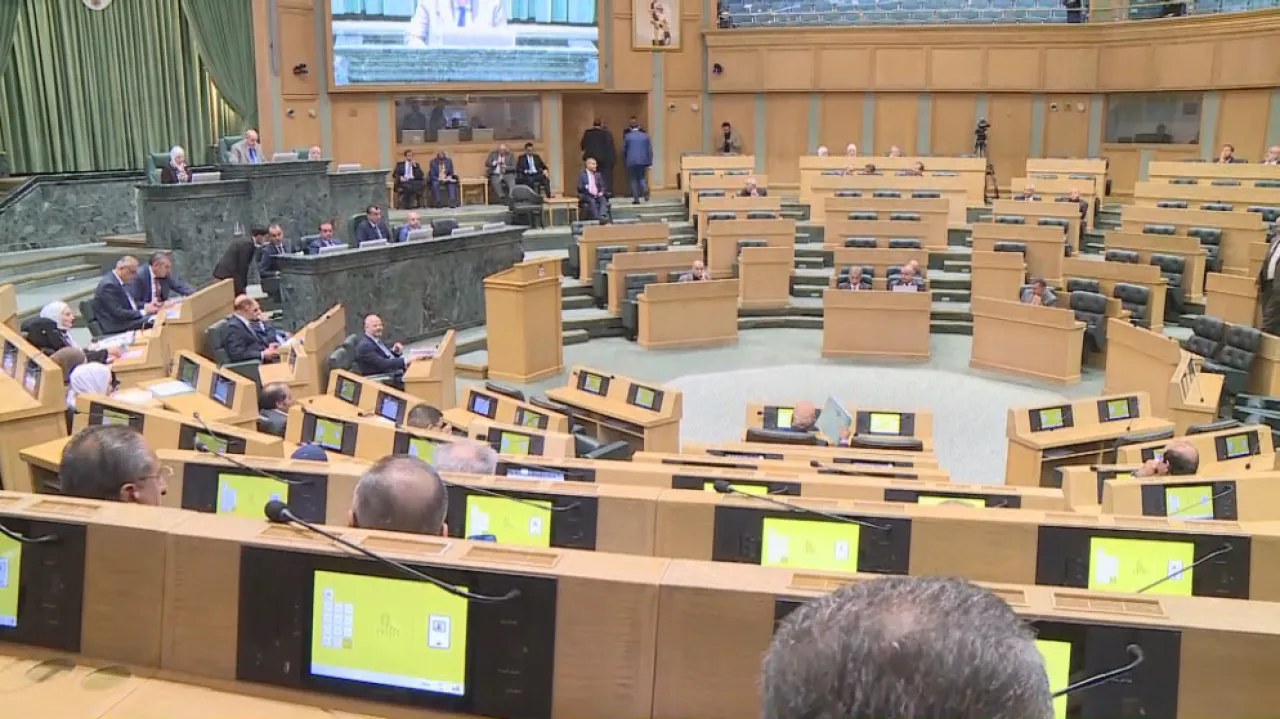
Khaberni - The House of Representatives, by majority, approved the referral of two legislative amendments for the civil status law for the year 2026 and the amendment for the real estate ownership law for the year 2026 to the Parliamentary Legal Committee, and the amendment for the traffic law for the year 2026 to the Joint Parliamentary Committee (Legal and Public Services).
During a legislative session held on Monday, chaired by the Speaker of the Council Mazen Al-Qadi, and attended by Prime Minister Jafar Hassan and members of the government team, the Council approved a bill ratifying a loan agreement between the Government of the Hashemite Kingdom of Jordan and the Government of the Republic of Italy for the year 2024.
Regarding the bill ratifying the loan agreement between Jordan and Italy, the State Minister for Political and Parliamentary Affairs, Abdul-Monem Al-Oudat, stated that this agreement must be approved by the National Assembly, in both its Senate and Representatives forms, to proceed with the constitutional ratification procedures, explaining that the agreement consists of a concessional loan to finance the general treasury.
Al-Oudat added, during the session presided over by the First Deputy Speaker of the Council Khamees Atiyah, that it is known that all countries sign agreements and loans with international institutions and banks, affirming that the agreement, like other agreements, is not a sovereignty agreement but an agreement to finance service projects.
He mentioned that the agreement came with a concessional loan for a duration of one year, with a half percent interest rate, and a grace period of 7 years, indicating that this agreement consists of an unrestricted loan, which allows high flexibility in financing government projects.
He emphasized that there is no intervention by any country in how the loan is managed, explaining that when a country offers you a concessional loan, it is a sign of Jordan's status, and the security and stability it enjoys.
The head of the Parliamentary Financial Committee, Nimr Al-Sulihat, said that the loan is directed to implement the "Hakeem" program, which aims to complete the electronic medical record, and ends with a qualitative leap that contributes to improving the services and medical care provided to citizens.
He explained that the loan amount is 50 million euros, 60% of which is a grant, while the rest of the amount is to be repaid over 20 years at only a half percent interest rate.
The Parliamentary Financial Committee approved, during a session held on February 4, the draft law ratifying the loan agreement between the Government of the Hashemite Kingdom of Jordan and the Government of the Republic of Italy for the year 2024.
Al-Sulihat, upon the approval of the draft ratifying the agreement, said that the committee discussed the terms of the agreement which stipulates that the Italian side provides an unconditional concessional loan with a value of 50 million euros, aimed at supporting one of the public budget projects, specifically directed to finance the implementation of the digital transformation program in the health sector.
He added that the loan comes within the framework of bilateral partnership and cooperation between the two countries, appreciating the Italian government's support for Jordan in various fields, contributing to the achievement of national priorities within the economic modernization vision and the public sector development map.
About the "Civil Status Amendment," which the cabinet approved its motivating reasons during a session held on March 11, it comes in line with government directives to develop public administration, and in implementation of digital transformation programs, by introducing the concept of digital identity within the legislative framework regulating the work of the Civil Status and Passports Department.
The bill aims to establish explicit legal validity for the digital identity; as an official identification means issued alongside the personal identity card by the department, granting it the same legal effect in proving and adopting the data contained therein, mandating governmental and private entities to adopt it in accordance with the law provisions and the regulations and instructions issued under it.
This amendment aims to enable citizens to conduct their transactions electronically in a secure, reliable, and legal manner; ensuring the protection, safety, and confidentiality of personal data.
The bill also aims to establish a legal basis for regulating the form, content, and mechanism of issuing and using digital identity, achieving integration between traditional and electronic means and keeping pace with technological developments and international best practices in the field of digital identity and electronic transactions.
The bill amended for the traffic law for the year 2026 aims to enable citizens to carry out all transactions and dealings related to the sale and purchase of vehicles, including the collection of their price, using electronic means, and implementing remote transactions and adopting electronic signatures to complete transactions.
For this purpose, the use of electronic signatures at the notary public in vehicle sales and purchase transactions will be adopted; allowing the completion of the sale process without the physical presence before the notary public, through the authorization of using electronic communication, visual and audio communication means, and the electronic signature, in the transactions conducted by the notary public officers and non-commissioned officers working in the Licensing Administration.
To ensure the completion of vehicle sales and purchase processes electronically, and to safeguard the rights of their owners, the buyer must deposit the vehicle price in a special account in the Licensing Department to guarantee vehicle prices, to be established for this purpose, with the amount being transferred to the seller's account upon completing the sale process.
To complete vehicle sales and purchase transactions through various financing institutions, a special regulation will be issued that regulates this process, according to the new electronic sales and purchase mechanism.
By adopting these procedures, all procedures for selling and purchasing vehicles will be completed electronically without the need to refer to the driver and vehicle licensing departments.
The law amendment project also grants the competent authorities the authority to sell vehicles in impound lots, within one year instead of two, in case the owners do not review to rectify their situation, considering the decrease in the value of these vehicles due to the lengthy retention period without settling their situation, thereby preserving the rights of the creditor or the impounding entity.
On the other hand, the "Real Estate Ownership Amendment" aims to facilitate the process of terminating joint ownership among partners, by simplifying and expediting its procedures, contributing to the resolution of many pending cases for years concerning thousands of properties, and introducing unutilized properties to the economic cycle.
It includes provisions that allow electronic sales, adopting electronic signatures, and digitizing all procedures and transactions, including payment, partitioning, and sales; thus making all procedures electronic in accordance with the provisions of the notary public law, besides easing the financial and procedural burdens associated with paper publishing; aiming to facilitate for citizens, reducing costs, time, and effort on them, as stated in the motivating reasons.
The amendments allow the sale and partitioning on the plan before starting the construction of the property, with a certificate of allocation issued by the bank for this purpose; contributing to encouraging investment and real estate development.
It also included replacing the requirement for unanimous consent of partners in the partition of properties with buildings on them, to now require the consent of three-quarters of the property owners, without affecting the rights of other partners.
The bill obliges the government and municipalities, including the Greater Amman Municipality, to pay compensation within a maximum period of 5 years, with delay compensation for each year, besides addressing the conflicting provisions of joint ownership removal with the legislation related to agricultural units, ensuring that its provisions are in line with the provisions of the Jordan Valley Development Law to prevent duplicative application.
The bill includes several steps to facilitate for citizens and lighten the procedures related to their transactions, through delegating powers to directors in different provinces and regions to limit centralization.