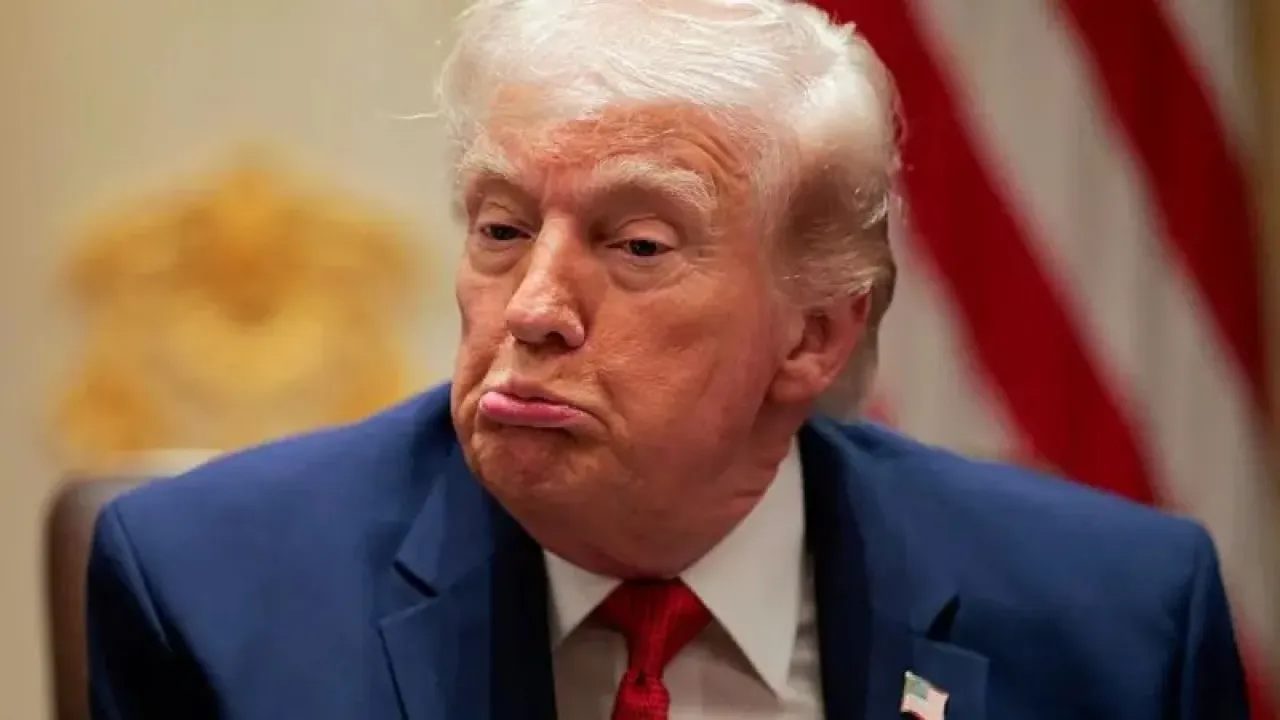
Some old truths about wars were knocking on the door of the Oval Office during the month following the dispatch of American President Donald Trump and Israeli Prime Minister Benjamin Netanyahu sending American and Israeli warplanes to bomb Iran.
Failing to learn from the past means that Donald Trump is now facing a tough choice; if he cannot reach an agreement with Iran, he must either try to declare a victory that will fool no one, or he must escalate the war.
One of the oldest of these truths goes back to the Prussian military strategist Helmuth von Moltke the Elder: "No plan survives first contact with the enemy." He wrote this in 1871, the year Germany was united as an empire, a moment that had a significant impact on the security of Europe, just as this war might impact the security of the Middle East.
Trump might prefer the modern version by boxer Mike Tyson: "Everyone has a plan until they get punched." More relevant to Trump are the words of one of his predecessors, Dwight Eisenhower, the American general who led the Normandy landings in 1944 and later served two terms as a Republican US president in the 1950s.
Eisenhower's saying was: "Plans are worthless, but planning is everything." He meant that discipline and methodology in drafting war plans allow for changing course when something unexpected occurs.
For Trump, the unexpected element was the resilience of the regime in Iran. It seems he was hoping to repeat the swift operation that American forces carried out last January when Venezuelan President Nicolas Maduro and his wife Celia Flores were kidnapped and are now imprisoned in New York facing trial, with Maduro's deputy, Delcy Rodriguez, replacing him as president and receiving instructions from Washington.
The hope of replicating the victory over Maduro indicates a significant lack of understanding of the differences between Venezuela and Iran.
Eisenhower famously spoke about prior planning in a speech delivered in 1957. He was responsible for planning and leading the largest amphibious military operation in history, the invasion of Western Europe on D-Day, so he knew exactly what he was talking about.
He went on to explain that when an unexpected emergency arises, "The first thing you do is take all your plans off the top shelf and throw them out of the window and start anew. But if you hadn't planned before, you wouldn't be able to start acting, at least not intelligently."
He added: "That's why planning is very important, and you should stay immersed in the nature of the problem that may one day be asked to solve, or help solve."
Despite the collapse or surrender after the United States and Israel killed Iran's Supreme Leader Ayatollah Ali Khamenei in the first airstrike of the war, the regime in Tehran is still operational and responsive, making good use of its weak position.
By contrast, Trump gives the impression that he is acting improvisationally as events unfold, following his instincts, not the pages of intelligence and strategic advice that other presidents have studied in depth.
The end of the war for Trump
13 days into the war, Trump was asked in an interview with Fox News Radio about when the war would end, and he replied that he does not think the war will "last long," and that it would end "when I feel it, I feel it inside."
Trump relies on a narrow circle of advisors whose task is to support his decisions and implement them, and telling the truth to power does not seem to be among their duties. Relying on the president's instincts rather than a well-thought set of plans, even if they need to be modified or abandoned, makes waging war more difficult, and the absence of clear political guidance reduces the effectiveness of the immense firepower of the U.S. armed forces.
Four weeks ago, Trump and Netanyahu placed their trust in a fierce bombing campaign that not only killed the supreme leader but also his closest advisors. So far, it has resulted in the deaths of 1,464 Iranian civilians, according to HRANA, a U.S.-based group that monitors human rights violations in Iran.
The leaders had expected a quick victory and had called on the Iranians to complete the bombing with a popular uprising to overthrow the regime.
Iran's stubbornness
But the regime in Tehran still stands and continues to fight. Trump now discovers why his predecessors were not willing to join Netanyahu in an optional war to destroy the Islamic Republic when the opposition did not rise up. They well understand that government forces killed thousands of protesters last January, and official warnings were broadcasted that anyone considering repeating the protests would be treated as a state enemy.
The Iranian regime is a stubborn, resilient, and well-organized adversary. It was established following the 1979 revolution that overthrew the Shah and then formed in the midst of the eight-year Iraqi war. The regime is based on institutions rather than individuals, drawing strength from steadfast religious beliefs and the ideology of martyrdom, meaning that while the assassination of its leaders was shocking and destabilizing, it does not necessarily spell the regime's doom. Since the killings that occurred last January, the regime has considered the further killing of Iranians, whether by its own forces or by American and Israeli bombing, an acceptable price for survival.
Although the regime in Iran cannot match the firepower of the United States and Israel, like Moltke, Tyson, and Eisenhower, it was planning and consequently broadened the scope of the war. It attacked its Arab neighbors in the Gulf, as well as American bases on their lands and Israel, distributing the losses as widely as possible.
Iran's actual closure of the Strait of Hormuz, the narrow entrance to the Gulf, cut off about 20 percent of the world's oil supplies, causing disruptions in the global financial markets.
Iran spent years and billions of dollars building a network of allies and proxies it calls the "Axis of Resistance," which included Hezbollah in Lebanon and the Hamas movement in Gaza and the West Bank, aimed at threatening and deterring Israel. Israel has delivered powerful and effective strikes to this network since the outbreak of the Gaza war following Hamas attacks on October 7, 2023.
But Iran is now showing that a geographical advantage, the narrow Strait of Hormuz, can be a more effective deterrent and threat than its very costly military alliance system. Iran can control the strait using low-cost drones that can be launched from hundreds of kilometers inside its mountainous territory.
Allies can be killed, but geography remains as it is. Without control and occupation of the slopes on both sides of the strait and the vast areas of Iranian land behind it, the United States and Israel, and the entire world, discover that the Iranian regime will demand a significant role in reopening the Strait of Hormuz.
As the former Deputy Commander of NATO, General Sir Richard Shirreff, pointed out on the BBC Radio 4 "Today" program, any military simulation dealing with the consequences of an attack on Iran would have shown that the Iranian Revolutionary Guard would close the Strait of Hormuz.
This brings us back to the importance of planning how to start the war, how to end it, and how to deal with the next day. It seems that Donald Trump and his inner circle, seduced by the idea of a quick and easy victory, have bypassed these steps.
The "Axis of Resistance" also includes the Houthis in Yemen, who last Friday launched a barrage of missiles at Israel for the first time since the war began with airstrikes on Iran on February 28, 2023. If the Houthis resume their attacks on shipping in the Red Sea, Saudi Arabia will lose its western maritime route for exporting oil to Asia.
The Red Sea has its choke point, the Bab el-Mandeb Strait, which is as important to global trade as the Strait of Hormuz. If the Houthis decide to escalate by attacking ships in Bab el-Mandeb and further south, as they did during the Gaza war, they will cut off the maritime route between Asia and Europe through the Suez Canal.
This could create a worse global economic crisis.
Netanyahu's clarity
Unlike Trump, Netanyahu has been thoroughly thinking about this war since he began his political career, which made him the longest-serving Israeli prime minister. On the first day of the war against Iran, Netanyahu recorded a video statement on the roof of a building in Tel Aviv known as "Kirya," which houses the Israeli military headquarters. He spoke clearly about Israel's goals in the war, a clarity that Trump lacks.
It should not be surprising, as waging war with Iran is easier for Israel than for the United States, where regional power interests differ from the broader global challenges facing the United States.
Netanyahu believes that he can ensure Israel's security in the future by inflicting as much damage as possible on the Islamic Republic. He said in the video that the war is "to ensure our existence and our future." Netanyahu has always considered Iran Israel's most dangerous enemy, and his critics say this focus was one of the reasons Israel failed to detect and prevent Hamas attacks that launched from Gaza on October 7, 2023.
He thanked the U.S. military and Trump for "their help," then moved on to the point that is the crux of the matter for him.
He said: "This coalition of forces allows us to do what I have longed to do for 40 years, which is to deliver a crushing blow to the terrorist regime. This is what I promised, and this is what we will do."
Netanyahu and the Israeli military establishment have studied, at various times during his long rule, ways to wage war with Iran and destroy its nuclear facilities and ballistic missiles and everything that makes it a threat to them. The prevailing conclusion in Israel has always been that although they can inflict severe damage on Iran, it would only be a setback for the regime. It has become accepted that the only way to break Iran's military capabilities for a generation or more is to ally with the United States.
But that required a president in the White House willing to wage war alongside Israel, something that had not happened before despite the close relationship between the two countries and Israel's dependence on U.S. military and diplomatic support. Netanyahu could not convince any American president that it was in the United States' interest to wage war with Iran until Trump's second term.
Despite the hostile and tense relationship between the United States and Iran since the overthrow of the Shah, a strong ally of Washington, in 1979, successive American presidents considered the best way to deal with the Islamic Republic was containment. During the U.S. occupation of Iraq, they did not enter into a war with Iran even when Tehran was equipping and training Iraqi militias that were killing American soldiers. They estimated that the only justification for war would be an imminent threat, especially information indicating that Iran was close to possessing a nuclear weapon.
Trump included the nuclear threat in his growing list of reasons for waging war, but there is no reliable evidence that Iran was about to possess a nuclear weapon or means of delivery. Even the White House still retains a statement on its website, dated June 25, 2025, titled: "Iranian nuclear facilities completely destroyed, any claims to the contrary are fake news."
Trump now discovers why his predecessors considered the risks of choosing war would be too great.
Asymmetric warfare
This war seems to be turning into a classic example of how a smaller, weaker power fights a larger, stronger enemy, the type of conflict that strategists call "asymmetric warfare." It is still early, after only one month, to compare it to other wars where the United States appeared to be winning on paper in terms of the number of enemies killed or the number of airstrikes carried out, such as in Vietnam, Iraq, and Afghanistan. But it is important to remember that these wars ended, after years of bloodshed and killing, in ways that were ultimately considered defeats for the United States.
The upcoming decisions of both Trump and Netanyahu will determine whether the war in Iran will turn into another major strategic error for the United States. Trump has twice postponed his threat to destroy Iran's electrical grid, which he described as a war crime. He says the reason is that Iran is eagerly seeking an agreement to end the war after receiving heavy blows in terms of losses and damage already inflicted by the United States, and fearing more.
Contacts are taking place between the two sides, mediated by Pakistan and other parties, but the Iranians deny Trump's confirmation that these negotiations have reached the level of comprehensive negotiations.
No official text has been published for the peace plan proposed by the president, consisting of 15 points, but leaked copies show a document that gathers all the demands the United States and Israel have presented to Iran over the years, closer to terms of surrender than a basis for negotiation. Iran has responded with its demands, which are unacceptable to the other side, including recognition of its control over the Strait of Hormuz, compensation for war damages, and the removal of U.S. bases from the Middle East.
Unless the two sides can make a qualitative leap toward unprecedented common ground, it is hard to envision reaching an agreement. This is not impossible, as the Iranian regime has a history of negotiating. Arab diplomatic sources have supported other reports, telling me that Iran was presenting a path toward an agreement on its nuclear program when the United States suddenly abandoned the diplomatic path and went to war on February 28, 2023. One source told me, "As you know, the Iranians were offering everything." This may seem overly simplistic, and the United States denies making progress, but the signs indicate that there was room for more diplomacy when the United States and Israel sent the bombers.
The war stands at a critical point. If an agreement is not reached between the Americans and Iranians, Trump will have only a few options where he can declare victory, claiming that the United States has destroyed Iran's military capabilities, and therefore the mission is accomplished, and that reopening the Strait of Hormuz is not his responsibility. This could lead to a collapse in the global financial markets and stir up already grumbling allies in Europe, Asia, and the Gulf, as well as provide the wounded and angry Iranian regime with ample opportunity to exert more pressure on the global economy.
Trump is more likely to decide to escalate the war. More than 4,000 U.S. Marines are aboard ships heading to the Gulf, and the 82nd Airborne Division is on alert, with plans being discussed to send additional reinforcements.
No one is talking about a full invasion of Iran, but the Americans might attempt to take control of islands in the Gulf, including Kharg Island, Iran's main oil station. This would involve a series of complex and dangerous amphibious landing operations. This could play into Iran's hands, which seeks to drag the United States into a long war of attrition. Iran believes its system's ability to endure pain is greater than Trump's.
Trump has realized in Iran that he faces the limits of his power. The Iranian regime has a different definition of victory and defeat, considering survival itself a victory.
But they now aspire to more, believing that controlling the Strait of Hormuz gives them new leverage to impose demands, and perhaps achieve strategic gains. Among other things, the Iranians have demanded guarantees of non-aggression in the future and recognition of their control over the Strait of Hormuz as a condition for opening it to navigation.
White House spokesperson Carolaine Levitt said last Wednesday that "President Trump is not stalling, he is ready to unleash hell, and Iran should not miscalculate again."
She added: "If Iran fails to accept the reality of the present moment, and if it does not realize that it has been defeated militarily, and will continue to be so, then President Trump will ensure that it is hit harder than ever before."
But defeat in war is