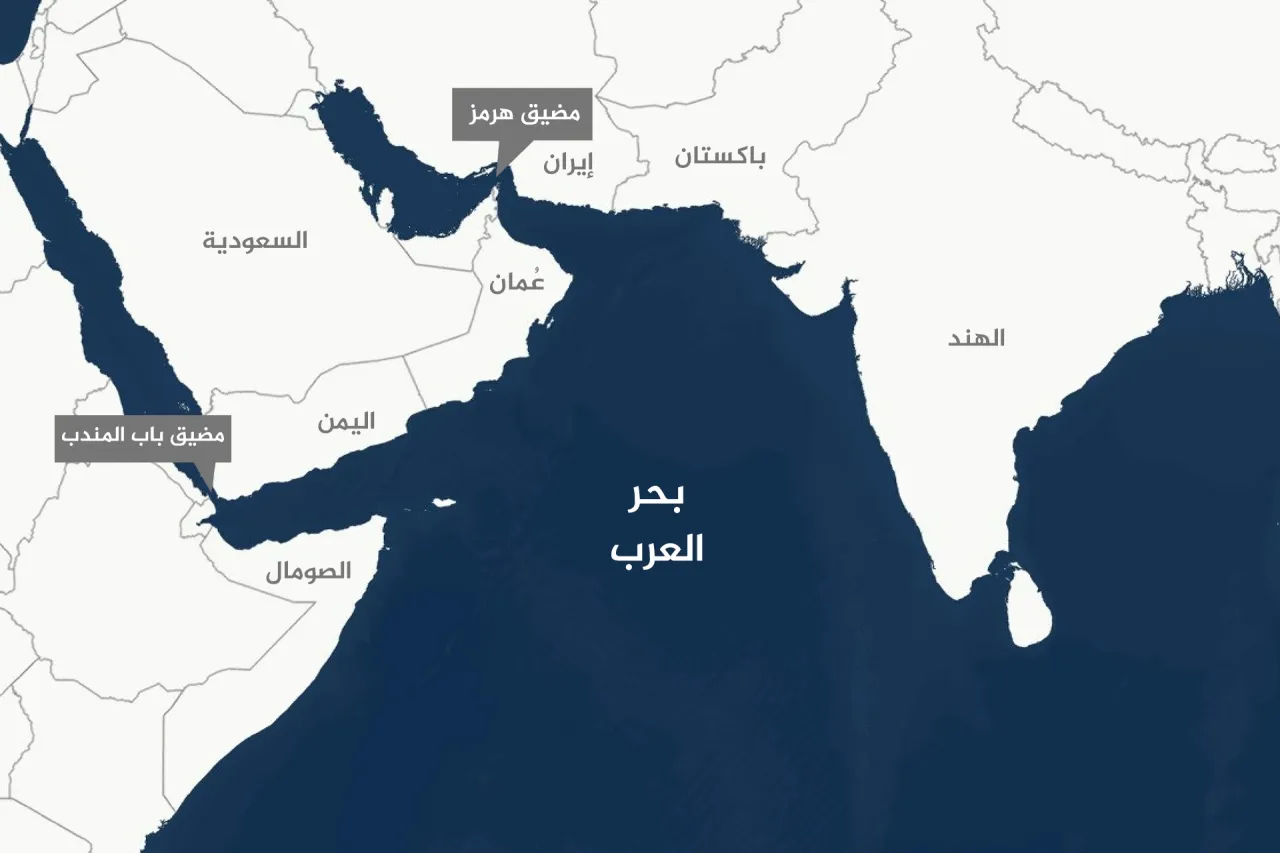
Khaberni - Concerns have escalated over the transformation of the American-Israeli-Iranian war into a new horizon focused on the Bab al-Mandab Strait, which carries about 10% of global oil trade.
In this context, Ibrahim Freihat, a professor of international conflicts at the Doha Institute for Graduate Studies, points out that merely announcing the possibility of closing the strait by the "Ansar Allah" group (Houthis) is enough to cause panic in the markets.
If that indeed occurs, oil tankers will be forced to navigate around South Africa, extending the shipping time by 10 to 15 days, increasing oil prices, and doubling the state of economic uncertainty, according to Freihat speaking to Al Jazeera.
Freihat explains that the strait is not only used for oil passage, as a significant part of the goods trade also traverses through it, making its control difficult and granting Iran horizontal influence over global trade.
The Bab al-Mandab is a waterway about 30 kilometers wide, of strategic, economic, and military importance, rendering it a battleground for regional and international conflicts.
It also represents the southern gateway to the Red Sea, connecting it with the Gulf of Aden, the Arabian Sea, and the Indian Ocean, forming a crucial link in the shorter and less expensive maritime commercial route that connects East Asia with Europe.
Freihat expressed his conviction that Iranian support for the Houthis through threatening the strait reflects a "horizontal pressure" strategy that allows Tehran to impact global energy markets without direct intervention, amplifying the economic impact of the war.
On Saturday, the Houthi military spokesman Yahya Saree announced that the group carried out attacks on targets he described as "vital" in southern Palestine using cruise missiles and drones.
Saree noted that the operation was synchronized with operations conducted by Iran and Hezbollah, asserting that the attacks "achieved their objectives successfully."
Two days prior, the Iranian Revolutionary Guard declared that the Strait of Hormuz was closed and that any attempt to cross it would be met with a stern response, adding that the passage of any ship from and to the ports of U.S. and Israeli allies is prohibited "through any corridor".
War Casualties
Meanwhile, military expert Brigadier Elias Hanna says that the American military buildup, ranging from marines and paratroopers to the aircraft carrier "George Bush," aims to broaden President Donald Trump's options on the ground, representing a "strategic flexibility" to present specific threats that could push Iran towards the negotiating table.
However, Hanna emphasizes - in his discussion with Al Jazeera - that any ground action must be limited and have a clear political impact to convince Iran to engage in negotiations, which has not yet been achieved.
From his side, Freihat explains that all parties involved have suffered significant losses so far:
• Iran lost a substantial military and security infrastructure.
• Israel has been subjected to ongoing missile attacks on its depth.
• The United States faces domestic and international political isolation, with the loss of European support and the marginalization of its traditional allies, compounded by economic crises resulting from rising oil prices and inflation.
Rates and Estimates
Regarding the possibilities of US ground intervention, the military expert estimates a 70% chance of launching a ground operation against Iran, compared to 20% for reaching a diplomatic solution and 10% for the possibility of non-intervention.
Hanna bases this on the concept of the "zone of possible agreement," where each party strives to achieve its maximum goals, but the political ground is still incomplete.
Freihat estimates the possibility of ground intervention at 40%, the diplomatic solution at 10% only, against a 50% chance of continuing without resolution while avoiding a U.S. ground operation against Iran, excluding the possibility of avoiding ground action entirely due to political complexities and the potential human cost.
The assessments concluded that any escalation or intervention would be limited in scope, with ongoing military and economic attrition of both parties, at a time when controlling oil straits and increasing the economic cost of war become crucial in creating pressure dynamics on the opponent and forcing them into negotiations.