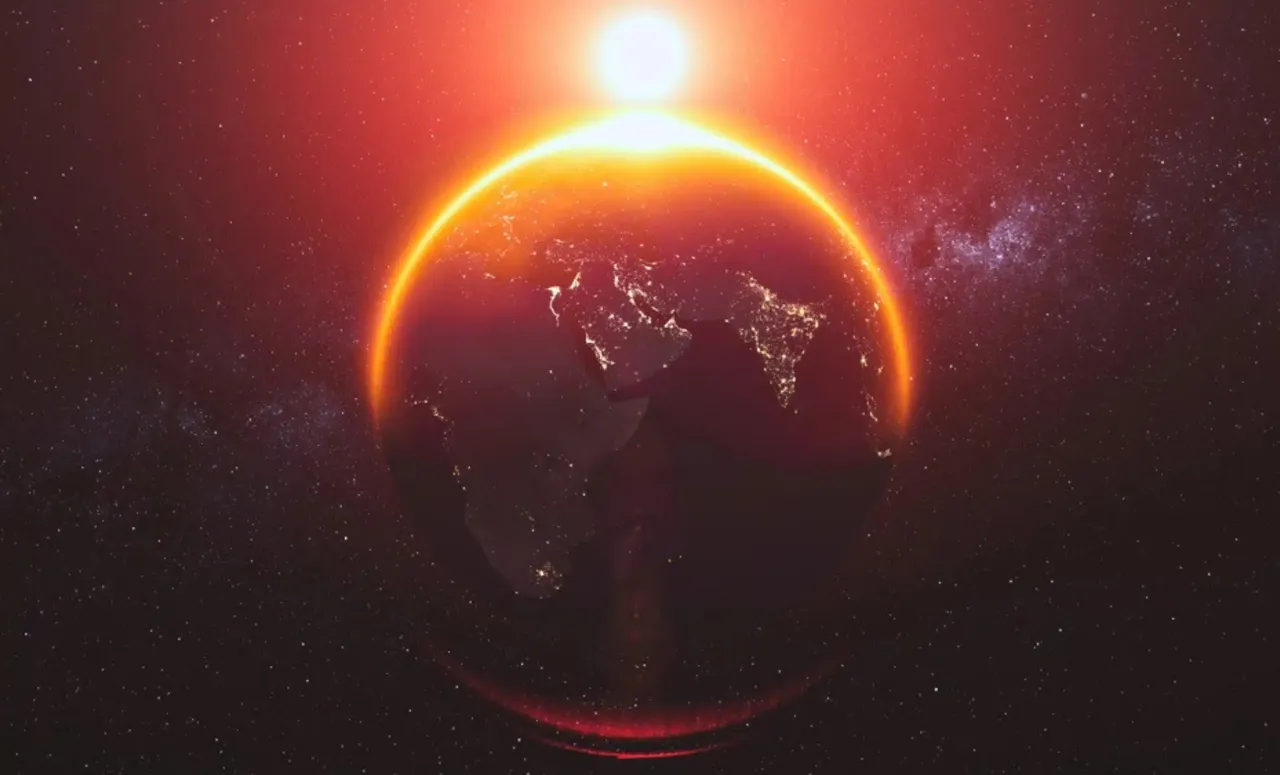
Khaberni - For the first time in modern history, scientists discover that the Earth does not rotate at a constant speed as we thought, but has begun to slow down at an unprecedented rate since 3.6 million years ago. Although this slowdown is measured in parts of a millisecond, it has real effects on our daily lives, especially in the field of global timing and modern space navigation systems.
At the International Earth Rotation and Reference Systems Service "IERS" in Paris, scientists regularly compare earth's rotation with ultra-precise atomic clocks, revealing that Earth's slowdown has unexpectedly accelerated over the past two decades, not because of the moon as was commonly thought, but due to the movement of water on Earth's surface resulting from the ice melting due to climate change.
Earth's slowdown.. from the moon to ice melting
The moon's gravity, over billions of years, has been the primary factor slowing Earth's rotation, where tidal friction between the moon and oceans transfers some of Earth’s rotational energy to the moon, thus lengthening the day by about 1.8 milliseconds per century. This process was predictable and constant, and thus scientists have been able to adjust global clocks with accuracy using what is known as "leap seconds," with 27 leap seconds added since the first insertion in 1972 until now.
However, in the last two decades, scientists observed that the rate of Earth’s slowdown was no longer regular, and a new factor appeared that had not been previously known, which is ice melting and redistributing water around the world. The water, which was trapped at the poles, started flowing towards the oceans, increasing the bulge at the equator and changing the Earth's moment of inertia (its self-rotation).
In a simplified explanation, scientists liken the Earth to an "ice skater;" when the skater extends her arms, her speed slows down. Similarly, the redistribution of water slows down the Earth's rotation.
In this regard, researcher Mustafa Kiani Shahvandi from the University of Vienna in Austria says, "Never before has the planetary skater extended her arms this quickly, as happened between 2000 and 2020, due to the rising sea levels to this extent."
The impact on modern timing and navigation systems
Although the change in the length of the day seems very small—about 1.33 milliseconds per century—these time fractions accumulate over time, affecting precise systems such as the Global Positioning System (GPS) and other satellites.
These systems rely on precise synchronization with Earth’s rotation, and even a slight discrepancy between atomic time and the actual rotation of the Earth can lead to errors in positioning, making control of space orbits more challenging.
Benedikt Soja, a geodesy and geophysics expert at the Swiss Federal Institute of Technology in Zurich, Switzerland, says that "by the end of the century, the impact of climate change on the day’s length is expected to be greater than that of the moon itself, indicating that human activity has become one of the main factors affecting Earth’s rotation."
However, these changes do not significantly affect daily life, but represent a major challenge for sciences and technologies that depend on millisecond precision, especially in space, military, and modern technological fields.
Geological evidence... what the fossils revealed
To understand whether the current slowdown is exceptional, researchers from the Swiss Federal Institute of Technology in Zurich and the University of Vienna collaborated to reconstruct the history of Earth's rotation over the past 3.6 million years. The team relied on fossils of benthic foraminifera, containing chemical traces of past sea levels.
Using this data, scientists were able to calculate how historical sea level changes affected Earth's rotation and the length of the day. Shahvandi states, "By analyzing the chemical composition of foraminifera, we can deduce the rise and fall of sea levels and then accurately calculate the length of the day for each time period."
The results, published in the Journal of Geophysical Research, show that the current increase in the length of the day is unprecedented compared to any natural glacial melting period over the past 3.6 million years, and even the largest similar periods, around two million years ago, did not reach the current slowdown rate.
ِAdditional impacts.. inclination of Earth's axis
Studies have not been limited to the day's length; scientists also observed that climate change affects the movement of the poles and the inclination of Earth's axis, known as axial precession. The distribution of the water mass between the poles and oceans leads to a slight shift in the axis of Earth’s rotation, which is directly connected to the slowdown.
It has become clear, as the team from the University of Zurich states, that climate changes now play a greater role than ever in long-term changes to Earth's rotation, including pole movement and ongoing slowdown.
How scientists analyze this complex data
Researchers relied on combining old climate data with deep learning algorithms to analyze incomplete or fluctuating records from the past. This method has enabled scientists to estimate how changes in sea levels affected Earth’s rotation speed, taking into account the large uncertainty in old records.
This model enables understanding of the physics behind sea level changes, and it remains robust and accurate despite the large complexities in old climate records. The result is a long temporal record of day length changes from the Quaternary period that clearly shows that the slowdown between 2000 and 2020 is faster than any similar natural period, directly reflecting the impact of human activity on the planet.
The first human fingerprint on Earth's rotation
Although a single millisecond might seem minuscule, the trend is clear; for the first time in millions of years, human-induced climate change has become a dominant factor in Earth's rotation, and Earth's rotation is no longer governed solely by natural forces like the moon or ice cycles, but is directly influenced by human activities that change the water distribution on the planet.
This discovery places climate change in a broader context than just rising temperatures and melting ice; it even changes the planet's rhythm itself, presenting a striking example of how significantly humans affect the natural system of Earth and reminding us of the importance of understanding these phenomena to avoid their impacts on technology and daily life.