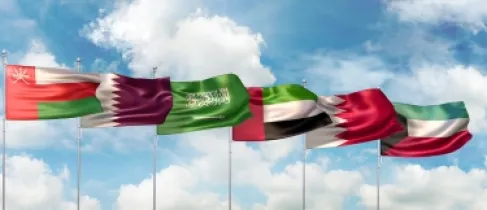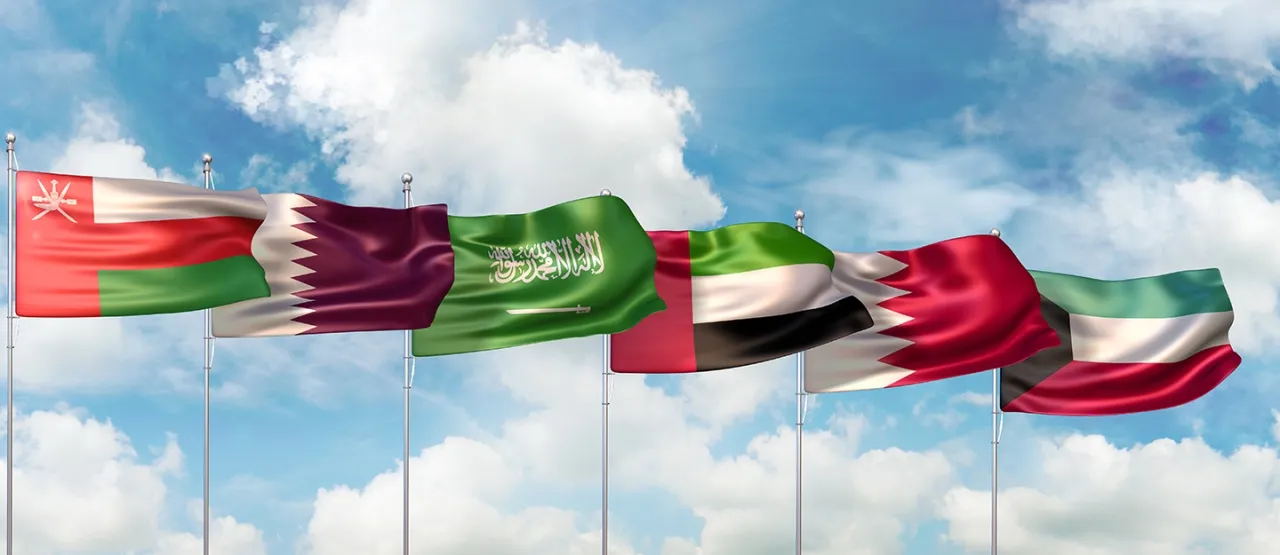
Khaberni - In the furnace of a regional war that has been blazing for a few weeks, the map of alliances in the Middle East is being redrawn to the rhythm of rockets and diplomatic statements. The confrontation began with American-Israeli strikes against Iranian targets, then spread to multiple fronts in Lebanon, Jordan, Iraq, and the sea, putting Gulf countries—facing direct threats—in front of a real test of the cohesion of the "Arab Front" long promoted.
It is not only the military escalation that worries the Gulf circles but also the stark discrepancy in political stances between the Gulf states, which bear the brunt of the cost, and some of the major Arab countries that have adopted a more cautious or balanced rhetoric, sometimes bordering on ambiguity.
This discrepancy is not just a tactical difference; it reflects—a deep sense of disappointment reverberating in Abu Dhabi, Doha, Manama, and Kuwait—a feeling that the support provided by the Gulf states in past times was not met with the same level of explicit political solidarity today.
This feeling is most vividly expressed by Dr. Anwar Gargash, adviser to the President of the UAE, in a tweet he posted on March 23, 2026, where he wrote:
"We in the Arab Gulf states have the right to ask: Where are the institutions of joint Arab and Islamic action, foremost among them the Arab League and the Organization of Islamic Cooperation, and our countries and peoples are subjected to this brutal Iranian aggression? And where are the major Arab and regional countries?"
In this absence and incapacity, it should henceforth not be permissible to speak of the decline in Arab and Islamic roles or to criticize the presence of American and Western forces.
The Arab Gulf states have been a support and partner for everyone in times of prosperity... so where are you today in times of hardship."
The question posed by Gargash is not merely an emotional expression; it is based on a clear historical memory. The UAE, for example, has not only provided financial support to a major Arab state like Egypt—surpassing tens of billions of dollars and saving the Egyptian economy from collapse several times—but also provided direct military support to Saudi Arabia in the Yemen crisis, sending its forces to the southern border to reinforce joint defense against the Houthis, with Abu Dhabi always being at the forefront, never hesitating to take risks when it comes to regional security.
Yet, it seems that this support has not been reciprocated with political stances of the same strength in the current crisis.
The Gulf people today—according to Gulf diplomatic sources—feel that Riyadh and Egypt have chosen at some critical moments a less aggressive political rhetoric, while Muscat appears closer to the mediation that grants Iran room to maneuver.
An article by the Omani Foreign Minister Badr bin Hamad Al Busaidi in "The Economist" magazine (March 2026)—describing U.S. policy as having "lost control" and considering the Iranian response a "logical choice"—was the straw that stirred the controversy and deepened the sense of discrepancy.
Sheikh Abdullah Mohammed Al Hamed, in a tweet he recently posted, deepens the diagnosis in this harsh manner:
"The problem with some countries in the region is not that they do not see the danger, but they see it then hesitate, understand it then bargain over it, know its source then choose to flee from naming it...
Over the years, the same scene has repeated... destructive projects and militias crossing states' borders, then we find those who justify them, appease them, or politically and media recycle them, as if terrorism could become a respectable partner if circumstances changed."
Dr. Yasser Al-Yafei summarized the essence of the crisis in a tweet on March 25, 2026 saying:
"The truth is that the essence of the Arab crisis lies in the lack of clarity of positions, or in the explicit contradiction between them. Some parties fight groups like the Muslim Brotherhood within their borders, then tolerate their presence in other countries. They talk at the same time about the Iranian threat and about Arab national security while practically enabling Iran's tools."
Dr. Anwar Gargash himself returns to complete the picture in a tweet: "Since the beginning of the brutal Iranian aggression, sister and friendly countries have continued their involvement, characterized by offering genuine support, which is appreciated and thanked, and those content with statements without action.
The UAE has proven its ability to confront and persevere, and it does not require equipment and numbers as much it needs clarity of positions and knowing who can be relied upon in times of hardship."
These Gulf voices—which combine firmness and regret—do not only reflect a temporary frustration, but reveal a deeper strategic shift. The Gulf states, which built their partnerships on unconditional support in times of prosperity, discover today that "Arab brotherhood" might not always be translated into mutual political action when fires ignite near their borders.
The question now arises in the corridors of Abu Dhabi, Riyadh, and Doha: Will this Gulf disappointment push towards reordering the priorities of their alliances, or will Iranian pressure be the drive that reunites the Arab community on more realistic and clear foundations? The answer will not emerge until the smoke clears, but the latest Gulf statements clearly say: In times of hardship, traditional rhetoric is no longer sufficient; what is required is action that is measured by the stance, not by words.