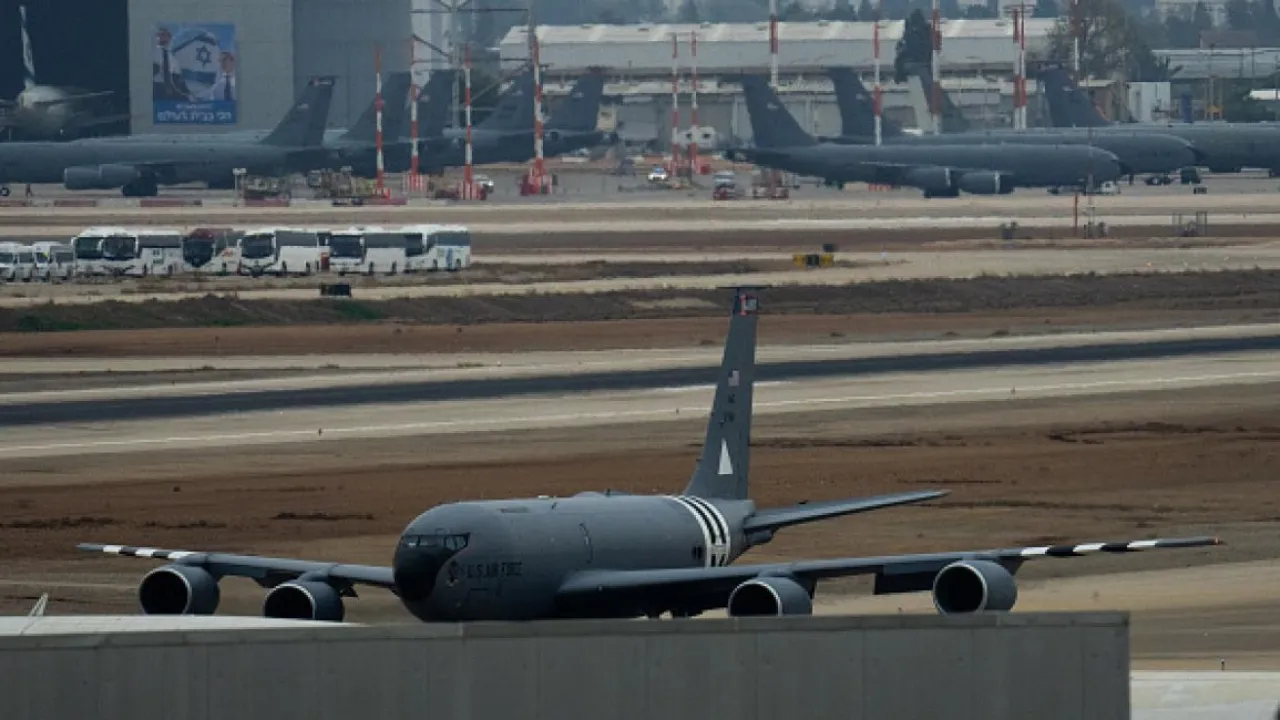
Khaberni - The Wall Street Journal reported on Friday that military equipment, radar systems, and aircraft worth billions of dollars were damaged or destroyed as a result of "Iranian attacks or accidents," in an analysis of the losses sustained by the US military since the outbreak of war on February 28th. The report indicated that the majority of the damage on the ground "resulted from ballistic missiles and Iranian drones."
According to a former Pentagon official who spoke to the newspaper, the cost of the damage and replacing equipment destroyed during the first three weeks of the war could range between 1.4 billion dollars and 2.9 billion dollars. The higher estimates also include damage to a radar that was stationed at a US base in Qatar, reflecting the magnitude of losses over a short period.
In detailing the losses, the report referred to a series of incidents and strikes that affected advanced military systems, including an incident at the beginning of March where a Kuwaiti fighter jet accidentally shot down three US F-15 aircraft, although the crew of six survived. Additionally, an American F-35 stealth aircraft made an emergency landing at a base in the region after being targeted over Iranian territory. Six crew members of a KC-135 refueling aircraft were killed in a collision with another aircraft over Iraq, in addition to damage to five other aircraft of the same model in an Iranian missile attack on a base in Saudi Arabia.
The report also pointed to the destruction of more than 12 MQ-9 Reaper drones since the outbreak of the war, including aircraft that were shot down by Iranian missiles, destroyed on the ground, or shot down accidentally, alongside additional drone damage. These aircraft are among the costliest assets, some of which have stopped production, thus increasing the cost of their replacement.
The report also mentioned a fire on board the aircraft carrier Gerald Ford in March, though it "was not subjected to a direct attack"; the fire spread to several parts of it, necessitating its transfer to a port in Greece for maintenance. Iran also targeted a TPY-2 radar in Jordan, which is part of the THAAD ballistic missile interception system, and its cost is in the hundreds of millions of dollars.
According to the American newspaper, Iran has expanded the scope of its targeting to include radar systems, communications, and air defense systems in several countries, including Qatar, the UAE, Jordan, Bahrain, Kuwait, and Saudi Arabia, including hitting a sophisticated early warning system for ballistic missiles belonging to the US Space Force estimated to cost about 1.1 billion dollars.
** 10 US soldiers injured
As for the latest US losses, according to the newspaper, they occurred yesterday, Friday, when an Iranian missile hit the Prince Sultan Air Base in Saudi Arabia, injuring 10 US service members, two of them seriously, and also damaging several US refueling aircraft, according to US and Saudi officials familiar with the attack. The officials added that the attack also included drones. This missile is at least the second to hit the base during the war against Iran, as five refueling aircraft had been damaged in a previous strike.
** US aircraft deploy mines in southern Iran
In a separate context, the American newspaper Washington Post reported that photos published last Thursday on social media show what experts described as "American mines" deployed in southern Iran, in what appears to be the first use of this type of weapon by the US military in more than 20 years. According to the report, the photos were taken near a village outside the city of Shiraz, about 5 kilometers from one of the Iranian ballistic missile sites in the area.
Four ammunition experts, who examined the documentation at the request of the Washington Post, said that the photos show anti-tank mines of the BLU-91/B model, dispersed by aircraft using the Gator mine delivery system. The report added that the US is the only known party in the ongoing war in the region to possess this system. According to the report, several sites for Iranian ballistic missiles in the mountains west of the point where the mine photos were taken have been damaged since the US and Israel began the war against Iran.
Nicole Graveski, an assistant professor at Sciences Po in Paris and an expert in studying the Iranian military, said, "The deployment of mines may complicate the movement in the surroundings of the missile facilities in the mountains." She added that mobile missile launch platforms had been operating near those sites throughout the war, indicating that the presence of mines could hinder Iranian forces from moving missiles from these sites to mobile launch platforms. The report clarified that these mines are air-dropped using the Gator system, allowing the distribution of dozens of mines at once. According to a report issued by the US Army on mine laying and removal operations, these systems often include anti-tank and anti-personnel mines, although the circulating images only show anti-tank mines.