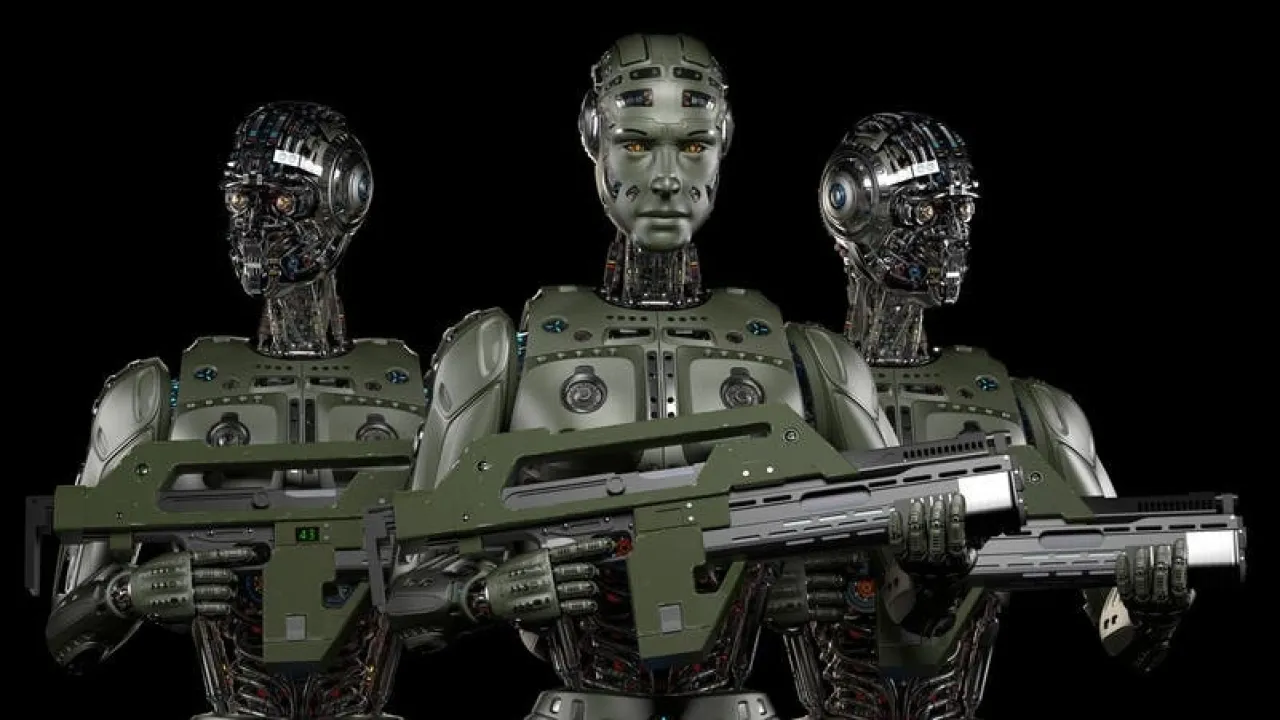
Khaberni - The use of AI-powered robots in wars is no longer just a futuristic concept, but has become a reality being tested on the ground, as armies around the world aim to reduce human risks and increase the efficiency of military operations.
Humanoid robots in the field
One of the most prominent developments is the humanoid robot Phantom MK-1, designed to mimic human movement and operate in challenging environments that traditional machines cannot handle.
The robot is about 175 cm tall and weighs approximately 80 kg, with the ability to carry a load of up to 20 kg and move at speeds of up to 6 km/h, equipped with cameras and sensors to understand the surrounding environment, according to a report published by "gizmochina" and reviewed by "Al Arabiya Business".
Despite this progress, these robots are still under testing, used to evaluate performance, movement, and the capability of AI systems to operate under pressure.
Human control and assisting artificial intelligence
Modern military systems rely on what is known as "Human-in-the-loop,” where artificial intelligence assists in data analysis, target identification, and decision-making suggestions, while the final decision remains in the hand of the human element, especially regarding the use of force.
Widespread deployment of ground robots
The developments are not limited to humanoid robots, as unmanned ground vehicles (UGVs) are increasingly used in military operations.
In January 2026 alone, more than 7,000 missions were carried out using these robots, primarily used for:
- Transporting supplies.
- Evacuating injured personnel.
- Reconnaissance and surveillance.
Reflecting their increased role in logistical tasks rather than direct combat.
A global race towards automated wars
Several countries, including the US, Israel, Russia, and China, are rapidly progressing in developing military robot technologies.
China has tested armed robotic dogs in field exercises, while the United States has used systems such as PackBot and TALON in conflict zones for years.
Technical and security challenges
Despite this progress, there are still significant obstacles, including:
- Limited battery life.
- High costs.
- Difficulty in handling complex environments.
- Risks of cyber intrusion and misuse.
The future of warfare
Experts predict that future wars will see the use of swarms of connected robots operating together across land, air, and sea.
This shift not only changes the nature of battles but also reflects the transition of artificial intelligence from merely a tool to an active partner in decision-making, opening the door to an entirely new phase in military technology development.