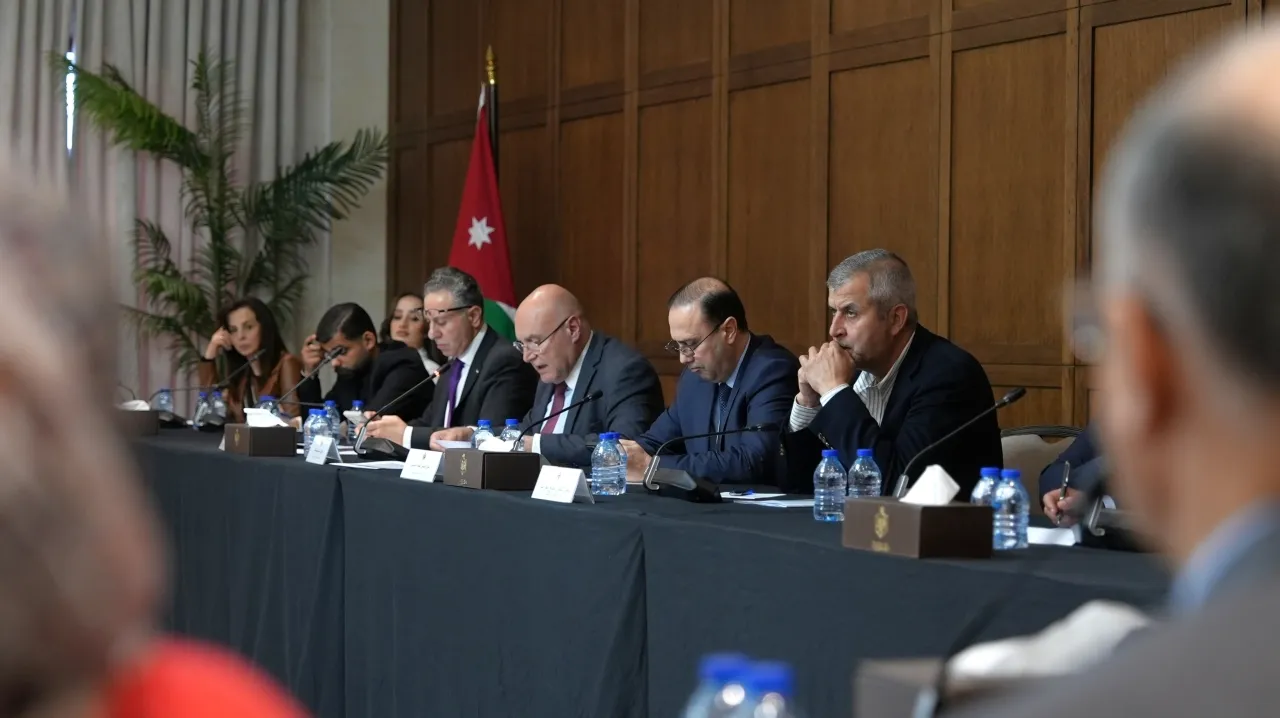
Khaberni - A meeting was held at the Prime Minister's office today, Wednesday, which included the ministers of governmental communication, energy, mineral resources, industry, trade and supply, and the state for economic affairs, along with a number of media leaders, journalists, and specialized analysts; to discuss the government's measures to deal with the repercussions of the regional situations, especially in the economic field.
The ministers presented an overview of the measures that the government has taken to enhance the strategic reserves of energy and basic goods, and to ensure price stability, alongside the outlines of the plans set to address various aspects of the regional crisis and its expected scenarios.
At the beginning of the meeting, the Minister of Governmental Communication, the official spokesperson for the government, Dr. Mohammad Al-Momani, confirmed that the government is following the regional crisis, which affects Jordan just like all other regional and global states, first and foremost on a daily basis, and has taken serious measures to deal with its repercussions and reflections on the economy and various sectors.
Al-Momani pointed out that things are proceeding at a normal pace, and that the government's message in this field is clear and reassuring, emphasizing the importance of not paying attention to rumors or misinformation, and verifying information before publishing it and sourcing it.
Al-Momani also highlighted the efforts of the armed forces – the Arab army and the security services, which deal with regional challenges with utmost professionalism and capability; in order to maintain national security and sovereignty, and guarantee the safety of citizens.
In turn, the Minister of Industry, Trade and Supply, Engineer Yarub Al-Qudah, confirmed that the industrial and commercial sectors have been operating at a normal pace since the beginning of the regional crisis, noting that the industry's contribution to the gross domestic product currently stands at about 23%, which is the highest contribution over the past ten years, and that national exports have increased by 9.9% during the year 2025, where it surged by 90% compared to 2020, reaching a value of 9.6 billion dinars compared to 5 billion five years ago.
Al-Qudah highlighted the notable aspect of the export sector, which is the diversification in the markets that Jordanian export products reach, where the percentage of exports to Arab countries increased by 10%, to non-Arab Asian countries by 15%, and to the European Union by 39%, emphasizing that this diversification serves the sustainability of national exports and reduces the impact of regional conditions on them.
He mentioned the importance of sustaining the service sector exports as Jordan is distinguished in this aspect and has a surplus in its trade balance.
Regarding the strategic stock of basic goods, Al-Qudah reaffirmed that it is safe and stable despite the regional conditions, confirming that supply chains and delivery continue at a stable pace, due to the quick and important decisions that the government took during the initial days of the war, especially the decisions allowing the movement of containers through the kingdom's land crossings for a month and cancelling the exclusivity of transporting them from Aqaba port, as well as exempting the increase in maritime freight charges from fees and taxes for six months.
He noted that local markets did not experience any rise in the prices of basic goods during the holy month of Ramadan, despite the ongoing regional crisis, mentioning direct contacts and opening channels of cooperation with a number of brotherly countries to provide alternative outlets for the passage of goods to the kingdom.
Al-Qudah also referred to Jordan’s safe stock of basic goods, which is sufficient for several months, notably wheat, which is sufficient for ten months, and similarly for barley, which is sufficient for nine months, confirming that the pace of shipping and supply from Aqaba port to other governorates is proceeding at a normal pace.
Meanwhile, the Minister of Energy and Mineral Resources, Dr. Saleh Al-Kharabsheh, stated that the energy sector, including electricity and oil derivatives, is operating regularly and very advanced despite the challenges it faced in past years when it depended on a single source, noting that reliance today is on multiple sources and different types of energy sources and developing infrastructure has increased the efficiency and sustainability of this sector.
He pointed out that the kingdom's energy stock is secure, and the supply of natural gas shipments is proceeding well and there is no problem in supply, emphasizing that the main challenge lies in the rising costs of shipping, especially if the duration of the crisis extends –God forbid– and costs continue to rise.
Regarding oil derivatives, Al-Kharabsheh confirmed that the kingdom's stock is secure and sufficient for 30 to 60 days at normal rates, and that shipments are arriving sequentially, noting that the strategic stock of derivatives has not yet been touched.
He also mentioned the continued work on major national projects in the energy field, including the Risha gas line project and its connection with the Arab gas line, scheduled to be ready by 2029, alongside other projects for investing in natural resources and maximizing the benefits from domestic resources.
Regarding the pricing of oil derivatives for the upcoming month, Al-Kharabsheh pointed out that the government is monitoring global prices that change daily and which have risen significantly in recent weeks, confirming that the government will not adjust fuel prices to the same degree as the rise in global prices in an attempt to alleviate the burdens on citizens.
In turn, the Minister of State for Economic Affairs, Mohannad Shehadeh, emphasized that in light of the sensitive regional circumstances, it is imperative to view Jordan as a model to be emulated compared to our regional surroundings, given the stability and resilience the national economy exhibits despite the many challenges that the region and the world have undergone over the past two decades which witnessed many crises that negatively affected many economies.
Shehadeh noted that the Jordanian economy has proven with every crisis that it is resilient and capable of advancement, pointing out that the credit rating by international credit institutions, and the recent confirmation of the sovereign credit rating of the kingdom with a stable future outlook by Standard and Poor's less than a month ago, reflects the ability of the Jordanian economy to deal with regional challenges and ongoing structural reforms.
During the meeting, Shehadeh presented a series of positive economic indicators that prove the resilience and capability of the national economy to withstand such as the central bank's foreign currency reserves reaching a record level of 28.5 billion dollars, an increase of 7 billion dollars over last year, alongside controlling inflation rates at 1.8%, a rise in the financial market by 3% during the regional crisis, and by 1.5% since the beginning of the year, where the daily trading value is about 9 million dinars, and a 9.9% increase in national exports, among other positive indicators.
Shehadeh noted that the government continues to build on the economic achievements made over the past year and a half, which increased confidence in the national economy, pointing out that the government has short, medium, and long-term plans to deal with the regional crisis, continue controlling prices by focusing on enhancing the stock of energy and basic goods, and continuing to monitor shipping and transportation movements, and taking necessary measures without rushing or making decisions that have a direct impact on the public treasury.
Shehadeh emphasized that the government monitors market movements and will not hesitate at all to impose the strictest penalties according to the law against those who attempt to practice monopolization.
During the meeting, an extensive dialogue took place, during which the media and economic analysts raised a series of views, questions, and proposals to deal with the regional challenges in various fields.