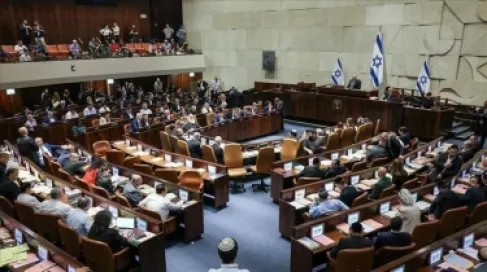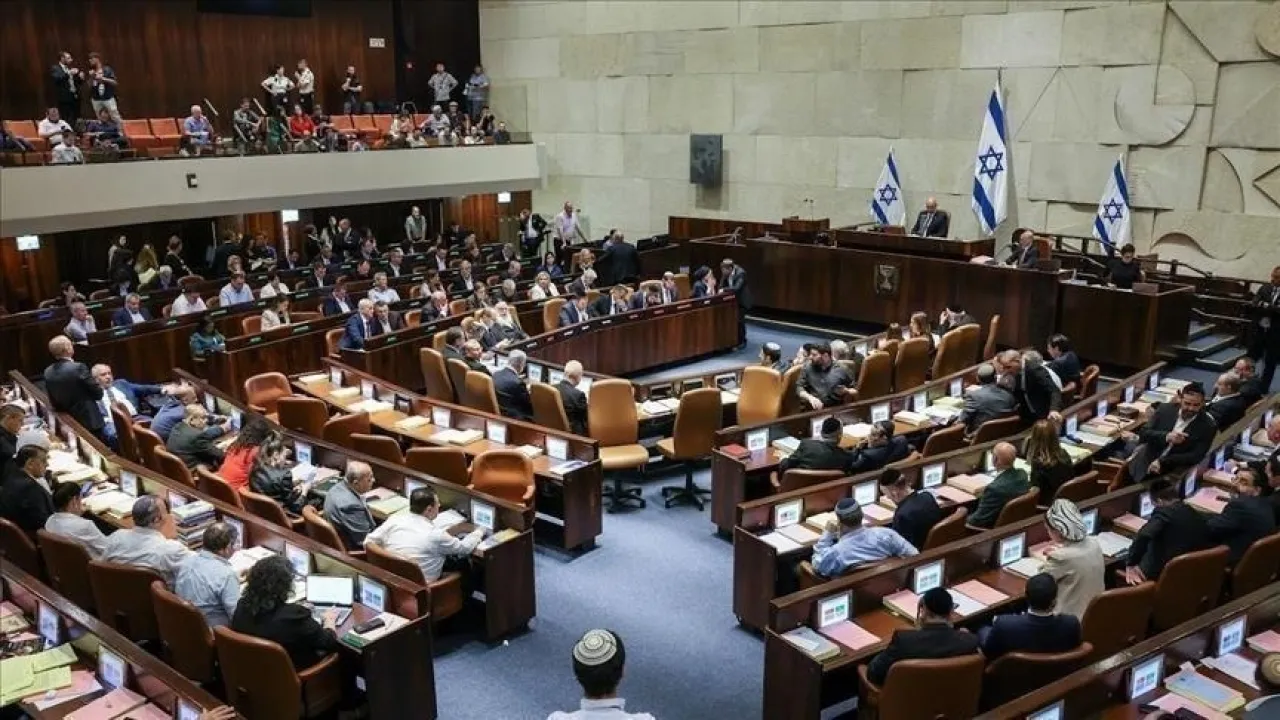
Khaberni - The law on executing prisoners has moved to the final decision-making stage in the general assembly of the Israeli Knesset, after its initiators announced they want to present it next Monday, before the Knesset breaks for the Passover holiday.
The National Security Committee in the Knesset approved the draft law on executing prisoners last Tuesday evening, paving the way for it to be voted on in the second and third readings in the general assembly. Thus, the initiative has passed a crucial parliamentary station and moved to the final decision-making stage.
The bill, as presented and promoted in the committee, is led by National Security Minister Itamar Ben-Gvir and Knesset member Limor Son Har-Melech from the "Otzma Yehudit" party, with direct support from the committee chairman Tzvika Fogel. In its recently discussed version, the law suggests two different paths: one for military courts in the West Bank, and another for civil courts inside Israel.
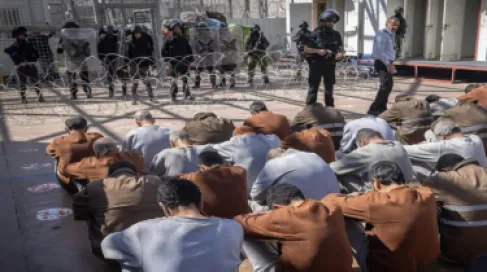
According to the current text, Palestinians convicted in military courts in the occupied territories of killing on grounds Israel defines as "terrorist" could face a mandatory death sentence, unless the court sees special circumstances that justify only life imprisonment. Meanwhile, the civilian track within Israel stipulates the death penalty or life imprisonment for murder cases attributed to the intent of "denying the existence of the state of Israel."
The bill also lowers the threshold required to issue a death sentence, so that a simple majority of judges is sufficient, and it eliminates the possibility of pardon or sentence reduction in certain cases.
Politically, Ben-Gvir leads the front of supporters, having introduced the law as one of the "most important" laws promoted by the right in recent years. During the project's discussions, he stated that he does not want a wide margin for judges' discretion because any such space, in his view, undermines the deterrent effect intended by the law.
Son Har-Melech, one of the most prominent presenters of the bill, argued that the law delivers a clear message that someone who kills Jews because they are Jews "forfeits their right to life," describing the legislation as "Jewish and ethical."
Committee chairman Tzvika Fogel also adopted the same stance, stating in the deliberations that he heard the security entities' estimates but was not convinced by them, and that the state needs "extraordinary tools" in an "extraordinary reality." These positions place the leadership of "Otzma Yehudit" at the forefront of the camp that wants to pass the law quickly and without further delay.
On the other hand, opposition is not limited to Arab or leftist parliamentary blocs. Knesset member Gilad Kariv (a religious member of the Democrats party) strongly attacked the bill, describing it as an extremist law that does not exist in any democratic country and carries significant moral and security flaws.
Kariv further criticized the law, explaining that the government and the coalition were, in his view, succumbing to a populist electoral campaign led by Ben-Gvir, and that the law could exacerbate operations of bargaining and revenge, and restrict the government's hand in any future deals for the release of detainees.
Knesset member Oded Forer from "Yisrael Beiteinu" held a more complex position. He is among the parliamentarians who have pushed for similar legislation in recent years but did not participate in the committee vote due to his objections to the current version, warning that its legal problems could render the law "dead letter" or lead the Supreme Court to overturn it. This means that the dispute is not only between supporters and opponents of the death penalty in principle but also between those who want it in any form and those who see the current text as legally untenable.
And among the notable political signals, the coalition replaced the representative of the Haredi parties in the committee with Knesset member Ofer Katz from "Likud" during the vote, to ensure approval of the law, due to the Haredim's opposition to it on principle. This procedural step was not a technical detail but reflected that the coalition was not assured of a stable majority in the committee without reorganizing the representation. It also showed that the law, despite the sharp rhetoric surrounding it, does not enjoy consensus even within the ruling camp itself.
On the legal and judicial level, the picture is more complicated. The legal advisor to the National Security Committee, attorney Ido Ben Yitzhak, warned that the death penalty is irreversible, and therefore must be approached with extreme caution. He highlighted that among the project's main issues is the absence of an option for offering a pardon, which could conflict with international obligations, in addition to the differences between the legal systems applied inside Israel and those applied in the West Bank. Concerns were also raised during deliberations, according to legal coverage and reports, by official and professional bodies from the Ministries of Justice and Foreign Affairs, and representatives from the military, because of the constitutional and legal questions and potential international consequences that the project opens. Even entities that did not adopt an overt political opposition to the law seemed concerned about the text's ability to withstand legal scrutiny and the price that Israel might pay in international forums if the project becomes enforceable law.
These institutional reservations are more clearly echoed in the positions of civil and human rights organizations within Israel. The Association for Civil Rights in Israel (ACRI) stated unequivocally that it opposes the bill "unequivocally." In a Q&A paper published in late February 2026, the association said that the law is harsh and violent, and contradicts the essential principle upon which human rights and democracy are founded, namely the sanctity of life and human dignity. It added that the death penalty is final and cannot be reversed, and that any judicial system run by humans is not immune to error, creating a real risk of executing innocent people. The association also emphasized that there is no research evidence that capital punishment achieves greater deterrence than imprisonment, and went on to warn that the law could have the opposite effect, either by creating motives for revenge or by encouraging armed groups to kidnap soldiers or civilians to prevent the execution of death sentences. Most importantly, the association stated that the version presented effectively targets only Palestinians, as only Palestinians are tried in military courts, and because the definition of the crime within civil courts is phrased in a way that effectively directs the punishment against Arabs.
The human rights opposition did not stop at ACRI. On January 16, 2026, four of the leading human rights organizations operating in Israel and the occupied Palestinian territories, namely, the Public Committee Against Torture in Israel, Adalah, HaMoked, and Physicians for Human Rights in Israel, published a joint position paper describing the bill as "a fundamental breach of international law" through the imposition of a death penalty specifically targeting Palestinians. These organizations asserted that the ongoing legislative projects in the Knesset aim to impose the death penalty "exclusively on Palestinians," threatening to establish a system of capital punishment based on racial discrimination. They added that any introduction of the death penalty against Palestinians through legal or military channels would constitute an arbitrary and illegal deprivation of life, and that the law establishes a punitive and discriminatory framework that systematically deprives Palestinians of equal protection under the law, guarantees of a fair trial, and protection against torture and inhuman treatment. These organizations also warned that applying the death penalty within the military system in the West Bank, which tries only Palestinians, makes discrimination a structural part of the law itself, not merely an incidental outcome of it.
In the same vein, the organization "Rabbis for Human Rights" said that the project is not Jewish, ethical, or necessary, and that the Jewish tradition itself has historically moved to restrict the death penalty and practically empty it of application. The organization's executive director, Avi Dabush, stated that the law is not a proven deterrent, and the real danger also lies in potentially broadening the use of this punishment against other groups. Despite the organization's Jewish religious background, its objection came at the heart of the general debate within Israel, as it responds to attempts to market the law as an expression of "Jewish values."
These positions align with broader warnings issued by UN experts and international organizations. UN experts called on Israel in February 2026 to withdraw the bill, stating that mandatory death sentences conflict with the right to life, and that removing discretionary power from judges and prosecutors prevents the court from considering individual circumstances and imposing a proportional penalty. They also warned that the different paths provided in the law would lead to discriminatory application of the death penalty, as Palestinians in the West Bank are subject to military law and military courts, while settlers are not, and because the law inside Israel and occupied East Jerusalem links the penalty to the killing of "Israeli citizens or residents." Amnesty International reached a similar conclusion, stating that Knesset members should vote against these bills because they expand the use of capital punishment in a discriminatory manner against Palestinians, and establish new channels for imposing the penalty instead of moving in the global direction towards its abolition.
From here, the confrontation around the law appears to be not just a transient partisan dispute or mere electioneering material. There is a right-wing bloc that wants to present the law as a political, deterrent, and ethical achievement. There is a parliamentary opposition that views it as an extremist law and a political and security risk. There is also wide legal, institutional, human rights, and general objection saying that the current text undermines the principle of equality, weakens guarantees of a fair trial, eliminates the possibility of pardon, and gives the law a clear discriminatory character against Palestinians, in addition to the fact that it is not based on professional evidence proving the deterrence it claims to achieve by its supporters. And if the law actually reaches the general assembly next Monday as its presenters plan, the vote on it will be a pivotal political and judicial moment, not just because it concerns the death penalty, but because it also reveals to what extent the Israeli right is prepared to turn the language of revenge into fully-fledged legislation.