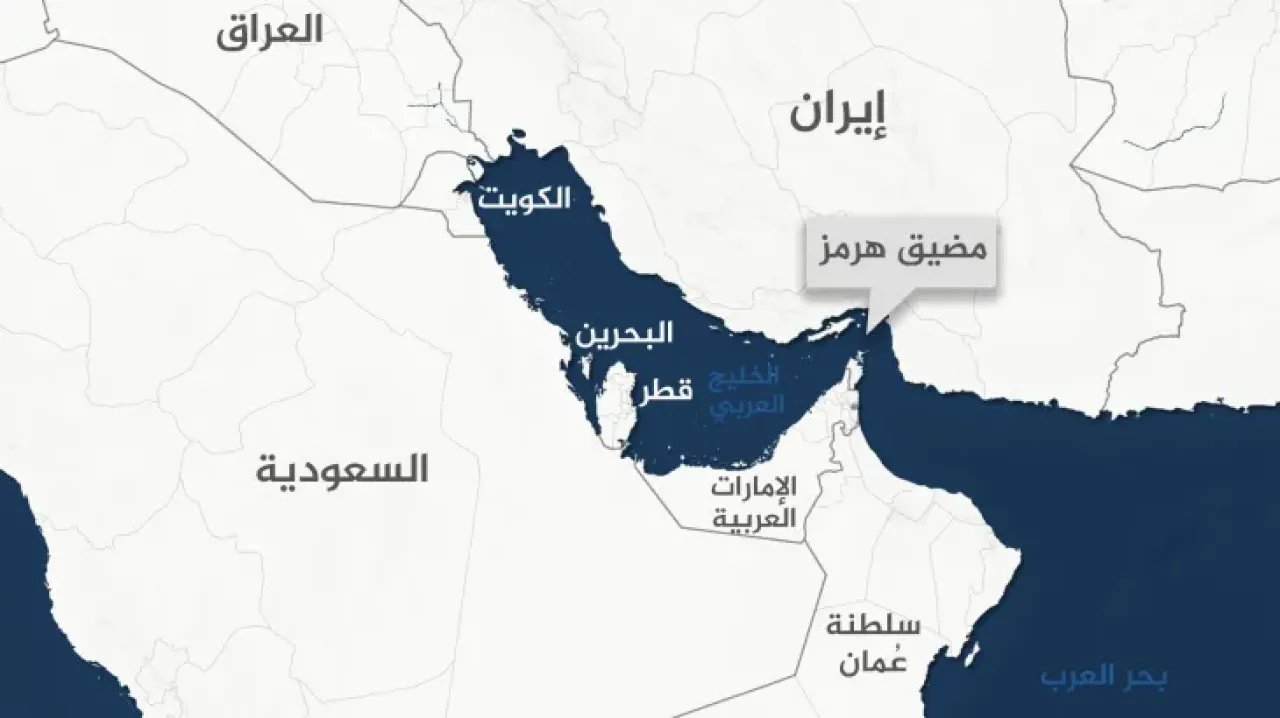
Khaberni - The Strait of Hormuz is considered one of the most important waterways in the world, but behind this name lie stories that blend myths, trade, and major wars.
Why is the Strait of Hormuz named this way?
One theory suggests that the naming of the Strait of Hormuz goes back to the name of the ancient Kingdom of Hormuz, which was established in the 10th century AD and was originally located on the Iranian coast before moving to the island of “Jarun” (the current Hormuz Island). This kingdom was known as the “Key to India” and controlled the eastern trade for centuries.
Another theory posits that the origin of the word (Ahura Mazda), as believed by historians, is derived from “Hormuz,” which is the Arabic pronunciation of the name of the deity “Ahura Mazda” (the god of goodness and wisdom in Zoroastrianism), reflecting the ancient Persian cultural influence in the region.
From a linguistic standpoint, there is an opinion that it is derived from the Persian “Khor-moz”; “Khor” meaning estuary or gulf, and “moz” possibly referring to the banana fruit or a type of palm, though this interpretation is less common among historians.
Who is “Hormuz,” the leader who confronted the Muslims?
If the strait was named after the kingdom or the ancient deity, then Islamic history has immortalized another name for “Hormuz,” that of the governor of the region of “Al-Ablaj” (current southern Iraq) under the Sassanian Empire.
Hormuz was one of the greatest Persian leaders, from the class of “Asawira” (the Persian elite), and it is said that he wore a crown worth one hundred thousand dirhams, an honor only bestowed upon major princes and leaders close to Khosrow.
He was known for his extreme arrogance and hatred towards Arabs, and he represented the first defensive line of the Sassanian Empire towards the Arabian Peninsula. However, his end came at the hands of the noble companion, Khalid ibn al-Walid, may God be pleased with him, in the Battle of Chains.
image 12
Battle of Chains: When “Hormuz,” owner of the crown, fell
The historic confrontation took place in the year 12 AH (633 AD), marking the first of Khalid ibn al-Walid's battles in Iraq, and is known as the “Battle of Kazima” (currently in Kuwait).
It was named “Battle of Chains” because Hormuz ordered his soldiers to be chained together to prevent them from fleeing the battlefield in front of the Muslims, a strategy reflecting his fear of his army's psychological collapse.
At the beginning of the battle, Hormuz requested a duel with Khalid ibn al-Walid, not just out of bravery, but also planning a premeditated betrayal. Hormuz conspired with a group of archers and cavalry to assassinate Khalid while he was distracted by the duel.
As the two commanders engaged, Hormuz’s men suddenly attacked, but Al-Qa'qa' ibn Amr al-Tamimi did not wait for orders; instead, he charged like lightning and killed the attackers, while Khalid ibn al-Walid completed his mission and struck off the head of Hormuz.
The death of Hormuz was a decisive blow to the morale of the Persians, leading to a resounding victory for the Muslims and paving the way for the fall of the Sassanian Empire.
Conclusion
There are “Hormuz” the place, and “Hormuz” the person. If the strait bears the name due to the geographical and ancient historical place linked to kingdoms and myths, while if it bears the name due to Hormuz the leader, it symbolizes the Sassanian arrogance that broke before the military genius of Khalid ibn al-Walid.