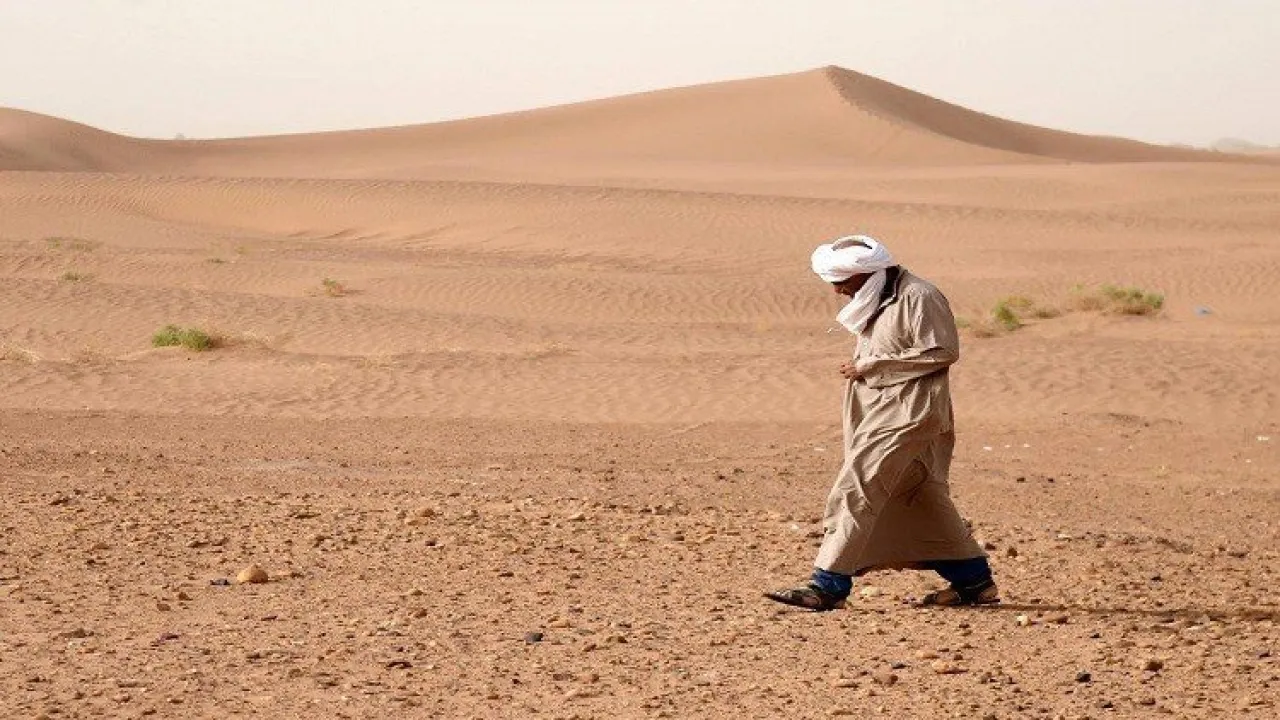
Khaberni - The Sahara Desert is considered the largest hot desert in the world, and one of the driest places on Earth. While air temperatures rise to 40 degrees Celsius, sand temperatures can exceed that by about 20 degrees Celsius.
Anyone who spends a night in this desert might be inclined to believe it has always been arid, desolate, and almost devoid of life. However, the situation appears different in a region that was once teeming with life, bustling with lakes and wildlife, to the extent that it was named "the green desert." Can those conditions return once again?
History of the Sahara Desert
In the heart of the desert, which stretches across more than 10 countries from the Atlantic Ocean to the Red Sea, and on the Ennedi Plateau located in northeastern Chad, rock art sites tell a story very different from today’s reality. Evidence of ancient human presence has been found in an area which looks nothing like it does today.
Yves Gauthier, former director of research at the French National Center for Scientific Research, says: "In the past, the Sahara was not barren like this."
He adds in his talk to Al Jazeera Net: "It is likely that it was a wide savanna landscape filled with pastures crossed by large herds of animals. Numerous lakes filled with fish existed, and semi-nomadic communities practicing pastoralism and early agriculture thrived."
Archaeological surveys document thousands of engravings and paintings on rock shelters and wadi walls in Ennedi, providing a long historical record of human settlement, laying the foundation for building a timeline of ancient human settlement in an area that is now a barren desert.
This rock art reveals a completely different image of the world's largest hot desert, when the region was rich in water and life, witnessing ancient communities that developed animal domestication and the beginnings of agriculture in that green environment.
It is noteworthy that many of the most exquisite engravings depict large animals that now live in Sub-Saharan Africa, such as antelopes, giraffes, elephants, and hippos, reflecting an environment where rivers, lakes, and meadows were widespread.
Drawings also display an extinct animal known as the "Bubalus antiquus," a type of wild cattle that disappeared about 5,000 years ago, used to date an early phase of rock art.
On a larger scale, these drawings document herds of cattle and pastoralist lifestyles in the Sahara between about 7,000 and 3,000 BC, in line with the rise of pastoralism across North Africa. Often shepherds appear with their livestock during the same period that environmental records show increasing aridity.
A long history of climate fluctuations
To understand the origin of these strange rock formations, we must go back half a billion years, when the Ennedi massif emerged from an ancient sea covered in sandstone. About 300 million years later, Africa separated from the giant continent of Gondwana and continued drifting north through millions of years until it crossed the lands that later became Chad across the equator.
Earth scientist Martin Williams, in his book "When the Desert Was Green," points to the origins of the Sahara about 7 million years ago when the recession of the ancient Tethys Sea between Africa and Eurasia disrupted regional water cycles, starting the widespread drying of North Africa.
However, this drying was not always consistent, as the German explorer Heinrich Barth in the mid-19th century—when most of the interior of Africa was still unknown to the world—revealed rock drawings showing animals that live today in Sub-Saharan Africa. Later, similar engravings were found across large areas of North Africa from the Atlas Mountains to the Nubian plains.
In the 1950s, French archaeologist Henri Lhote documented about 15,000 rock art works in the Tassili n'Ajjer area in Algeria, describing it as "the greatest prehistoric art museum in the world."
It took decades of research for scientists to conclude that the Sahara had experienced recurring wet and dry periods during the current geological era, known as the Quaternary, which began about 2.5 million years ago, in a long-term climatic cycle.
This cyclical process repeats over long geological time. As climatic conditions change, the rain belts in West Africa move north, bringing water and life to the desert in what is known as the "African humid period" or "greening of the desert."
During these periods, the monsoon winds intensified, and basins filled with lakes and wetlands, while great rivers linked the Atlantic Ocean to the Mediterranean coasts in the Maghreb, as large animals roamed vast meadows.
The rock engravings commemorate the most recent of these stages, the Holocene wet period known as "the Green Sahara" that is believed to have lasted between about 11,000 and 5,500 years ago, when Lake Chad was about 20 times larger than its current size.
Gauthier predicts that "if temperatures continue to rise as they are now, Lake Chad is very likely to completely disappear within a decade or two. And if the climate continues to change in the way it is now, it is very likely that the southern part of Chad will become completely desert."
Satellite images reveal traces of what are known as "Saharan rivers" that flowed from the ancient Mega Chad Sea towards the Mediterranean, and herbivores flourished in the riverine forests, while large predatory cats roamed vast meadows.
Yet, this flourishing declined with the end of the African humid period about 6,000 years ago, as summer rains gradually reduced, and North Africa moved towards drier conditions, accompanied by major changes in vegetation cover, water availability, and livable spaces, as confirmed by sediment records and pollen grains.
With the collapse of these ecosystems, large animals either disappeared or migrated south, while humans who carved their images moved to oases and highlands like the Tibesti Mountains in Chad or the Nile Valley.
The rock art in Ennedi reflects this transition, as Gauthier notes a decline in wild animal images in favor of pastoral scenes and cattle herds, while the appearance of horses and camels indicates communities gradually adapting to a drier environment.
Is the Sahara greening again?
Today, some scientists believe that the Sahara may witness a new greening due to climate change, thousands of years sooner than expected, with unpredictable consequences for ecosystems and human communities, yet this hypothesis remains controversial.
In an attempt to build a timeline of the Sahara's climate, geologists have expanded their research outside the desert, studying records of dust and plant debris carried by the winds from the desert and accumulating in inland lakes and ocean basins.
Over the past few decades, this evidence has shown that the last African humid periods, which ended about 5,500 years ago, were just the latest episode in a long climatic cycle.
A study analyzing more than 1,200 sediment samples taken from lakes, wetlands, and rivers across North Africa indicates that the region experienced about 230 wet periods over the past eight million years.
Scientists attribute the timing and intensity of these cycles to several factors, most notably the patterns of ocean currents and the beginnings of polar ice ages, but most researchers agree that the most significant factor is the precession of the equinoxes, a periodic change in the Earth's rotational axis that affects the distribution of solar radiation and climate.
In 2001, a part of a skull was discovered in Djurab Desert in northern Chad, belonging to Sahelanthropus tchadensis, who some scientists consider to be among the oldest hominins, raising the hypothesis that human ancestors may have lived in this region about 7 million years ago, with some researchers suggesting that the Sahara, rather than the Great East African Rift, could be the cradle of humanity.
In terms of climate, Stephan Kröpelin, a geoarchaeologist at the University of Cologne in Germany, associated for decades with attempts to decode the Sahara's climate history, believes that current warming could enhance the monsoon winds in West Africa, which could lead to increased rainfall in parts of the desert over several centuries.
Despite the difficulty of long-term predictions due to fluctuating rainfall rates in North and Central Africa, Kröpelin points to signs of life returning to areas that were recently arid, explaining that continued warming could recharge aquifers across the desert, and as plant roots reach them, greening could begin anew.
Although most of the desert's surface is rocky, beneath the eastern and western deserts in Egypt and parts of Libya, Sudan, and Chad lies the world's largest fossil water aquifer, covering an area larger than one million square kilometers, containing more than 36,000 cubic miles of water, about 30 times the volume of Lake Michigan or equivalent to the amount of water in the Nile River over 500 years.
However, Kröpelin's hypothesis about a new greening phase of the Sahara is not without controversy, as some researchers believe it is exaggerated, considering that the current effects are much less than the orbital cycles that caused the Sahara's greening in the past.
Yet, everyone agrees that much remains unknown, and that weather patterns in North Africa—as in other places—are likely to experience more fluctuations in the coming decades.
Despite the allure of a more humid, productive desert with a return of wildlife, the immediate consequences of such a transformation could be catastrophic. In December 2014, rain exceeding the amount typically received in a full year fell, but it only served to form new valleys in southern Morocco.
In Chad, a severe rainstorm caused widespread flooding that claimed the lives of more than 500 people within weeks and displaced nearly two million others, while similar floods struck areas from Morocco to Sudan.
As the rains receded, satellite images showed the green pastures creeping toward the edges of the desert, indicating the possibility of the Sahara Desert greening once again in the future, but the question remains: when?