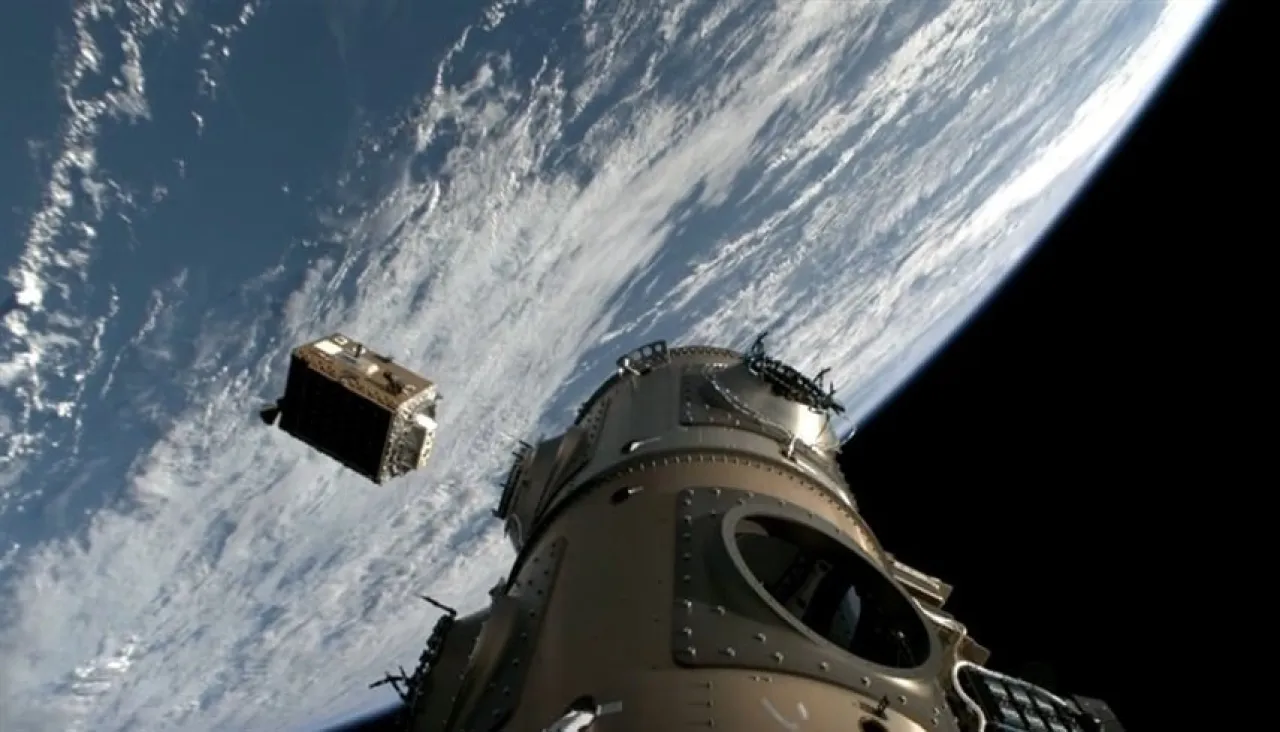
Khaberni - In a move that could redraw the global digital infrastructure map, the American company "Star Cloud" unveiled an ambitious project to move artificial intelligence data centers into space through a massive constellation consisting of 88,000 satellites orbiting in low Earth orbit.
The "Starlink" network affiliated with SpaceX currently includes about 10,000 satellites
The project, which the company submitted to the Federal Communications Commission for approval, is based on an unconventional idea of operating artificial intelligence applications from space instead of Earth; aiming to overcome the increasing obstacles faced by traditional data centers such as land shortage, high energy consumption, and cooling difficulties.
The company believes that moving computing to orbit could be the most efficient and scalable solution, given the huge growth in demand for artificial intelligence capabilities, according to the website "Interesting engineering".
Complex orbital architecture
According to the plan, the satellites will operate within orbital ranges between 600 and 850 kilometers above the Earth, in sun-synchronous orbits that allow them to benefit from nearly continuous sunlight to generate power.
This means that the orbital data centers will have a stable power source to operate processors and artificial intelligence systems without relying on limited terrestrial resources.
Competing with space giants
Despite the enormity of the project, it enters a heated race with major companies, as the "Starlink" network affiliated with SpaceX currently includes about 10,000 satellites, while other plans are being studied to deploy much larger numbers to serve the digital infrastructure in space.
Star Cloud" relies on advanced communication technologies, notably optical links between satellites, alongside integration with existing networks such as "Starlink" and the "Kuiper" project, to ensure high-efficiency data transmission.
It is noteworthy that the company has already begun practically testing its idea, as it launched its first satellite "Star Cloud-1" in November, equipped with the advanced "Nvidia H100" processor from "Nvidia", to operate artificial intelligence models in space.
And it plans to launch the next generation of satellites "Star Cloud-2" by 2027, with greater computing capabilities and more advanced energy and cooling systems.
Phase "space computing"
In the long term, the company's ambitions do not stop there, as its plans include developing giant satellites equipped with solar arrays spanning several kilometers, capable of operating data centers with a capacity of up to 5 gigawatts.
In contrast, these projects raise questions about the congestion of Earth's orbit and the risks of space debris, and the company confirms that it will adopt designs that reduce these risks, ensuring the quick return of any disabled satellites to the atmosphere, in addition to cooperating with the scientific community to minimize impacts on astronomical observation operations.
But if the project receives the necessary approvals, it could pave the way for a new phase known as "space computing," where the sky turns into a giant network for data processing.