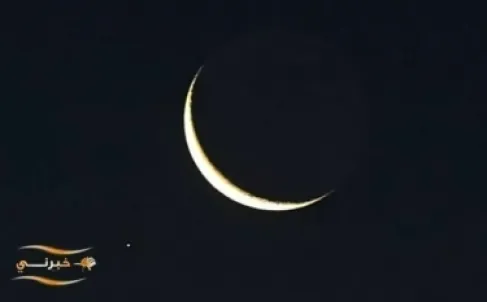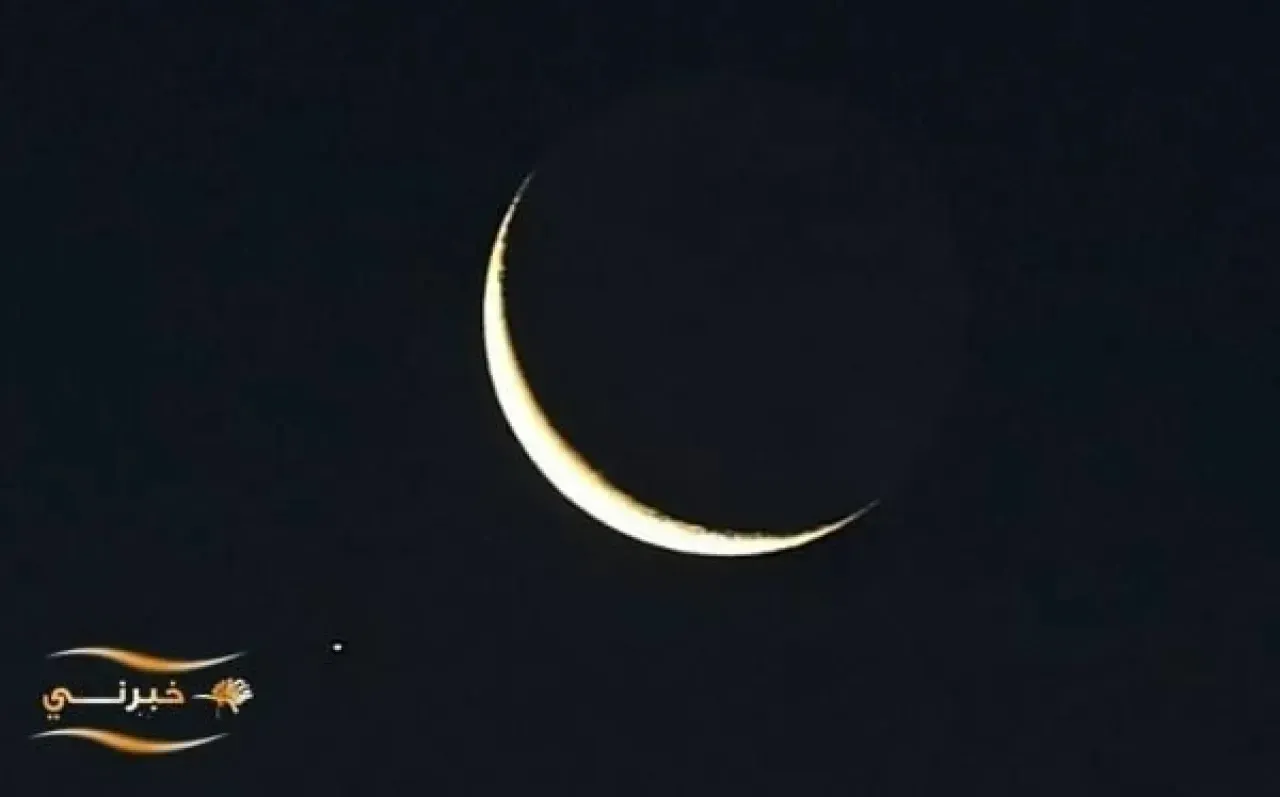
Khaberni - The president of the Jordanian Astronomical Association, Ammar Al-Sakaji, confirmed that astronomical calculations indicate that observing the crescent of Shawwal on the evening of Thursday, March 19, currently corresponding to Ramadan 29, 1447, will be "possible but with difficulty," and only by using telescopes and advanced optical devices by professional observers.
He said that the association had previously monitored crescents "more difficult than the astronomical data of the current crescent," while indicating that its visibility with the naked eye on Thursday "is practically impossible" in the Kingdom and neighboring areas.
Al-Sakaji explained that the astronomical data relied upon by the association "presents astronomers with a very thin and low crescent, just above the international Danjon limit, which makes observation require precise optical tools and high expertise."
While he confirmed that seeing the moon on the evening of Wednesday, March 18, is "completely impossible" as the moon sets before sunset, so no moon appears on the western horizon after sunset, "because it is not there at all."
The Crescent Observation Committee in the association issued a detailed astronomical report based on the "Precise Timings" program prepared by the association member Mohammad Ouda, and it is based on the Ouda standard and data from the Islamic Lunar Observation Project (ICOP).
According to the calculations, the central conjunction occurs at 4:23 AM on Thursday, while the surface conjunction occurs at 3:46 AM Jordan time, with sunset in Amman at 6:53 PM, with the crescent being about 15 hours and 7 minutes old, and it remains above the horizon after sunset for only 36 minutes, where the crescent sets at 7:28 PM.
The elongation angle of the crescent ranges from 7.2 to 7.3 degrees, with its altitude being about 5.3 degrees, and a difference in azimuth amounting to 1.3 degrees to the right of the sun, while the illumination percentage of the crescent reaches 0.4%, and its thickness reaches about 7.76 arcseconds.
Al-Sakaji told "Al-Mamlaka" that these precise values make the crescent a thin thread that is difficult to distinguish amid the light of the twilight, the glow of the sun, and pollution, according to the adopted international standards, confirming that "any successful observation will crucially depend on the clarity of the sky and the absence of clouds or dust on the western horizon."
The association formed several specialized observing committees equipped with astronomical telescopes, astronomical cameras, and binoculars, with the Crescent and Timings Committee headed by association member Mohammad Ouda, and the Weather and Astronomical Imaging Committee headed by Imam Hamdi, and the association's observing teams will spread out in comprehensive geographic coverage extending across various terrains of the kingdom and its climatic conditions.
These sites include; the Central Region in the capital Amman and Al-Salt, the Northern Region in Irbid and Ajloun Mountains, and the Southern Region in Wadi Rum and Shoubak Mountains, and observation operations may also cover some areas in the Jordanian desert, especially if the western horizon remains cloud-covered.
Al-Sakaji explained that the ability to observe the crescent is significantly affected by the prevailing weather conditions at the time of observation, as several factors play an important role in the clarity and purity of the western horizon. Clouds may completely obscure the crescent even if its astronomical conditions are suitable for visibility, while high humidity in the layers of atmosphere near the horizon reduces the transparency of the atmosphere and increases light scattering, which weakens the contrast of the faint crescent against the background of the sky.
He pointed out that suspended dust in the air also plays a significant role, especially in desert areas, as it absorbs and scatters the light of the crescent, and winds may stir up dust or move clouds, while light fog, or "haze," causes a reduction in the range of horizontal visibility and increases the difficulty of distinguishing the crescent, especially when it is low and close to the horizon after sunset, making a clear sky and stable weather conditions fundamental factors for successful observation operations.
Al-Sakaji confirmed that there had been direct and prior coordination with the Meteorological Administration to obtain immediate updates on cloud movement, the clarity of the western horizon, wind speed, humidity levels, and the percentage of dust on Thursday evening during the period the crescent stays above the horizon, aiming to select the best observation sites, away from pollutants and atmospheric obstacles, ensuring the highest possible success rate for scientific observation.
The astronomical association stressed that its role is limited to the scientific and technical aspect through providing precise calculations, conducting field observation operations, and presenting technical reports to the relevant authorities, while the official announcement of the confirmed sighting of the crescent and determining the first day of the joyous Eid al-Fitr remains under the jurisdiction of His Eminence the Grand Mufti of the Hashemite Kingdom of Jordan.
The association invited citizens interested in more information about the current Shawwal crescent conditions and various astronomical events to follow its official updates through its social media pages, affirming that weather conditions will be the decisive factor on the critical night of observation.