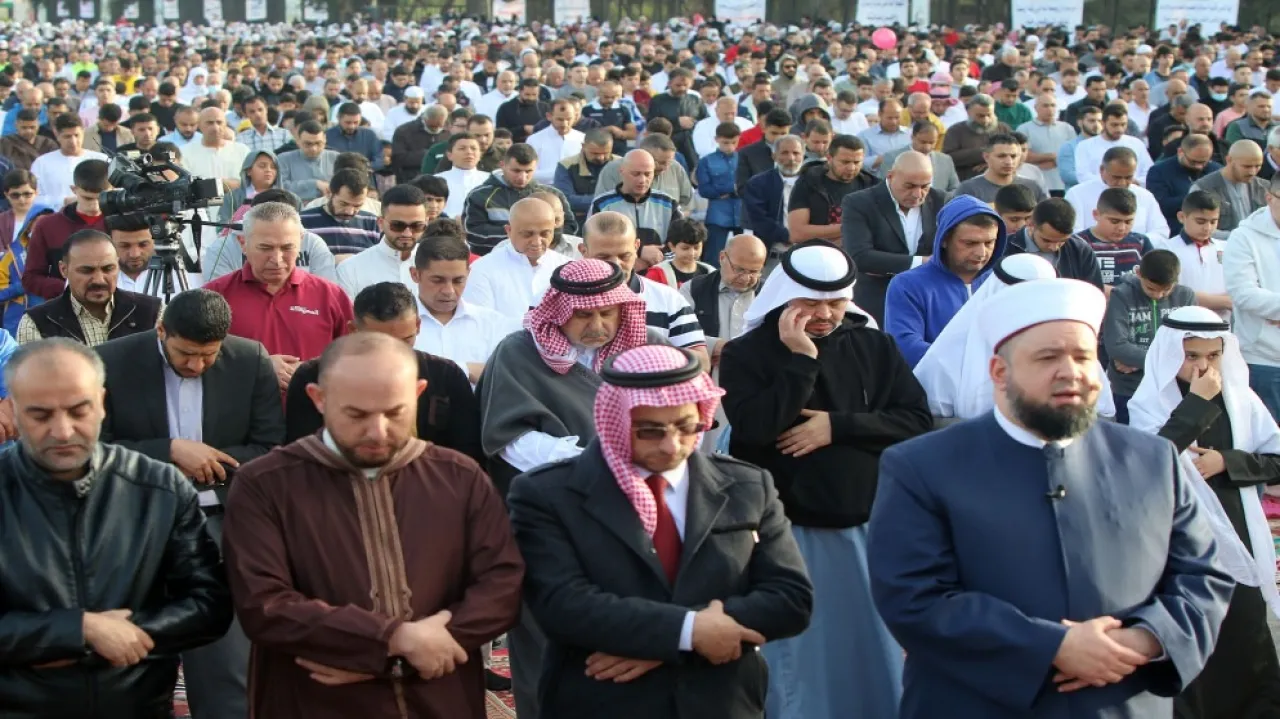
Khaberni - The General Iftaa Department confirmed that "Friday prayer is an individual obligation for every Muslim who meets the conditions of the Friday prayer obligation," stressing that "if the first day of Eid al-Fitr or Eid al-Adha coincides with Friday, Friday prayer must be held and is not omitted by the Eid prayer; because Friday prayer is an obligation, and Eid prayer is a confirmed Sunnah, and the Sunnah does not omit the obligation nor suffice for it."
The fatwa is based on the words of Allah Almighty: "{O you who believe! When the call is proclaimed for prayer on Friday, hasten earnestly to the remembrance of Allah, and leave off business}," affirming that the legal ruling is fixed and does not drop by the conjunction of Eid with Friday.
The fatwa clarified that "the Prophet's guidance, peace be upon him," when Eid and Friday coincide, "was that he prayed both prayers, and gave both sermons, and did not leave out either Friday or Eid," describing it as "a well-known matter acknowledged in the books of Sunnah and Hadith," and this is what "the majority of Muslim jurists from the Hanafis, Malikis, Shafi'is, and a narration from the Hanbalis" have gone to.
It explained that the exemption mentioned for leaving the Friday prayer "was only for the people of Awaali who lived far from the Prophet's Mosque, and it was difficult for them to travel back and forth twice for the prayers," where "they were permitted to pray Dhuhr in their neighborhoods," based on the hadith of the Prophet, peace be upon him: "Today, two Eids have gathered; so whoever wishes, it suffices him from the Friday, and we are still gathering."
It added that the majority of scholars interpreted this hadith "as applicable to those who came to the Eid prayer from outside of Medina; for whom Friday prayer is not originally obligatory," explaining that "if they waited until they could pray Friday, it would be hard on them, and likewise if they returned to their families and then came for the Friday prayer; hence, they were then given a license to leave the Friday prayer."
The fatwa cited legal texts, including what is mentioned in "Mughni al-Muhtaj": "If Eid coincides with a Friday and the villagers who can hear the call to Eid prayer attended, and if they went back to their families and missed the Friday prayer, they are then allowed to return and leave the Friday prayer on that day based on the correct opinion," and similarly mentioned in "Al-Binayah Sharh al-Hidayah": "Neither should be left... As for Friday because it is an obligation, and as for Eid because leaving it is innovation and misguidance."
It also pointed to some Hanbali scholars who went to the opinion that "those who prayed Eid are not obliged to pray Friday at all, instead, they should pray Dhuhr," although it clarified that this statement "removes the Friday in terms of attendance not obligation," and nonetheless, "it is obligatory for the Imam to hold the Friday prayer."
The General Iftaa Department emphasized that "a Muslim should be cautious and clear of liabilities in matters of worship," confirming that "it is not permissible" to claim that Dhuhr prayer is dropped for those who prayed Eid, considering that this claim "contradicts the texts that stipulate the five daily prayers, thus it is not permissible to act on it, nor to imitate it, nor to issue a fatwa based on it."
The fatwa concluded with a firm statement that "there is no room for argument and conflict that divides the ranks of Muslims, but rather it is obligatory to act by the decisive matters, leave the ambiguous ones, and submit to what the followed Muslim doctrines have settled on."