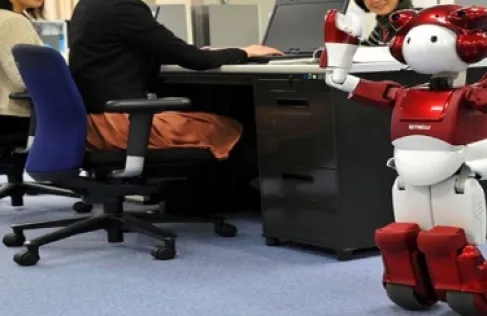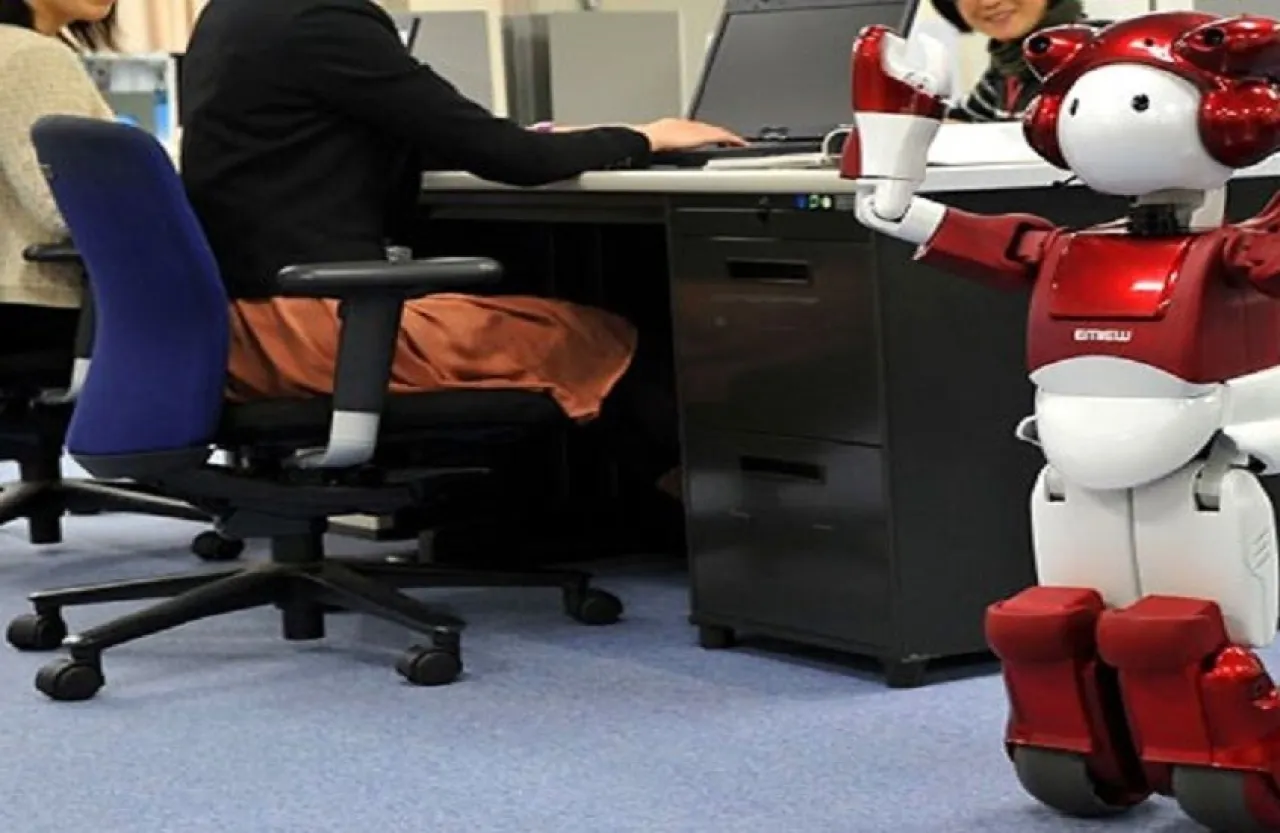
Khaberni - A robot has been developed at Munich Technical University, specifically for searching for lost items inside enclosed spaces.
This robot relies in its task performance on internet-derived knowledge, as well as an accurate spatial map of the environment it operates in.
This development, which was completed by Angela Schoellig from the Learning Systems and Robotics Lab at Munich Technical University, was published in the journal IEEE Robotics and Automation Letters. The robot appears as a mop on wheels topped with a camera.
To find something like forgotten glasses in the kitchen, the robot first needs to explore the location and build a three-dimensional map of the room. The camera captures two-dimensional images, but each pixel in these images contains depth information. From these data, an accurate spatial map of the environment is built up to the centimeter and is continuously updated. In addition, the computer embedded in the robot recognizes the objects in the image and assesses their importance to humans.
Professor Schoellig says:
"We trained the robot on how to recognize its surroundings. Our goal is to develop robots that can autonomously navigate in any conditions. This fundamental understanding is necessary for humanoid-like robots in factories, or care robots in homes, and is important for all robots operating in continuously changing spaces."
Knowledge from the Internet
In this way, the robot understands that a table or a window ledge are suitable places to put glasses, whereas a stove or sink are not.
The researcher explained that the language model comprehends the relationships between objects, and this information is translated into a language the robot can understand. On the three-dimensional map appear numbers indicating the probability of each point containing the desired object, and these probabilities are constantly updated. The experiments showed that the robot explores potential locations with 30% more efficiency compared to random searching throughout the room. Artificial intelligence is used in two ways: for image recognition and operating the language model.
The robot also has the ability to remember past images and compare them with new images of the location. If a new object suddenly appears in the kitchen, the robot captures this change with an accuracy of 95% and classifies the area as "most likely" for searching.
Next Steps
Developers plan to train the robot to search for hidden items in drawers or behind doors. This will not only require the use of internet-derived knowledge but also interaction with the surrounding environment, where robotic arms will open cabinets, determine the direction of door opening, and the method of handling the handle, enabling the robot to search even in closed locations like cabinets and drawers.