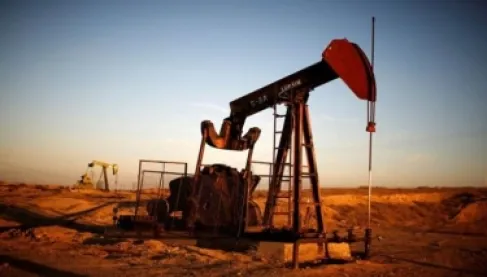
Khaberni - The attempts of the occupying government to revive the economy have not been successful under the continued bombing with Iranian and Lebanese missiles intended to protect the natural gas sector. As the war enters its third week, the Israeli gas platforms in the Mediterranean are still shut down, forcing the energy sector to revert to using more costly and polluting fuels such as coal and diesel, according to what was reported by the Israeli economic newspaper "Calcalist" today, Monday. Since the outbreak of the war in the region, the gas platforms "Karish" owned by Energean, and "Leviathan" owned by partners including Chevron, NewMed, and Ratio, have been shut down by a decision of Israeli Energy Minister Eli Cohen.
Last week, Cohen decided to extend the closure decision until March 26th, which means that the operation of the platforms will remain prohibited at least until this date unless security changes occur allowing their reoperation. The newspaper data indicates that natural gas constitutes about 70% of the fuel used for electricity production in Israel, while the remaining percentage is distributed between coal, renewable energy, and diesel. Since the platforms stopped, the Ministry of Energy and the electricity network management company "NOGA" have withheld from disclosing the types of fuel currently used in electricity production, citing information security restrictions. Moreover, the assessments that the closure decision was based on have not been disclosed, as the newspaper classifies them as "sensitive intelligence information." Both the Ministries of Energy and Defense consider that stopping the operation of the platforms contributes to enhancing security in light of the increasing threats associated with the war.
The newspaper attributes the closure to capabilities possessed by Hezbollah, which might enable it to target gas platforms, including sea-to-land missiles like the Russian "Yakhont" and the Chinese "C-802", in addition to its possession of hundreds of drones. Despite what Israel suggests about the decline of the party's arsenal after years of confrontation, the security establishment still considers those capabilities a serious threat. The newspaper explains that damaging a gas platform during operation might lead to a major disaster, as it could be completely destroyed and its workers killed instantly. However, if it were attacked while non-operational, the extent of damage and risks would be lesser, as it could be repaired and returned to service later. The cost of a single platform ranges between one billion and one and a half billion dollars, making them among the most expensive infrastructure facilities in Israel.
According to a senior official in the Ministry of Energy, damaging an operational platform could mean losing billions of shekels, while damaging it while it is non-operational could cost only tens of millions. Despite the platforms being shut down for more than two weeks, the Israeli security establishment sees the current damages to the energy sector as "relatively acceptable" compared to a scenario where the platforms are completely destroyed as a result of a missile attack, a scenario that could set the Israeli gas industry back years and make rebuilding the platforms economically unfeasible due to high costs.
Direct losses of 600 million shekels
The closure of gas platforms has resulted in direct financial losses for the energy sector. The chief economist at "BDO" company, Hin Herzog, estimated that the Israeli economy loses about 300 million shekels a week due to the shutdown of the Karish and Leviathan fields. Thus, the losses after two weeks of closure amounted to about 600 million shekels. Herzog explained that these losses result from the decline in national output and the loss of government revenue and taxes associated with the gas sector, in addition to increased electricity production costs due to greater reliance on coal and diesel.
In contrast, the Israeli Ministries of Energy and Defense announced that the decision to close the platforms came after preparing large stocks of fuel alternatives to ensure the continued production of electricity. The newspaper also mentioned that the Israeli government does not intend to compensate gas companies for their losses, as happened in previous cases when some platforms stopped during the war on Gaza or during confrontations with Iran. The Ministry of Energy sees the current losses as acceptable compared to the potential risks in case the platforms were attacked while operational. It also confirms that the gas in the reserves is not damaged due to the production stop and can be extracted later. However, the current situation has led to a state of frustration within the gas sector. A high-ranking official in the sector indicated that the agreements signed between the companies and the government did not include any clauses related to production cessation due to war. He added, "All the previous discussions about security threats were answered by the fact that there are warships providing full protection and that Israeli sovereignty in the economic waters is fully applied.
Negative impact on investment attractiveness
Just one week before the war broke out on Iran, the Israeli Ministry of Energy announced the launch of the fifth round of gas exploration tenders in the Mediterranean, which includes six sea blocks with a total area of about 8600 square kilometers believed to contain large reserves of natural gas. The government had hoped that this tender would attract global energy companies, but the war led the ministry to postpone a promotional round that was scheduled in the city of Houston, America, to introduce the tender to investors. The procedures related to the bid were also temporarily frozen. Officials in the energy sector believe that the precautionary measures taken by Israel may be excessive and harm the attractiveness of the Israeli market, as global companies may hesitate to invest in a country that experiences frequent wars and stops production operations without transparency or compensation.
Herzog stated that the world is watching the developments in the region, pointing out that one of the facilities in Qatar was directly targeted but continued to operate despite having less sophisticated defense systems than Israel. According to his assessment, the excessive Israeli caution might reduce the market's attractiveness to international investors. In contrast, an official in the Ministry of Energy said that the "Tamar" field is still supplying the local market with gas, while the surplus is exported, confirming that the electricity sector has not yet been affected by the closure of the northern platforms.
He also mentioned that electricity production companies stored large quantities of alternative fuel before the war broke out, affirming that the war's impact on gas prices in the Israeli economy is still limited. He added that the global companies considering investing in the gas sector are looking at prospects extending for 25 years, considering the current war a temporary factor. Nonetheless, the outcomes of the war with Iran and the possibility of it expanding with Hezbollah remain unclear, raising questions about whether the region is moving towards a long phase of frequent confrontations.
In response to the criticisms, the Israeli Ministry of Energy assured that the gas sector in Israel remains attractive for investment thanks to a stable regulatory environment, advanced infrastructure, and increasing regional_demand