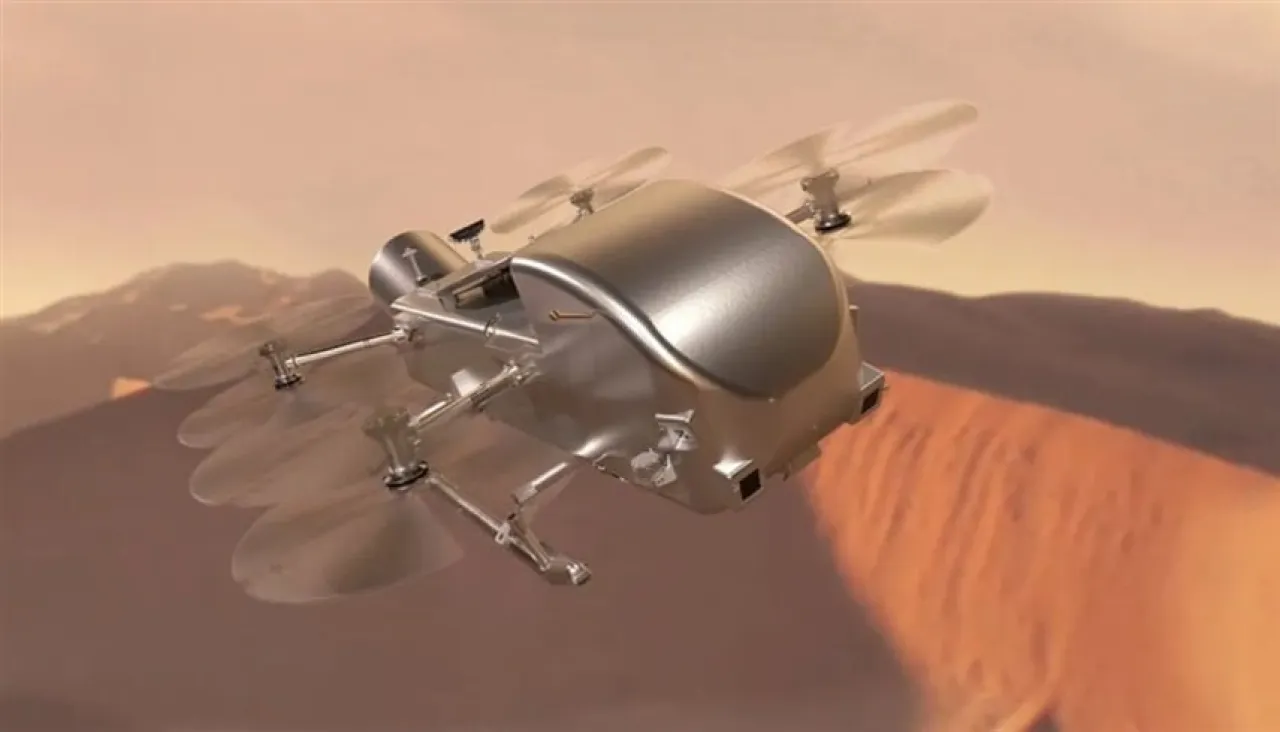
Khaberni - NASA has begun the construction and testing phase of its new aircraft "Dragonfly," in a step that brings it closer to launching an unprecedented mission in 2028 to Saturn's largest moon, "Titan".
The nuclear drone is being developed at Johns Hopkins University's Applied Physics Laboratory in Maryland, where technicians have begun assembling and testing the robotic helicopter, which is the first of its kind to be nuclear-powered and designed to fly in the atmosphere of another world, according to the website "Space".
Elizabeth Turtle, the mission's principal investigator, said that this stage represents the birth of the flight system, adding that building a unique vehicle capable of flying over an oceanic world in the solar system pushes the boundaries of what is scientifically and technically possible.
Second extraterrestrial helicopter
"Dragonfly" will become the second "drone" vehicle to fly in the atmosphere of a celestial body other than Earth, after the "Ingenuity" helicopter NASA sent to Mars in 2021. However, it differs from the former as it is the first to be powered by nuclear energy.
A significant difference, indeed; while "Ingenuity" was roughly the size of a tissue box and funded as a pilot project with a cost of $85 million, "Dragonfly" is about the size of a car and has a budget estimated at approximately $3.35 billion, as a comprehensive scientific mission.
Moreover, the new helicopter will rely on nuclear power instead of solar power, which gives it a longer operational capability in the cold, dark environment of "Titan".
Why "Titan"?
"Titan" is Saturn's largest moon and the second largest moon in the solar system after "Ganymede," belonging to Jupiter. Scientists believe it is rich in primary molecules that make up life, making it an attractive target for research into the origins of biochemical chemistry.
The moon was closely studied only once, through the European Space Agency's "Huygens" probe, which landed on its surface on January 14, 2005, and operated for a few limited hours.
After landing, "Dragonfly" aims to explore various sites to study the moon's chemistry, geology, and atmosphere, in an attempt to gain a deeper understanding of the chemical origins of life.
Construction and testing phases
Initial tests at the Applied Physics Laboratory focus on the integrated electronics module, which acts as the "brain" of the vehicle responsible for guidance, navigation, and data management, alongside power switching units.
Integration and testing operations are expected to continue until early 2027.
After that, the vehicle will be transferred to Lockheed Martin Space in Colorado for system testing, before temporarily returning to the laboratory to evaluate its performance in a space environment.
The spacecraft is scheduled to be sent to Kennedy Space Center in Florida, in preparation for its launch aboard the "Falcon Heavy" rocket owned by SpaceX, at a date no earlier than spring 2028.
Special preparations for a harsh environment
The protective shell of the vehicle undergoes aerodynamic testing in wind tunnels at the Langley Research Center in Virginia, while an insulating foam designed to protect it from freezing in the extremely cold atmosphere of Titan is evaluated, and the integration of the scientific payload and specialized communication systems for flight continues.
Although years still separate us from the launch date, entering the actual construction phase is a pivotal milestone in the mission's path, as theoretical designs transform into an integrated flight system paving the way for one of the most ambitious planetary exploration missions.