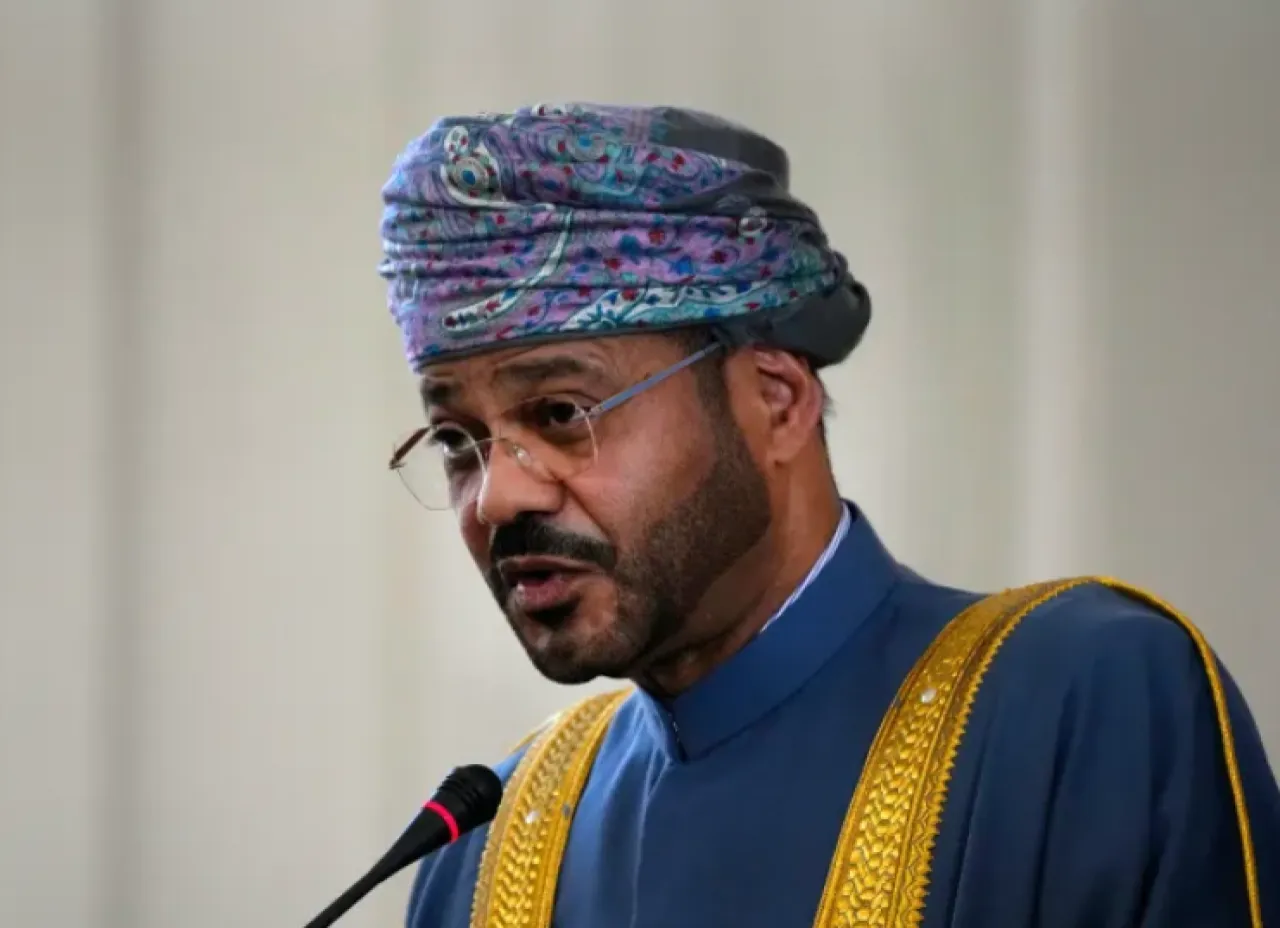
Khaberni - Oman's Foreign Minister Badr Al-Busaidi, on Wednesday, affirmed that his country will not normalize relations with Israel and will not join the "Council of Peace," emphasizing that the current war "aims to weaken Iran and reshape the region, push forward the normalization agenda, and prevent the establishment of a Palestinian state." He also predicted that the war will soon end, but emphasized "the need to prepare for the worst possibilities."
During a meeting with local newspaper editors, Al-Busaidi said, "The Sultanate of Oman will not join the Council of Peace, and will not normalize with Israel," confirming that his country's stance remains firm on regional issues, as reported by the Oman newspaper.
In his reading of the background of the American-Israeli war against Iran, Al-Busaidi believed that the real goal of the war "is not limited to the nuclear file but extends to weakening Iran, reshaping the region, promoting normalization, in addition to preventing the establishment of a Palestinian state, and weakening all those who support the project.
Targeting the region
The Omani minister indicated that "there is a broader plan targeting the region," clarifying that Iran is not the only target in it, and that "many regional parties realize this, but they are betting that aligning with the United States may lead it to adjust its decisions and directions."
Al-Busaidi believes that the United States "would not have achieved through the war concessions from Iran greater than those achieved through negotiation." He pointed out that the latest negotiations had reached advanced stages, which included "Iran's pledge not to possess nuclear material that could produce a bomb, with a commitment not to accumulate or store enriched materials, and to convert the existing stock into fuel that cannot be reverted to its original state."
The Omani minister explained that the American and Israeli attacks on Iran "threaten to damage the legal framework that has provided protection and stability to the countries of the region for decades."
He also stressed that the Sultanate of Oman "remains steadfast on the principles of its foreign policy despite the serious transformations occurring in the region," noting that Muscat "continues to work to halt the war and return to the diplomatic path."
He stated that the Sultanate of Oman "refused to provide any level of support that could contribute to this war or any other war," confirming that any facilities provided by Oman "must be for defensive reasons, and must be based on explicit international legitimacy from the Security Council."
Gulf solidarity
In the context of the Iranian war as well, Al-Busaidi reaffirmed his country's solidarity with the Gulf Cooperation Council countries, Jordan, Iraq, and Lebanon, in facing the violations of their sovereignty and attacks on their territories and infrastructures.
The Omani minister stated that the Sultanate "dealt with the violations that affected its sovereignty responsibly and in a measured manner in response, in line with our shared commitment to de-escalate, seek peaceful solutions to conflicts, and adhere to the provisions of international law."
He praised "the balance of positions of the Gulf Cooperation Council countries that have broken the cycle of escalation," confirming "their adherence to international law even as some parties abandon it."
Regarding the ramifications of the conflict, Al-Busaidi warned that the continuation of the war would lead to rising oil prices and disruptions in global supply chains, adversely affecting the international economy.
According to the newspaper, the Omani minister expected that "the war will soon stop," but emphasized the necessity of preparing for the worst scenarios, while also calling for a reassessment of "the Gulf's defensive philosophy."