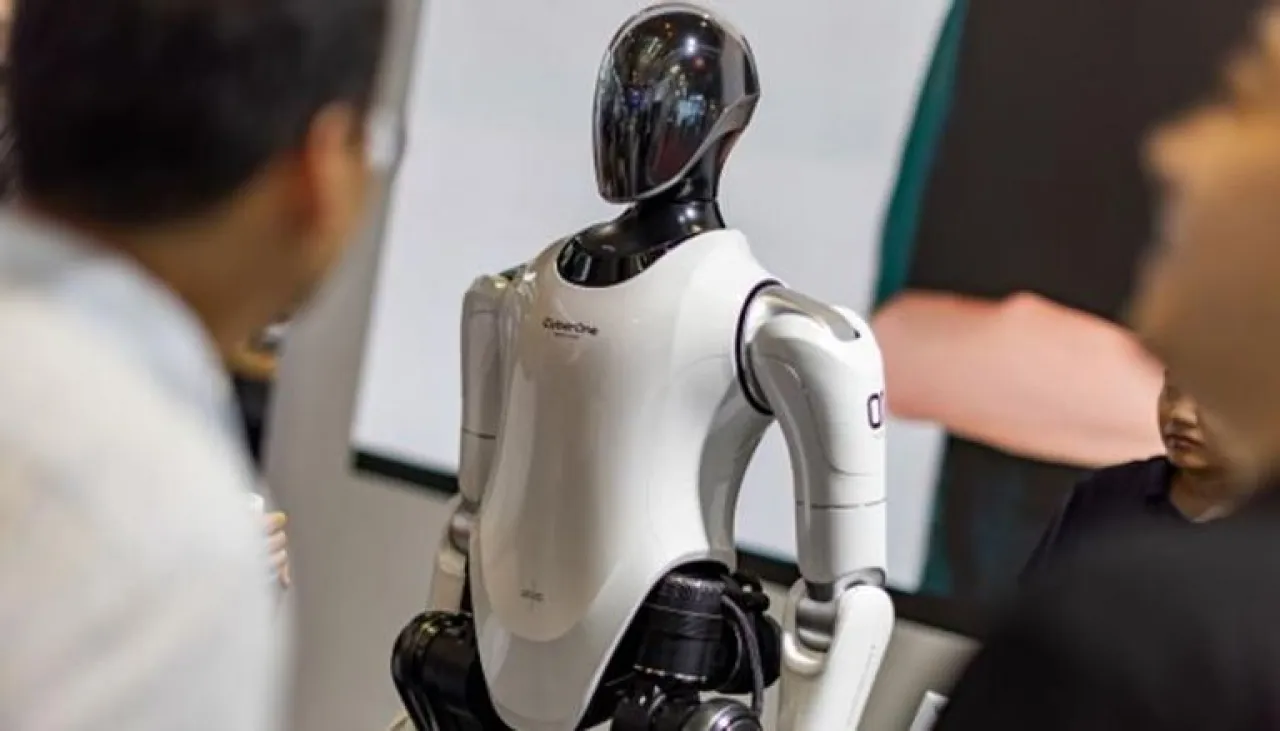
Khaberni - Xiaomi has conducted experiments with human-like robots in the production factories of its electric cars as part of the company's efforts to enhance productivity in its factories.
The company's CEO, Lei Jun, said in a statement to CNBC on the sidelines of the Mobile World Congress in Barcelona, Spain, that two human-like robots are capable of completing 90% of the work in three hours.
He added that they can perform tasks such as assembling nuts and moving materials.
Lei continued: "The biggest challenge in integrating robots into our production lines is their ability to keep up with the pace of work. In a Xiaomi car factory, a new car comes off the assembly line every 76 seconds, and the two human-like robots can keep up with this pace."
He added that in the future, these robots will be able to "replace humans in certain jobs" and "perform tasks that humans are unable to do."
Xiaomi launched its human-like robot "CyberOne" for the first time in 2022, but it is not currently selling it.
However, Lei stated that using robots in production plants is still in its early stages.
Lei told CNBC: "The robots in our production lines were not performing formal tasks, but were more like interns."
However, this experiment highlights the rapid investment of Chinese companies in robotic capabilities and their development.
There are a large number of Chinese companies, some of which have recently gone public, that are working on developing this technology.
Experts expect Chinese companies to ramp up their robot production this year, as China is one of the first countries to adopt this technology.
Analysts at RBC Capital Markets expect the total global market targeted for human-like robots to reach $9 trillion by 2050, with China accounting for more than 60% of this amount.
Xiaomi has built its business on selling a wide range of consumer electronic products, but it has recently launched an electric vehicle sector, which is growing rapidly.
While Lei expressed optimism about the future of robots, he also noted that it is "premature" to determine the market size.
Other companies in China have also expanded into the robotics field. The emerging Chinese electric car company XPeng developed a human-like robot, while the smartphone specialist company Honor unveiled its first model on Sunday.
In the United States, Elon Musk sought to establish Tesla's position as a leading company in the field of robotics and artificial intelligence.
In January, Musk announced that Tesla would stop producing the Model S and Model X and would use its Fremont, California, factory to manufacture human-like Optimus robots.
According to "Kron 4" network, Elon Musk, CEO of Tesla, announced during the financial report presentation for the last quarter of the previous month that the company will stop producing the Model X and S cars and will convert the space of its Fremont factory into a robot manufacturing plant, capable of producing a million Optimus robots annually.
The Fremont factory will continue to produce other Tesla car models, but the company plans to repurpose the space allocated for the X and S models, which will soon be discontinued, to produce the third generation of Optimus robots, which the company will reveal "in a few months,"according to Musk.
Musk added: "Optimus 3 will be a multipurpose robot, capable of learning by observing human behavior. You can show it a task, describe it verbally, or even show it a video clip, and it will be able to handle it. It will be a very high-capacity robot; I think that Optimus, in the long run, will have a significant impact on the GDP of the United States."