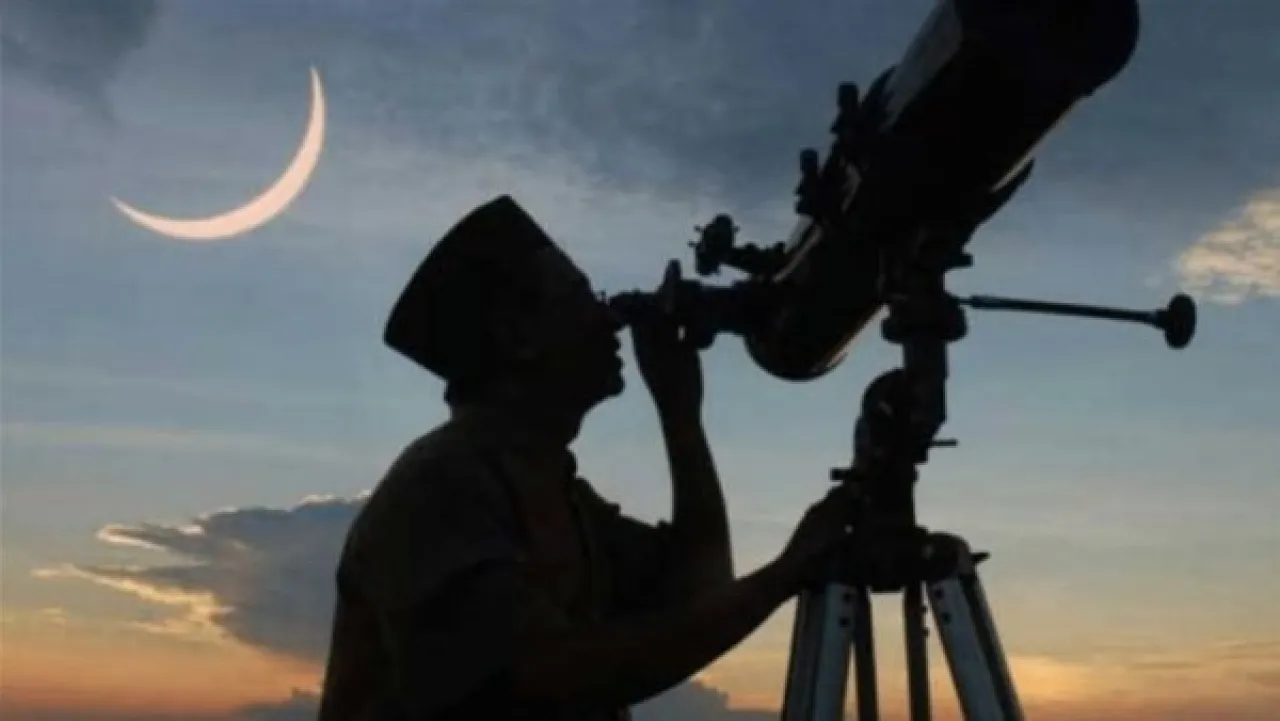
Khaberni - The International Astronomy Center has determined the date of Eid al-Fitr in Jordan, according to astronomical calculations for the possibility of seeing the crescent moon of Shawwal.
The director of the center, engineer Mohammed Shawkat Odeh, said that some countries started the month of Ramadan on Wednesday, February 18, 2026, and these countries will look for the crescent moon of the Eid on Wednesday, March 18, while other countries started the month of Ramadan on Thursday, February 19, and these countries will look for the crescent moon on Thursday, March 19, corresponding to the twenty-ninth of Ramadan in them.
As for the countries that will search for the crescent moon on Wednesday, March 18, its sighting on that day is impossible due to the moon setting before the sun and the conjunction occurring after sunset, and therefore it is supposed that these countries complete thirty days of Ramadan, making Friday, March 20, Eid al-Fitr in them.
And as for the countries that will search for the crescent moon on Thursday, March 19, including Jordan, its sighting on that day is not possible from the Eastern world, while it is difficult using a telescope from Western Asia and Central and North Africa, and it is possibly visible with the naked eye with great difficulty from Western Europe and West Africa, and the sighting of the crescent moon is relatively easy with the naked eye from most of North America.
Therefore, it is expected that most of these countries will announce that Friday, March 20, is also Eid al-Fitr in them.
Given the difficulty in sighting the crescent moon on Thursday from wide areas of the Muslim world, especially in the East and Center, it is expected that a considerable number of countries will declare that the sighting of the crescent moon is not confirmed on Thursday, making Saturday, March 21, Eid al-Fitr in them.
Regarding the situation of the crescent moon on Thursday, March 19, in some global cities, the surface calculations of the crescent moon at sunset are as follows:
- Jakarta: The moon sets 10 minutes after sunset, with an age of 11 hours and 23 minutes, and 5.2 degrees away from the sun, and the sighting is not possible even using a telescope.
- Abu Dhabi: The moon sets 29 minutes after sunset, with an age of 14 hours and 12 minutes, and 6.6 degrees away from the sun, and the sighting is possible with great difficulty using a telescope only and in case of completely clear skies.
- Riyadh: The moon sets 30 minutes after sunset, with an age of 14 hours and 38 minutes, and 6.9 degrees away from the sun, and the sighting is possible with difficulty using a telescope only and in case of completely clear skies.
- Amman and Jerusalem: The moon sets 36 minutes after sunset, with an age of 15 hours and 07 minutes, and 7.3 degrees away from the sun, and the sighting is possible using a telescope only in case of clear skies.
- Cairo: The moon sets 35 minutes after sunset, with an age of 15 hours and 19 minutes, and 8.6 degrees away from the sun, and the sighting is possible using a telescope only in case of clear skies.
- Rabat: The moon sets 44 minutes after sunset, with an age of 17 hours and 11 minutes, and 7.4 degrees away from the sun, and the sighting is possible with great difficulty with the naked eye in case of completely clear skies.
- Amsterdam: The moon sets 57 minutes after sunset, with an age of 16 hours and 23 minutes, and 8.4 degrees away from the sun, and the sighting is possible using a telescope, and may be possible with the naked eye with great difficulty in case of completely clear skies.
To understand the meanings of these numbers, it should be noted that the minimum values for which the crescent was visible with the naked eye were: the crescent stayed 29 minutes, with an age of 15 hours and 33 minutes, and 7.6 degrees angular distance from the sun. It is not enough for the stay of the crescent, or its age, or its angular distance to exceed these values for it to be visible, as the sighting of the crescent is related to interconnected factors that must be studied together, such as its angular distance from the sun and its distance from the horizon.