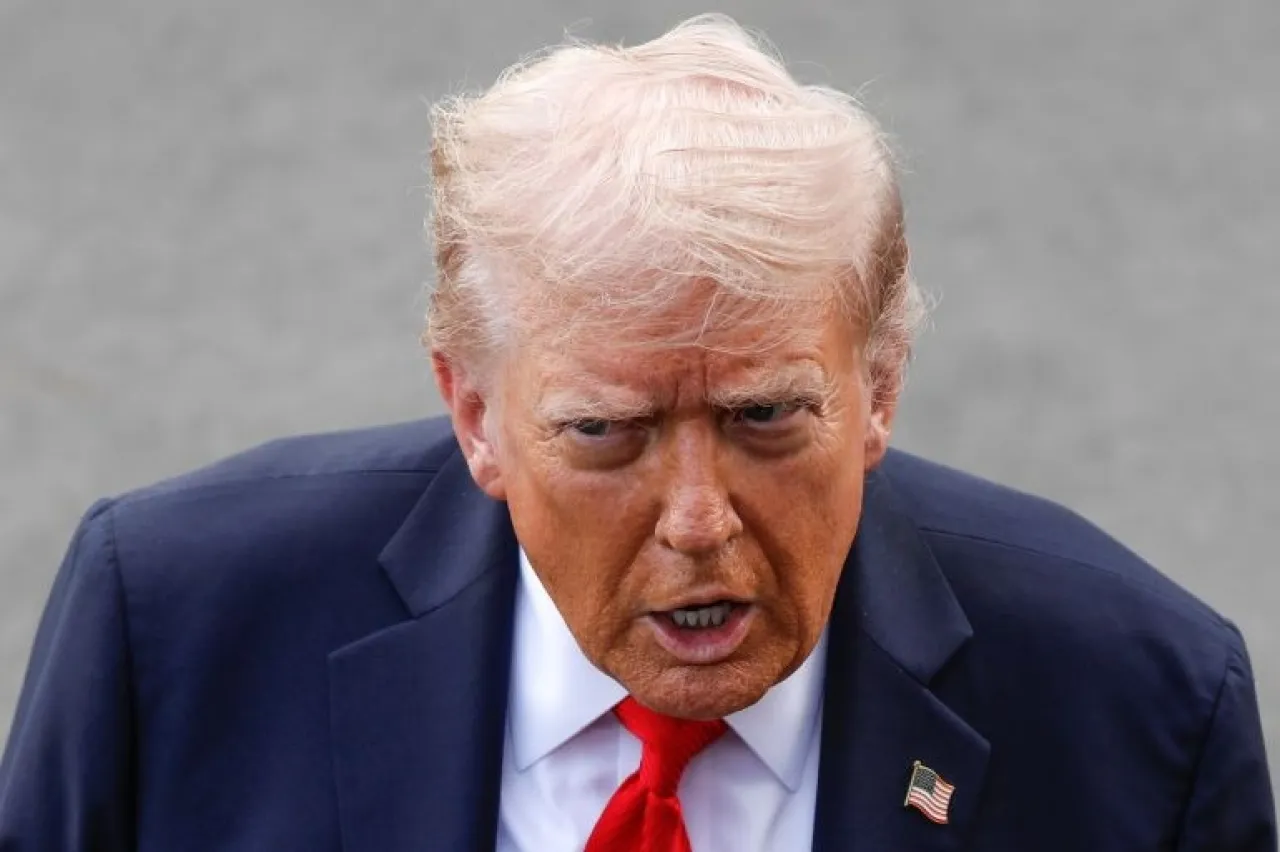
Khaberni - As US President Donald Trump raises his ambitions demanding "unconditional surrender" from Iran and promising to choose "good leaders" to manage it, other types of discussions take place in closed rooms in Washington.
A secret report from the American "National Intelligence Council" (NIC) reveals a deep gap between the White House's political desires and the complex realities on the ground, presenting policymakers with an assessment that redraws the limits of military power in the engineering of "the day after" the war.
The intelligence report, details of which were leaked to the "Washington Post", deconstructs the Iranian scene through strategic angles that put Washington and Tel Aviv in a real test.
The stumble of the "Venezuela model"
Trump's declared strategy appears closer to an attempt to replicate what could be called the "Venezuela scenario", delivering a crushing military blow to remove the top of the pyramid (as later happened with the assassination of the late leader Ali Khamenei), keeping the governmental structure intact, then appointing new leadership.
However, the National Intelligence Council's report - which represents the unified opinion of all 18 U.S. intelligence agencies - significantly reduces this perception and radically questions its feasibility.
The report conclusively finds that "even a large-scale attack by the United States is unlikely to topple the entrenched military and religious establishment in Iran".
These findings raise doubts about President Trump's declared plan to "purge" Iran's leadership structure and appoint a ruler of his choosing.
Informed individuals explained that the report reviewed the succession scenarios after Khamenei's death, and in both cases, intelligence concluded that the religious and military establishment in Iran would respond to the supreme leader's death by following protocols designed to "maintain continuity of power".
Suzanne Maloney, Vice President of the Brookings Institution, stated that the National Intelligence Council's American expectations of the resilience of Iranian institutions stem from its precise knowledge of the Islamic Republic.
The responsibility of replacing the supreme leader falls on the "Assembly of Experts", but members of the Revolutionary Guard and others within the security establishment also play a significant role. There are speculations that the council will appoint the leader’s son, Mojtaba Khamenei.
Holly Dagres, from the Washington Institute, summarizes this clash by saying, "Kneeling to Trump is contrary to everything they stand for.. The upper ranks of the religious establishment are ideological, and their way of working is to resist American imperialism".
This idea was sharply responded to by Iranian Parliament Speaker Mohammad Bagher Ghalibaf, who asserted that the fate of Iran will be determined by the Iranians "and not by Jeffrey Epstein's gang".
The trap of "the day after" and the void
The second angle in the intelligence assessment relates to the alternative: the United States, by striking the current leadership, could face the trap of a "deadly void." Describing the possibility of the scattered Iranian opposition taking control of the country as "unlikely".
U.S. officials see few signs of a massive popular uprising leading to a new regime, while Trump's instructions to the Iranian people were merely to "take shelter" until the bombing campaign is over.
This assessment rings an alarm bell in models of "the day after", as the absence of a ready political alternative does not mean an organized division of the country. In this context, Western analyses (including an assessment published by "National Interest" magazine) support the intelligence view, ruling out the scenario of "Balkanization of Iran" (its breakdown into ethnic states like the Balkan countries) due to the strength of social overlap and Persian nationalism.
However, the real danger lies in the "security vacuum"; as the central authority erodes due to bombing, minorities prepare to fill the void, with 5 Kurdish factions forming an armed coalition in the west, concurrent with movements by Baluchi organizations in the southeast.
Despite reports of contacts made by the Trump administration to support these groups as a "land-based alternative" compensating for the air force's inability to topple the regime, experts confirm the lack of these militias' unified vision or capability to govern.
This poses a forward-looking scenario warned by observers, instead of transitioning to a "pro-Western democracy", arming these minorities could turn Iran into a "civil war" hotspot necessitating counter-regional interventions (like Turkey wary of Kurdish expansion, and Pakistan concerned about Baluchi insurgency), potentially transforming the Revolutionary Guard into a decentralized network managing guerrilla warfare from within and controlling the chaos.
The gap between American assessments and Israeli objectives
The secret document highlights an inherent discrepancy between the ambitions of the allies, as Israel, particularly in the speech and assessments of Prime Minister Benjamin Netanyahu, views this war as a historic opportunity to weaken or overthrow the Iranian model. Meanwhile, American intelligence, according to the report, recognizes the impossibility of completely eradicating this regime.
The Office of the Director of National Intelligence has refused to comment on the report. The White House did not clarify whether the president had been briefed on this assessment before approving the military operation.
This intelligence acknowledgment of the limits of military power in shaping Iran’s domestic politics sets a ceiling for the viability of military action, which may align with statements by White House spokeswoman Anna Kelly who limited the goals to military frameworks such as "destroying Iran's ballistic missiles and its production capacity, demolishing their navy, ending their ability to arm proxies, and preventing them from acquiring a nuclear weapon".
This American focus on curbing capabilities may prompt Washington to seek a later negotiation exit, while Israel continues to pursue a goal that U.S. intelligence considers "unlikely", hinting at a looming clash over determining the acceptable end moment for the war.