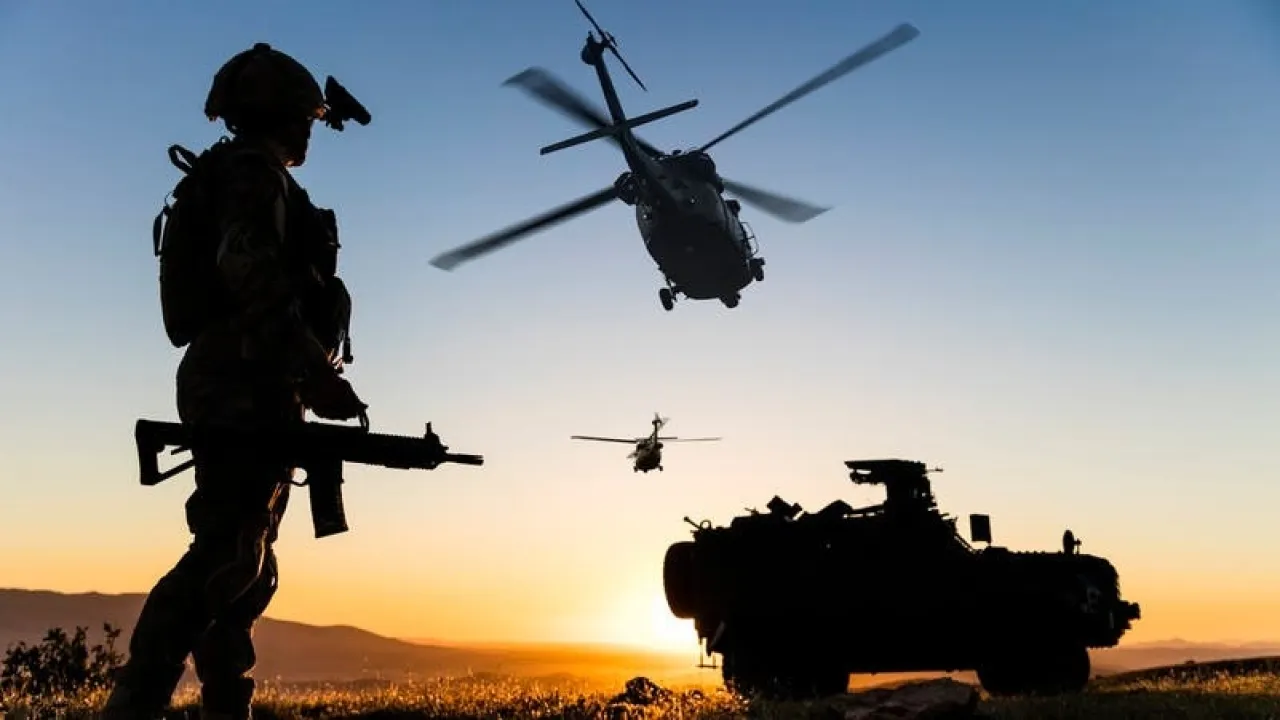
Khaberni - The U.S. military has suddenly canceled a major military training in recent days that was scheduled for the leadership of an elite paratrooper unit, a move that has triggered speculation within the U.S. Department of Defense about the possibility of sending ground troops to the Middle East amid escalating confrontations with Iran.
Officials said that the 82nd Airborne Division, stationed at Fort Bragg in North Carolina, includes a brigade-sized combat team consisting of between four to five thousand soldiers, who are among the most ready formations in the U.S. Army. They can be deployed within 18 hours to perform various tasks, such as controlling airports and critical infrastructure, enhancing the protection of U.S. embassies, and conducting emergency evacuation operations, according to the Washington Post.
The unit's headquarters oversees the coordination of planning and execution for these operations. Nevertheless, officials confirmed that as of Friday no formal orders have been issued to deploy the forces, pointing out that the army plans to soon announce a previously scheduled deployment of a helicopter unit from the same division in the Middle East, but this will not occur until later in the spring.
While other soldiers from the division continued their training in Louisiana in recent days, the sudden change in the training plans for the command crew, where they were asked to remain in North Carolina instead of heading to Fort Polk in Louisiana, has reinforced expectations of the possibility of calling up the division's rapid response force.
One of the officials informed about the matter said, "We all are preparing for something, in anticipation of any possibility."
The army referred questions to the U.S. Department of Defense (Pentagon), which issued a brief statement refusing to provide details, saying that operational security considerations prevent discussing future or hypothetical troop movements. The U.S. Central Command, responsible for operations in the Middle East, also declined to comment on the matter.
Over the past few years, the division's rapid response force has been summoned on several occasions, including enhancing the security of the U.S. Embassy in Baghdad prior to the killing of Iranian Quds Force commander Qasem Soleimani in 2020, as well as during the evacuation operation of troops and civilians from Afghanistan in 2021, and also in showcasing American power in Eastern Europe as the Russian operation in Ukraine approached in 2022.
Since the outbreak of fighting about a week ago, the U.S. military command has mainly relied on airstrikes and naval strikes to target Iranian military sites and Tehran's arsenal of missiles, drones, and warships. As Iranian defense capabilities have diminished, American planes have increasingly flown over Iranian territory to carry out direct strikes using fighters, bombers, and other aircraft.
White House spokeswoman Caroline Levitt said sending ground forces to Iran "is not part of the current plan," yet at the same time she confirmed that the administration does not want to rule out any option that the president might decide.
During a press conference at the Pentagon, Chairman of the Joint Chiefs of Staff General Dan Kin refused to comment on the possibility of deploying ground troops, considering it "a matter for policymakers," adding, "I do not make policies, but execute them."
Earlier, Kin had warned the White House that a shortage of certain munitions and the lack of extensive military support from allies could increase the risks associated with any military operation inside Iran, which the Trump administration tried to downplay.
In turn, the commander of U.S. Central Command Admiral Charles Cooper said that the American combat force in the region is still being enhanced, while Iran's capabilities are gradually declining, noting the decreased number of missiles and drones launched by Tehran in recent days.
Cooper explained that American aircraft flying over Iran allows for directly targeting Iran’s military center of gravity with significant force, including the use of B-2 stealth bombers to drop two thousand pound bombs on underground ballistic missile launch pads.
Among the main concerns voiced by some officials is the limited stock of certain essential weapons, as the Pentagon quickly consumes its inventory of precision munitions and air defense missiles. However, senior defense officials denied there is a crisis, pointing out that the decline in Iranian defenses allows for greater reliance on airstrikes using abundantly available munitions.
If Washington decides to send ground troops to Iran, some analysts see Kharg Island in the Arabian Gulf, about 15 miles off the Iranian coast with major oil facilities through which around 90% of Iranian oil exports flow, as a potential target.
Some experts believe that controlling the island could provide the United States significant leverage over the Iranian economy, but it could also make American forces vulnerable to direct attacks.
Nonetheless, any decision to send ground troops could carry significant political risks for the American president, who faces increasing opposition to the war from Democrats as well as from a faction within the Republican Party.
A poll published by CNN showed that only 12% of Americans support sending ground troops to Iran, compared to 60% who oppose it, while 28% said they were unsure of their stance.