Khaberni - Just three months before the blast of the starting whistle for the largest sporting event in history, troubling questions loom about the fate of the 2026 World Cup scheduled in the United States, Canada, and Mexico. Amid escalating geopolitical conflicts, the hardest question emerges: Can the International Federation of Football Associations (FIFA) postpone the tournament? And what is the real cost of such a decision?
When Does Postponing the World Cup Become "Unavoidable"?
We answer these questions through two experts, the first being international expert Simon Chadwick, who previously served as the director of research for the organizers of the 2022 World Cup, who stated in comments reported by (SPORTbible), that the continuation of the war in the Middle East alone may not be a sufficient reason to postpone the World Cup from a logistical perspective, but the situation would radically change and become "unavoidable postponement" in two cases:
- The spread of attacks: The spark of conflict reaching American or European territories.
- Supply paralysis: Disruptions in global aviation or a major crisis in oil supplies affecting the movement of teams and fans.
"Emergency Postponement" Scenarios of the World Cup
The second expert is Tarek El Diab, a consultant on sports governance and former head of the information sector at the African Football Confederation (CAF) who provided an exclusive reading of the perplexing scene to "Al Jazeera Net,” summarized in the following points:
First. The Regulatory Cover and Historical Precedents: "Force Majeure"
Legally, the FIFA Council has absolute authority to postpone or move the tournament based on the "Force Majeure" clause. Historically, it has previously canceled the 1942 and 1946 editions due to World War II, and moved the 2003 Women's World Cup from China to America due to the "SARS" epidemic, in addition to postponing recent youth tournaments due to coronavirus. FIFA places the safety of teams and its commercial obligations above all else, but activating this clause today requires a justification as significant as closing international airspace or a direct threat to the national security of the host countries.
Second. If the Decision to Postpone is Made as an "Emergency Plan," FIFA Will Face Severe Financial Consequences as Follows:
- Insurance: Despite having huge insurance policies against cancellation, the geopolitical crises collide with the "Act of War" exclusion clause, which means that insurance companies might shirk payments, leaving FIFA to bear the loss.
- Sponsors: Who paid millions for the 2026 World Cup campaigns will demand immediate compensation, while America, Canada, and Mexico will require strict guarantees to retain the rights to host at the new date in order to protect their billion-dollar infrastructure investments.
Third. European Clubs and Player Contracts
Tarek El Diab emphasizes that changing the tournament's date will create repercussions that affect the core of club football. Postponing the tournament to winter will halt major leagues for several weeks reaching up to two months, while postponing it to the summer of 2027 will conflict with the new edition of the Club World Cup.
There is also a legal point related to contracts, as the vast majority of player contracts conclude by this date. Postponement will create a legal crisis for players who may find themselves without contracts, potentially leading the International Federation of Professional Footballers (FIFPRO) to intervene and possibly resort to sports arbitration.
Clubs will also demand to double the money of the "Club Protection Program" (which compensates the club for each day its player spends with the national team) as a condition for agreeing to the amendments.
El Diab notes that all this is without delving into the dilemma of broadcasting rights, as broadcast rights constitute more than 50% of FIFA's revenues. Global networks contracted with FIFA to sell advertising spaces during the summer timing, and the adjustment could lead to a collapse in viewership and advertising returns.
Finally, El Diab believes that postponing the World Cup would be "the last option" for FIFA, which will fight fiercely to keep the tournament on schedule, and will not succumb to postponement or relocation unless international decisions are issued or international travel becomes impossible, as solving contract complications, the sports calendar, and broadcasting rights would require legal and financial settlements that FIFA's treasury may not be able to bear.
Is the 2026 World Cup in Danger?
Experts believe that rescheduling an event of this magnitude just 90 days before its launch is considered "economic suicide." Practically, the tournament is linked to billion-dollar broadcast contracts, hotel bookings for millions of fans, and complex security preparations, making the idea of postponing the World Cup to 2027 an unlikely option except in cases of ultimate force majeure.
The Trump Administration's Position on the World Cup
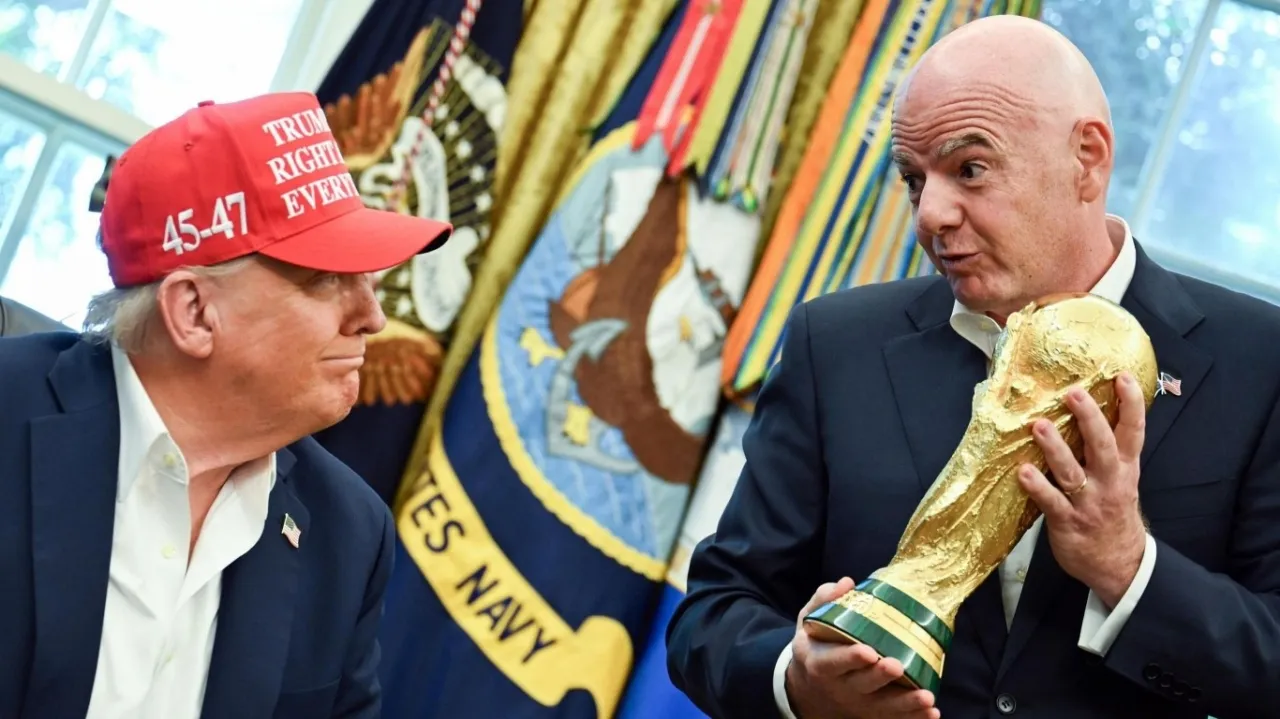
Political factors strongly come into play in this crisis; reports indicate that Donald Trump and his administration would strongly oppose any idea of postponing the tournament. For the White House, backing down from hosting the World Cup on schedule might be internationally interpreted as "surrender" or a weakness in the American security grip, which Trump categorically rejects according to (SPORTbible).