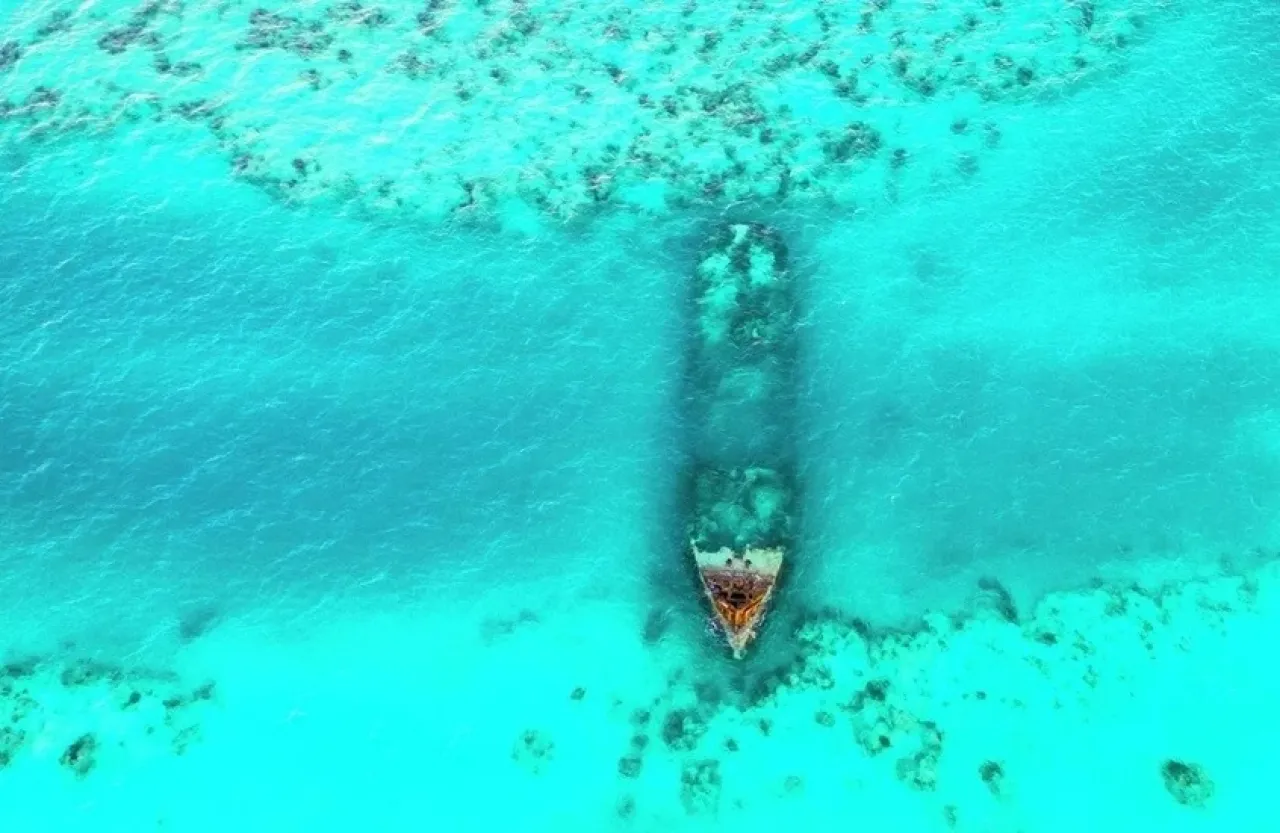
Khaberni - On March 4, 1918, the American Navy ship "Cyclops" disappeared in the waters of the Bermuda Triangle, carrying 306 crew members and passengers without leaving any trace.
The ship, named after a one-eyed giant from Greek mythology, had sailed from Brazil in March of that year after loading a full cargo of dense manganese ore, a mineral used in ammunition manufacturing, and was headed for Baltimore. However, the journey was never completed, as it was swallowed by the ocean without any prior warning.
The last message received from the ship was a routine one saying: "Weather fair, all is well." It was scheduled to arrive in Baltimore on March 13, but it never did. When its arrival was delayed until mid-April, the American Navy declared it missing and launched a massive search operation. No wreckage, oil slicks, or bodies were ever found. It seemed as if the ship had simply vanished. This disaster was the largest loss of life the American Navy had ever suffered in a non-combat operation.
The mysterious disappearance of the ship occurred just before the end of World War I, leading some to believe that a German submarine may have sunk it. However, Germany denied this. Others speculated that a sudden storm might have caused the ship to sink, but no evidence supporting this theory was ever found. The story remained mysterious, and the fate of the ship is still unknown today.
"Cyclops" was last seen off the coast of Barbados, where it stopped unexpectedly due to the excessive load. The crew sent no distress signals. Despite extensive search operations, no trace of the ship or those aboard was ever found.
Several theories about the disappearance have emerged. One prominent theory is that the excessive load of manganese ore was responsible for the ship capsizing, especially if it shifted during a storm. Another theory suggests that the captain, Worley, who was of German descent, might have been sympathetic to the Nazis, raising suspicions that he could have deliberately sunk the ship in a sabotaging operation.
Another intriguing theory is the possibility of a magnetic anomaly in the area. In 2015, the Russian research vessel "Akademik Mstislav Keldysh" detected compass deviations of up to 17 degrees in the Bermuda Triangle area. NASA satellite data also indicate active methane emissions from the seabed, which could explain an underwater volcanic eruption that swallowed the ship.
Another theory discusses secret experiments. In declassified documents from 1972, a peculiar note was found stating: "Check the relationship between Project Phoenix and the 1918 incident."
Adding to the mystery, the crew had complained two weeks before their disappearance of a "strange buzzing in the ship's structure," and the temperature in the cargo hold had reached 50 degrees Celsius, much higher than the normal 25 degrees. Some experts believe this could have been caused by a chemical reaction between the manganese and seawater. Captain Worley also mentioned in a letter to a friend "unusual lights" off the coast of Barbados, adding another dimension to this mystery.
More than a century later, the disappearance of "Cyclops" remains one of the most perplexing mysteries in American Navy history. Experts suggest three main reasons for not finding the ship so far. First, the ship may have sunk to depths as deep as 7500 meters, a massive depth compared to the Titanic, which lies at only 3800 meters. Second, ocean currents, such as the North Equatorial Current, may have moved the ship more than 300 kilometers from its last known location. The third reason is political, as the United States controls the area, thus limiting and restricting access to any foreign search missions.
Russian maritime archaeologist Ivan Petrov says: "If the Cyclops had disappeared in 2025, it would have been found within a week, but the technology of 1918 left us with only legends."
In any case, the mysterious fate of this ship remains one of the many disappearance incidents in this region of the Atlantic Ocean. As of 2024 statistics, data indicates that between three and five ships disappear annually in the Bermuda Triangle, and 67 percent of them occur without the ship being able to send any distress signal.