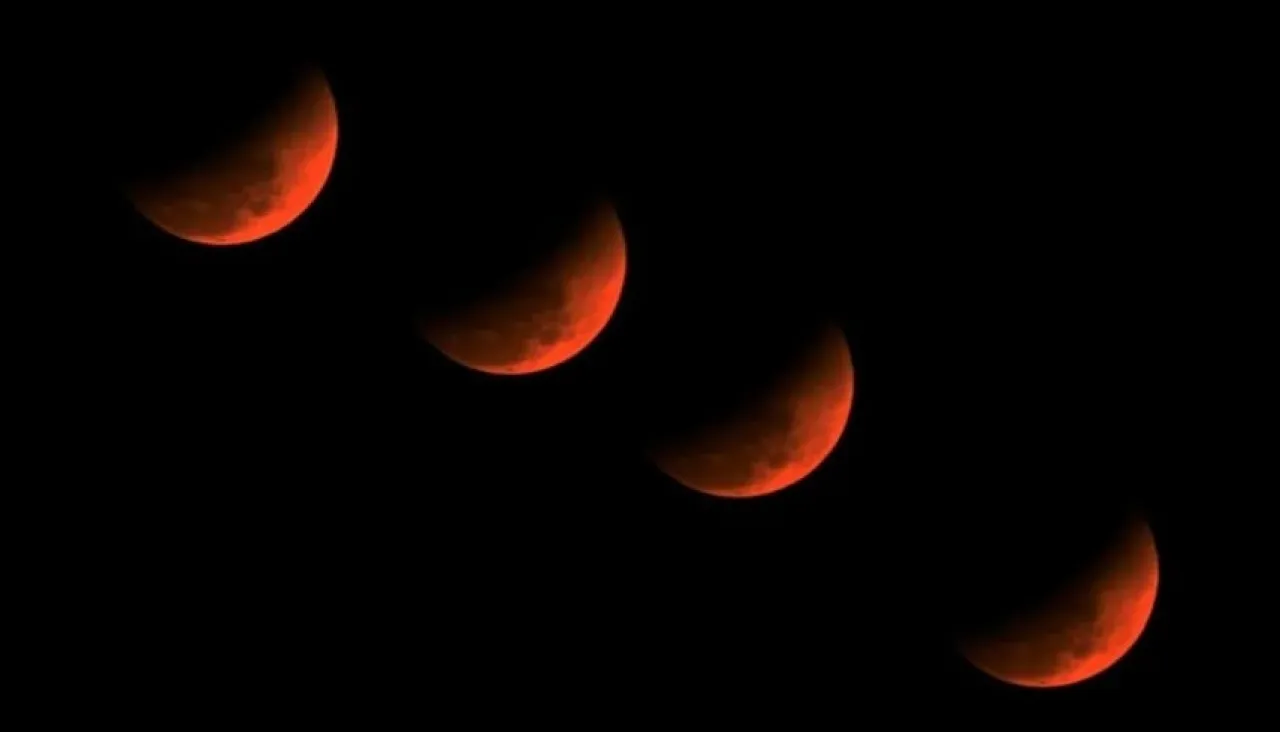
Khaberni - As the full moon set over North America in the early hours of March 3, it gradually slipped into the deepest shadows of the Earth, in a majestic celestial scene that marked the last total lunar eclipse visible from the United States until 2029.
The eclipse lasted about 5 hours and 39 minutes, beginning late at night for most North American sky watchers. The captivating total phase—when the moon moved through the darkest part of Earth's shadow—lasted about an hour, during which the moon donned its dense red cloak.
On the East Coast, the opportunity to follow the peak between 6 and 7 AM Eastern Time was limited, coinciding with the moon setting below the horizon.
In contrast, residents of the Central and Pacific time zones enjoyed a clearer view, as they watched the moon turn a deep red in the early dawn hours.
The cosmic display was not confined to the American continent; residents of Australia, New Zealand, and East Asia also followed the scene, with estimates suggesting that up to 3 billion people around the world saw at least part of the eclipse, according to "Live Science".
The total lunar eclipse is known as the "blood moon," due to the red color it acquires when it dips into Earth's shadow.
This eclipse is due to the "Rayleigh scattering" phenomenon, where sunlight is filtered through Earth's atmosphere before reaching the moon’s surface; shorter, bluer wavelengths are absorbed, while longer, redder wavelengths pass through, making the moon appear blood-colored.
Eclipse and solar eclipse phenomena often occur in pairs, with a solar eclipse typically occurring two weeks before or following a lunar eclipse.
Just two weeks ago, specifically on February 17, Antarctica witnessed an annular solar eclipse which was observed by a limited number of humans, and many penguins.
The next total lunar eclipse to be visible over North America will occur on June 26, 2029, offering sky enthusiasts a new appointment with an exceptional cosmic scene.