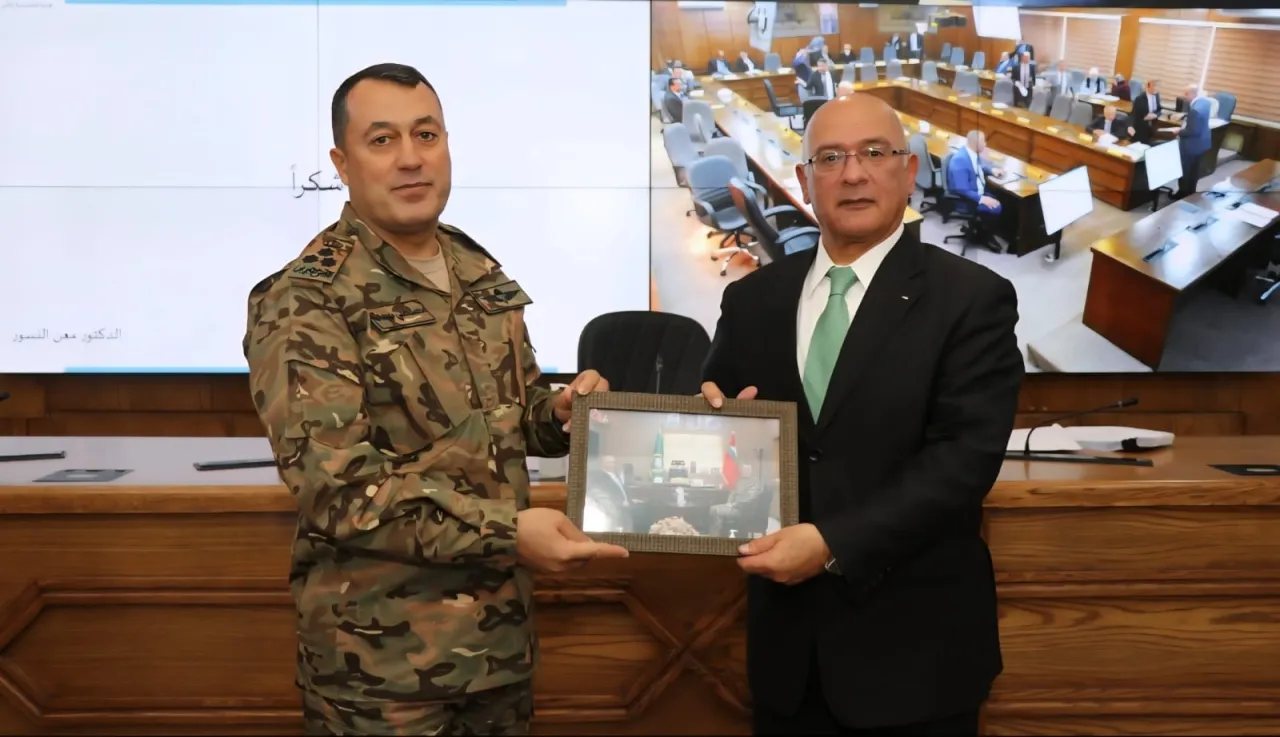
Khaberni – Dr. Maen Al-Nsour, CEO of Arab Potash Company, emphasized that efficient economic management is a pivotal tool in enhancing the state's capacity to handle challenges and protect its interests. He stressed that a strong and cohesive economy forms a fundamental base for supporting the national security system.
This was stated during a lecture he delivered at the Royal Jordanian National Defense College titled: "Economic Management as a Strategic Tool to Enhance National Security – Mining Sector as an Example", as part of the Management and Strategic Studies program, attended by the Head of Guidance Authority at the college, Brigadier General Mohammed Ali Al-Muhaidat, and members of the guidance staff.
Dr. Al-Nsour explained that rapidly evolving global developments and consecutive crises have imposed a new reality where economic management becomes a decisive factor in building the state's capacity to achieve its goals, as a robust economy enables the state to fund its defense needs, enhance its social security, and ensure the continuity of its vital services, directly impacting its ability to protect its interests both domestically and abroad.
Dr. Al-Nsour discussed the complementary relationship between economic management and national security, explaining that modern economic management is based on strategic planning, risk analysis, coordination between fiscal and monetary policies, and institutionalizing the decision-making process, thereby enhancing the efficiency of resource management in a volatile regional and international environment. He also pointed to the importance of proactive readiness to deal with geopolitical and economic changes, in light of energy crises, global financial fluctuations, regional conflicts, and the repercussions of refugee flows.
Dr. Al-Nsour also reviewed a set of economic indicators comparing Jordan with various regional and global countries, highlighting their impact on national competitiveness and the robustness of economies, noting that Jordan shows positive performance in vital sectors, primarily the mining sector.
In an expanded section on the mining sector, Dr. Al-Nsour affirmed that this sector represents a strategic lever for the national economy, contributing significantly to supplying the kingdom with foreign currencies, bolstering the balance of payments, supporting national exports, and creating direct and indirect job opportunities, thereby enhancing economic resilience to shocks and cementing financial sustainability.
Dr. Al-Nsour noted that the Arab Potash Company serves as a prominent example of the role played by the mining sector, having achieved remarkable financial results in recent years, strengthened its exports, expanded its presence in global markets, and contributed to supporting the kingdom's foreign currency reserves, in addition to its role in contributing to global food security and supporting the state treasury, alongside its community contributions in areas surrounding its operations.
In this context, Dr. Al-Nsour mentioned that the Economic Modernization Vision (2022–2033) launched by His Majesty King Abdullah II represents a national roadmap to enhance the competitiveness of the Jordanian economy and stimulate sustainable growth, affirming that His Royal Highness Crown Prince Al Hussein bin Abdullah II continuously focuses on supporting the economic modernization paths and enhancing productive sectors.
Dr. Al-Nsour commended the government's efforts in translating the vision's targets into specific, time-framed implementation programs, noting that organized institutional work and coordination among various stakeholders have contributed to advancing economic reform, enhancing the investment environment, and stimulating vital sectors, reflecting the government's dedication to supporting the national economy and advancing its various sectors.
Dr. Al-Nsour also pointed out that the modernization vision prioritizes the mining sector among its strategic sectors, targeting to increase its exports to about (2.3) billion Jordanian Dinars, achieve qualitative annual growth rates, and generate more job opportunities, reflecting a national understanding of the importance of the sector as a fundamental pillar in supporting the trade balance, strengthening foreign currency flows, and consolidating economic stability.
Dr. Al-Nsour reviewed Jordan's experiences in dealing with regional and international economic crises, affirming that wise economic management can transform challenges into opportunities through efficient public debt management, enhancing reserves, diversifying income sources, supporting productive sectors, protecting monetary stability, and developing the business environment. He emphasized that adopting geo-economic thinking has become a necessity amid accelerated global changes and increasing interconnections between the economy and security.
At the end of the lecture, Dr. Al-Nsour confirmed that enhancing national security requires institutional economic management based on governance, transparency, and sustainability, linking economic policies with the state's supreme interests. He explained that a nation's strength is measured by its capability to protect its domestic front, strengthen its economy, efficiently employ its resources, enhance its regional and international stature, and noted that comprehensive and effective economic management represents the cornerstone in enabling the state to face various challenges and elevate its competitive level.