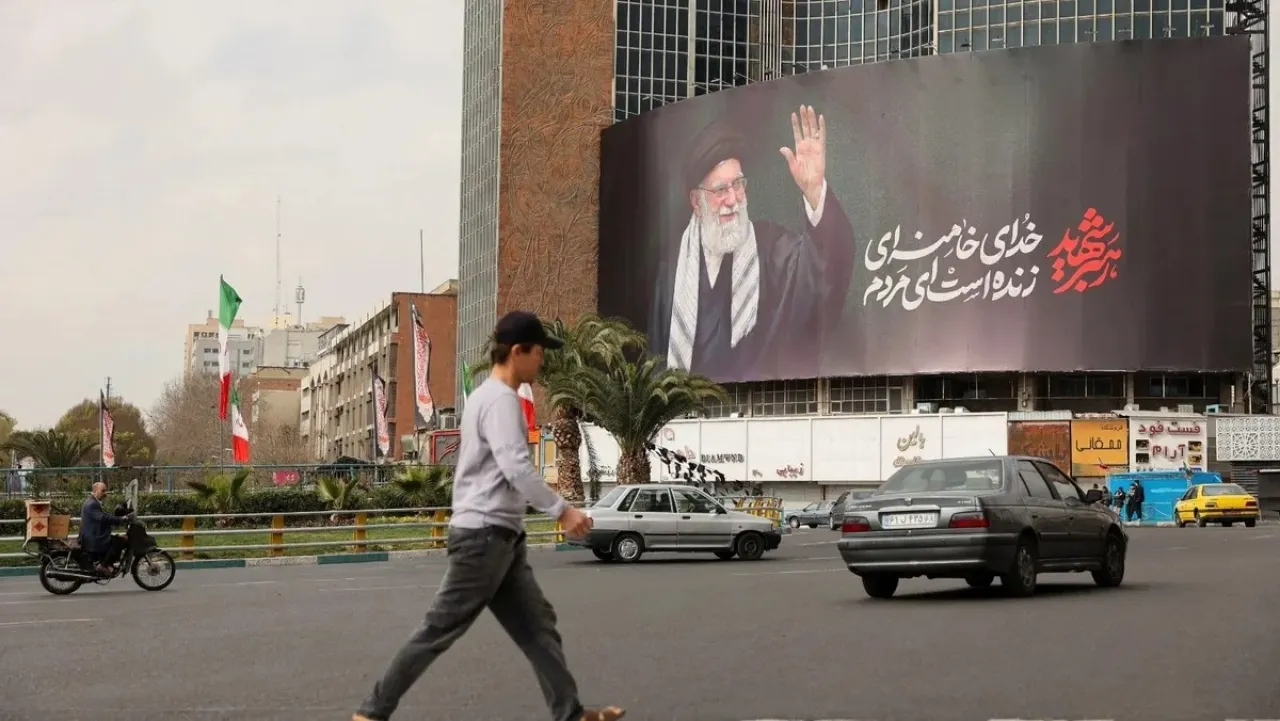
When the loyal, highly-trained bodyguards and drivers for senior Iranian officials arrived at their jobs near "Pasteur" Street in Tehran, where the Iranian leader Ali Khamenei was assassinated in an Israeli airstrike on Saturday, the Israelis were monitoring everything, according to informed sources reported by the "Financial Times".
The British newspaper reported that two informed sources said, "Most of Tehran's traffic cameras had been hacked for years, with their images encrypted and sent to servers in Tel Aviv and southern Israel."
One of the sources mentioned that the angle of one of the cameras was particularly useful, as it enabled them to know where the men preferred to park their personal cars, and gave them a chance to view details of a daily part of the highly fortified compound.
Complex algorithms added details to these guards' profiles including their addresses, working hours, the routes they take to work, and most importantly, the individuals they are typically tasked with protecting and transporting, what intelligence officers call the "lifestyle".
These capabilities were part of an intelligence campaign that lasted years, and paved the way for the assassination of the Iranian leader. This real-time data source, one of hundreds of different intelligence sources, was not the only way that enabled Israel and the American CIA to determine the time Khamenei would be in his office on that fateful Saturday morning, and who would be with him, according to the "Financial Times".
Moreover, Israel was also able to disrupt some parts of about 12 mobile phone towers near Pasteur Street, making the phones appear busy when called, preventing Khamenei's protection team from receiving any possible warnings.
"We know Tehran like Jerusalem"
Long before the bombs fell, an Israeli intelligence official said, "We knew Tehran as we know Jerusalem, and when you know a place well like the street you grew up on, you notice anything out of the ordinary."
The complex intelligence landscape of the Iranian capital was the result of a strenuous effort in data gathering, made possible by Israel thanks to the advanced signals unit "Unit 8200", the human elements recruited by the Israeli foreign intelligence service "Mossad", and the massive amount of data analyzed by military intelligence into daily summaries.
Israel used a mathematical method known as "social network analysis" to analyze billions of data points and uncover unexpected decision-making hubs, identify new surveillance and assassination targets, and all of this is part of a single mechanism dedicated to target selection, as reported by the "Financial Times" from a source informed about the use of this method.
Itai Shapira, a reserve officer with the rank of brigadier general in the Israeli army who served 25 years in military intelligence, said, "The culture of Israeli intelligence considers target intelligence the most important tactical issue, as it is designed to enable a strategy. If a decision-maker decides that someone must be assassinated, Israeli culture says: We will provide the target intelligence."
Israel has assassinated hundreds of people abroad, including leaders of armed groups, nuclear scientists, and chemical engineers, as well as many innocent civilians who were accidentally killed.
However, even with the assassination of a prominent political and religious figure like Ali Khamenei, the debate remains heated inside and outside Israel about how much this aggressive strategy, based on technological and technical superiority, has led to major strategic gains.
Israeli intelligence superiority was clearly demonstrated during the 12-day war in June, when over 12 Iranian nuclear scientists and a number of senior military leaders were assassinated within minutes in the opening strike.
It coincided with an unprecedented paralysis of Iranian air defense systems through a mix of cyberattacks, short-range drones, and precision munitions launched from outside Iran's borders, leading to the destruction of Russia-made missile radars and platforms.
"Sparrow missiles"
One of the intelligence officials said: "We targeted their eyes first." In the June war and the recent operation, Israeli pilots used a specific type of missile known as "Sparrow", which are models capable of hitting a target no larger than a dining table from more than a thousand kilometers away, well beyond the reach of any of Iran's air defense systems.
While all details of the recent operation remain unknown, and some may never be disclosed to preserve the sources and methods still used to track other targets, according to the newspaper.
However, more than 6 current and former Israeli intelligence officials, interviewed, confirmed that the assassination of Khamenei was primarily a political decision, not just a technological or technological achievement.
When the CIA and Israel concluded that Khamenei would hold a meeting Saturday morning in his office near Pasteur Street, the opportunity was considered exceptionally ripe for his assassination along with a large number of senior Iranian leaders.
The two parties estimated that tracking them down after a full outbreak of war would be much more difficult, as the Iranians would quickly resort to evasive actions, including moving to underground shelters fortified against Israeli bombs.
How did Khamenei live?
Unlike his ally, the late Secretary-General of the "Hezbollah" Lebanese group Hassan Nasrallah, who spent years of his life in underground shelters, avoiding several Israeli assassination attempts, until Israeli fighter planes dropped up to 80 bombs on his hideout in Beirut in September 2024, killing him, Ali Khamenei did not live in hiding.
On the contrary, Khamenei openly spoke about the possibility of his assassination, considering that his life was not as important as the fate of the country. However, some experts on the Iranian matter said he expected to "martyr" himself. Nonetheless, he took some precautions during wartime, according to one of the sources the newspaper interviewed.
The source added: "It was unusual for him not to be in his shelter, as he had two shelters, and if he had been in them, Israel would not have been able to reach him with the bombs it had."
Even in June 2025, in the midst of a full-scale war, no known attempts by Israel to bomb Khamenei were recorded. Instead, their strikes mostly focused on leaders of the "Revolutionary Guards", missile launch platforms and their storerooms, Iranian nuclear facilities, and the scientists working there.
As US President Donald Trump repeated in recent weeks his threats to attack Iran, enhancing the presence of the "fleet" off its coast, negotiations between the United States and Iran regarding Tehran's nuclear program were supposed to continue this week.
The Sultanate of Oman, acting as a mediator, said Iran expressed readiness to make concessions that could help avoid war, describing the last meeting held last Thursday as "fruitful".
While the American president openly expressed his dissatisfaction with the slow progress. But an informed person said Trump was "dissatisfied with the Iranian responses" behind the scenes, paving the way for war.
The informed said the attack on Iran had been planned for months, but officials modified their plan after American and Israeli intelligence confirmed that Khamenei and his top aides would hold a meeting in his complex in Tehran on Saturday morning.
Israeli algorithms
Tracking individual targets in the past was a laborious task requiring visual confirmations and sorting through misleading information, but Israel's big data collection system based on algorithms has automated this task in recent years.
For a target as valuable as Khamenei, failure was not an option. Israeli military doctrine dictates that two separate senior officers, each working independently and with a high degree of certainty, confirm the presence of the target at the intended location and know who is accompanying him.
In this case, according to what was reported by the "Financial Times" from two people informed on the details, the Israeli intelligence owned information from signal intelligence, including hacked traffic cameras and deeply infiltrated mobile phone networks. One of them said that this data showed that the meeting with Khamenei was proceeding as scheduled, with senior officials heading to its location.
"Human Source"
But the Americans had something clearer, according to the informed: a human source. The CIA declined to comment.
At 03:38 PM Eastern Time, Friday, President Trump, while traveling aboard Air Force One to Texas, gave the order to proceed with "Epic Rage", the strikes led by the United States on Iran.
American forces paved the way for Israeli fighter jets to bomb the Khamenei complex by launching cyberattacks that "disrupt, diminish, and blind Iran's ability to see, communicate, and respond," according to General Dan Cain, chairman of the Joint Chiefs of Staff.
Cain said the strike on the complex was carried out in broad daylight based on a "triggering event" that enabled the Israeli forces to execute with the aid of American intelligence.
A former Israeli intelligence official added that the Israeli planes, which had been flying for hours to arrive at the right time and place, launched about 30 precision munitions at the Khamenei complex.
Trump said in remarks to FOX News that the Iranians were in a breakfast meeting at the moment they were targeted.
The Israeli forces said that daytime bombing provided a tactical advantage, noting that "the decision to bomb in the morning instead of at night allowed Israel to achieve a tactical surprise for the second time, despite Iran's intensive preparations."
Sima Shine, a former official at the Mossad and an expert on Iran, said that the tactical success was the result of two separate incidents, more than 20 years apart.
The first was a directive issued in 2001 by the late Prime Minister Ariel Sharon to Meir Dagan, then head of the Mossad, who was busy with Syria, Palestinian militants, "Hezbollah" in Lebanon, and others, to make Iran a priority.
Shine said, quoting Sharon: "Everything the Mossad does is good and acceptable, but what I need is Iran. This is your target." She added, "And since then, this target has remained constant."
Israel sabotaged the Iranian nuclear program and killed Iranian scientists, faced arms for Tehran, and even destroyed the military infrastructure of its vital ally Syria in the days following the overthrow of former President Bashar Assad.
Iranian Intelligence
But Iranian intelligence agencies were a strong adversary, according to the "Financial Times". In 2022, a group linked to Iranian security services released data allegedly stolen from the phone of the Mossad chief's wife.
Iran also hacked surveillance cameras in Jerusalem during the 2025 war to obtain immediate damage assessments that Israel had blocked from broadcast, accessing images of missile defenses, and plotted the jogging route of a key politician through bribing Israeli citizens, according to Israeli prosecutors.
According to Shine, the second event was an attack by the Palestinian "Hamas" movement on October 7, 2023, which Israel claims was supported by Iran, altering long-term calculations in Israel.
Shine explained that assassinating foreign leaders is not just a political red line but involves significant operational risks, as failure enhances the status of the target, as happened after the American CIA's failed attempts to assassinate Fidel Castro, while success can open the door to unforeseen chaos.
She added that a series of Israeli intelligence successes, including the assassination of the political bureau head of "Hamas" Ismail Haniyeh in Tehran in 2024, and a secret multi-year project worth $300 million to rig thousands of communication devices of "Hezbollah" operatives, holds a special allure for Israeli decision-makers.
Shine concluded by saying, "In Hebrew, we say: with the food comes the appetite, meaning that each achievement spawns a new desire for more."