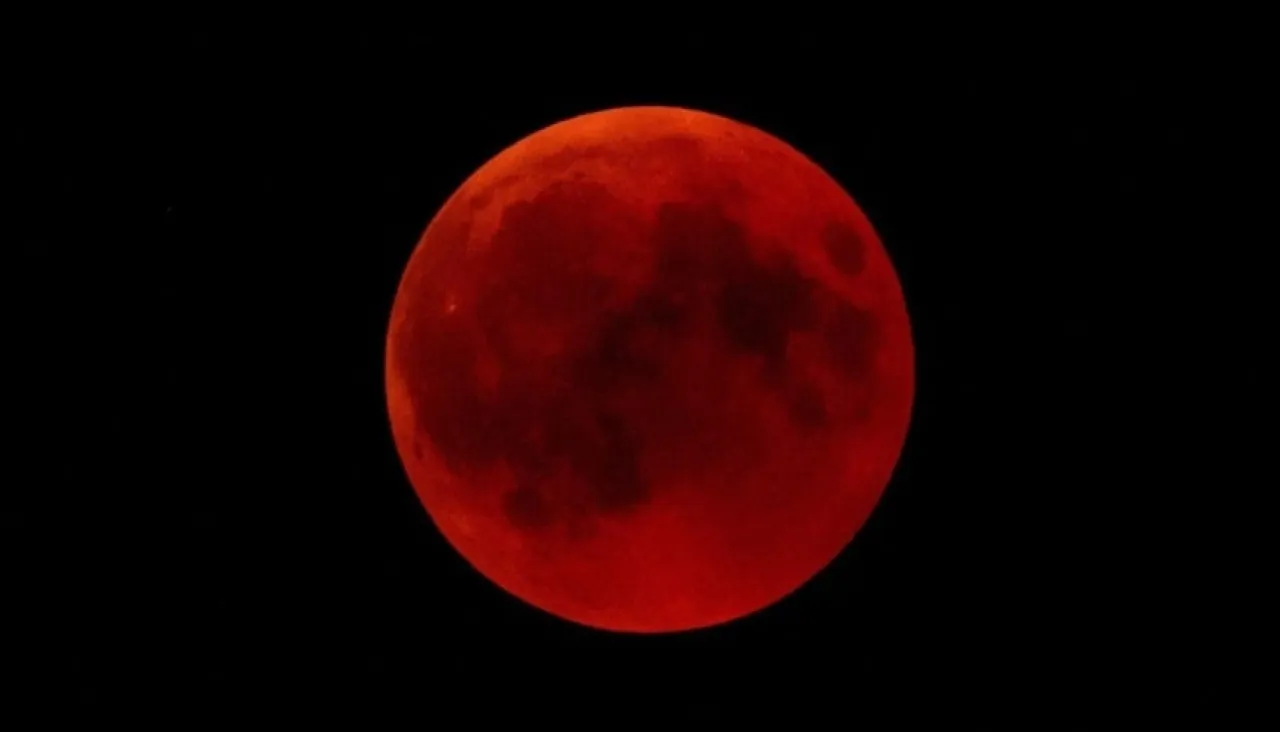
Khaberni - The world's sky will witness an exceptional astronomical event in the early hours of March 3 (March), with the full moon entering the Earth's deepest shadow during a total lunar eclipse, turning into an enchanting coppery red color known as the "Blood Moon" phenomenon.
The eclipse will be visible to millions of followers in North America, Australia, New Zealand, and East Asia, weather permitting. Over 40% of the world's population will be able to see at least part of it, according to data from "Space".
When does the phenomenon peak?
The best time to watch the peak of the total eclipse will be at 6:33 AM Eastern Time (11:33 GMT), when the moon enters the deepest point in Earth's shadow.
The scene begins gradually with the partial eclipse phase around 4:50 AM Eastern Time (09:50 GMT), where the Earth's shadow can be observed slowly creeping across the moon's surface, before it turns dark red at the start of the total phase at 6:04 AM (11:04 GMT), which lasts about 58 minutes.
Because the eclipse occurs before sunrise in many areas, some observers might have the rare opportunity to see the "selenelion" phenomenon, where a lunar eclipse and the sun appear in the sky at the same time, a scene described as "the impossible moment".
Safe viewing with the naked eye
Unlike a solar eclipse, a lunar eclipse does not require special glasses or protective filters, as it can be safely observed with the naked eye. All you need is to choose an open location with a clear view towards the west, and stay as far away from light pollution as possible.
A rare opportunity before 2028
The March 3 (March) eclipse represents the first lunar eclipse in 2026 and is the last of its kind until the end of 2028, when a new series of total eclipses begins. This event is a golden opportunity for sky enthusiasts before a long wait.
7 easy tips for photographing the "Blood Moon"
You don’t need professional equipment to capture a unique photo of the eclipse, but advance planning is important, so:
1- Know your area's timing accurately: Review the phase schedule according to your geographic location, as the eclipse occurs at the same universal time, but the viewing timing varies locally.
2- Head westward: The farther west you are, the better the visibility. It is best to choose a high place or a wide-open area that offers a clear horizon.
3- Monitor the weather: Clouds are the primary enemy of astrophotography, so keep track of cloud forecasts and be ready to change your location if necessary.
4- Practice focusing: Try photographing the moon before the eclipse night, especially if you are using a long lens (200–600 mm). Precise manual focusing using the live view zoom feature yields better results.
5- Constantly adjust the exposure: As the brightness of the moon varies during different phases, you need to adjust the shutter speed, aperture, and ISO sensitivity. In brighter phases, choose fast shutter speeds like 1/250 second, while in the total phase, you may need a longer exposure (1–2 seconds) with increased ISO.
6- Don’t overzoom on your smartphone: If using a phone, avoid digital zoom. Photograph the moon within a broader scene - above trees, buildings, or reflected in water - and use a tripod to stabilize the image.
7- Be thoroughly prepared: Make sure to charge batteries, bring extra memory cards, activate noise reduction in long exposures, and don't forget to enjoy the scene away from the camera lens.