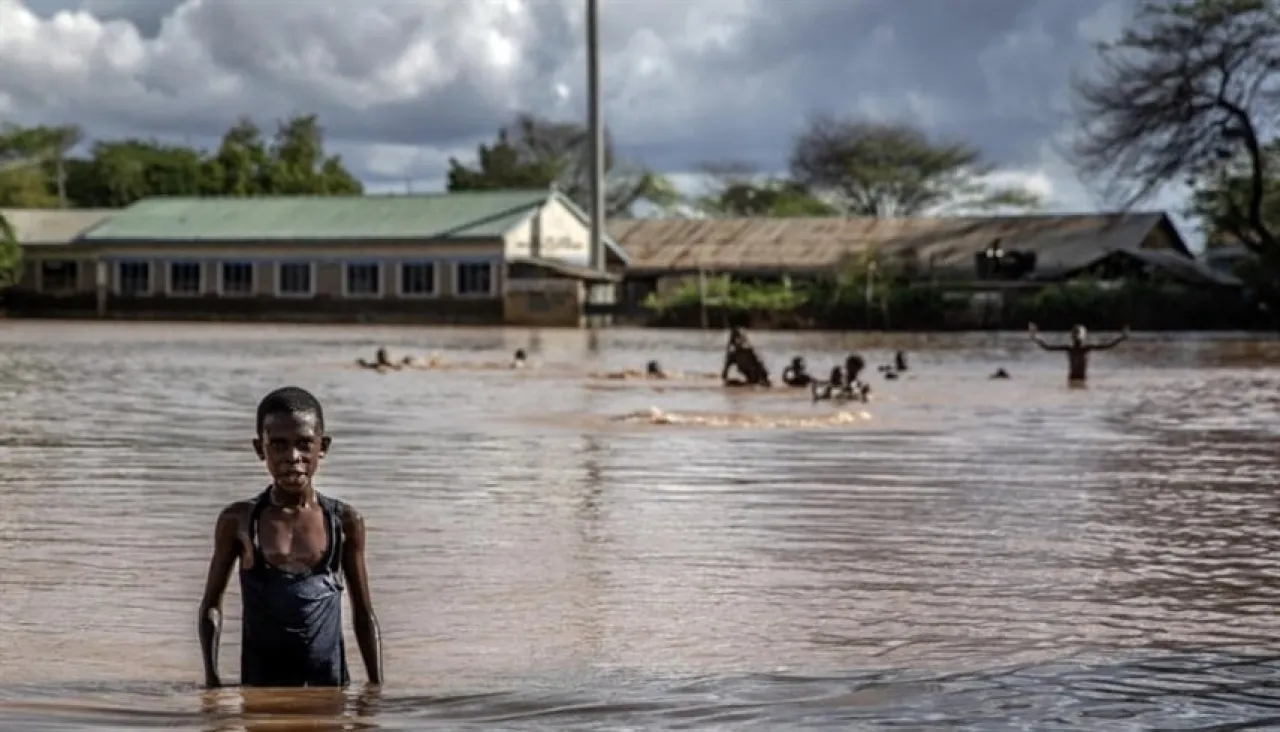
Khaberni - The climate agenda for 2026 stands on the brink of a critical juncture, with a 60% probability of the return of the "El Niño" phenomenon in the second half of this year, global scientific and political circles await tomorrow's update from the World Meteorological Organization (WMO). After successive heat shocks in 2024 and 2025, experts fear that this acceleration in the warming of the Pacific Ocean may push the Earth towards unprecedented levels of thermal stress, putting global food and energy systems to a rigorous test.
The naming of "El Niño" was no coincidence, as it was coined by South American fishermen in the nineteenth century for a warm current that disrupted their fishing seasons right before Christmas. Today, this designation has transformed from a local observation into a global climate nightmare.
"El Niño" weakens the trade winds that drive the waters of the Pacific Ocean, allowing the warm waters to settle in the central and eastern regions. This "excess energy" does not remain in the ocean, but is released as a warm exhalation into the atmosphere, raising the global average temperature by 0.1 to 0.2 degrees Celsius.
"El Niño" and "La Niña" are two phases of a natural climatic pattern across the tropical Pacific known as the El Niño-Southern Oscillation (ENSO). The name "La Niña" was chosen as the cold counterpart to El Niño. Between the two phenomena lies a "neutral" phase. The phenomena occur every two to seven years and typically last 9 to 12 months, but can extend for several years during their occurrence.
2026 and 2027: Betting on the "hottest" in history
Although the year 2024 currently holds the title of "hottest year," Carlo Buontempo, director of the "Copernicus" service, warns that 2026 might take the title under the impending El Niño. However, scientists present a critical perspective: the effects of El Niño are not immediate.
Climate scientist Tiedo Simler explains that the atmosphere needs time to react to El Niño, yet there is a risk that 2026 could be the hottest year on record even without El Niño, due to the general trend of global warming.
Simler noted that 2027 faces an increased risk of setting a new record if El Niño develops in the second half of 2026.
"La Niña".. the calm before the storm
On the opposite side, "La Niña" (the cooler younger sister) is currently gathering its forces, as the latest wave of La Niña was relatively weak and short-lived, beginning in December 2024, with an expected shift to a neutral phase during the period from February to April.
La Niña cools the eastern Pacific Ocean for a period ranging between one and three years, causing climatic effects opposite to those associated with El Niño. It brings more humid conditions to parts of Australia, Southeast Asia, India, and southeastern Africa, and northern Brazil, while causing drought in parts of South America.
Yet, La Niña did not prevent 2025 from being the third hottest year on record.
New calculation method
In February, NOAA adopted a new method for defining El Niño and La Niña events.
The old index, known as the "Oceanic Niño Index" (ONI), compared the average sea surface temperature over a three-month period in a region of the Pacific to a 30-year average in the same area.
But with the rapid rise in ocean temperatures, the old thirty-year average has become less accurate.
The new method, called the "Relative Oceanic Niño Index" (RONI), compares how warm or cool the east-central Pacific is relative to other tropical regions.
NOAA noted that RONI provides a "clearer and more reliable" method for tracking El Niño and La Niña in real-time.
In light of the scientific linkage between the El Niño phenomenon and rising global water levels, the greatest challenge looms for coastal communities in Africa. With the continent's coastline nearing 19,000 miles, the pressure intensifies on 38 countries to adopt urgent climate resilience policies to protect their population and economic stability.