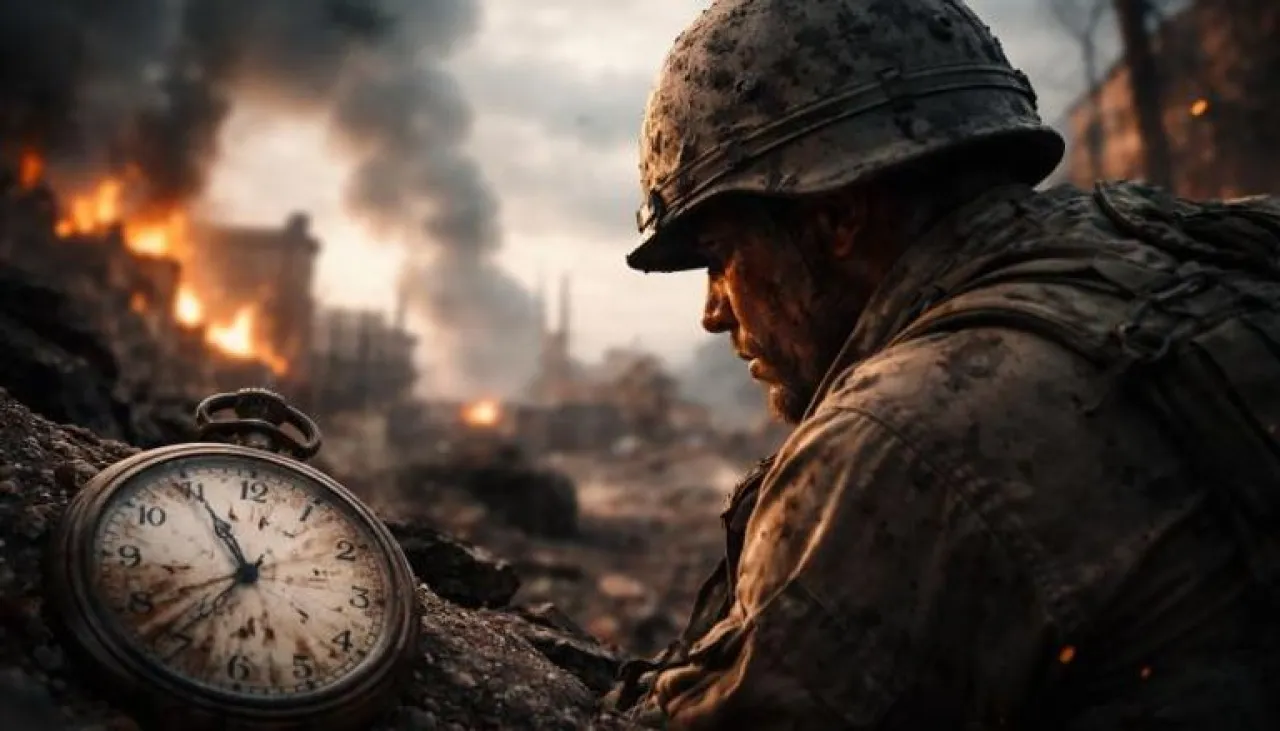
Khaberni - In times of peace, time passes like a calm stream that we hardly feel moving. But in war, it turns into a heavy burden, where minutes linger, and hours seem endless.
This sensation is not merely metaphorical, but has deep roots in the brain and nervous system, and has been the subject of dozens of studies in psychology and neuroscience.
The brain under threat.. when time slows down
Mahmoud Shawky, a mental health consultant, says, "When exposed to danger, the brain enters a state of high alert, where the amygdala, responsible for monitoring threats, becomes highly active, and triggers a series of physiological responses."
Research published in neurology journals indicates that this condition causes the brain to process a larger amount of information in a shorter time, creating a subjective illusion that time has slowed down.
A classic study published by the American Psychological Association describes how people in shocking situations report a recurring sensation of 'moment stretching,' because awareness is intensely focused on every tiny detail: sound, movement, shadow, or even heartbeat.
Why do moments last longer in our minds?
Fear does not actually slow down time, but it extends its impact on memory. Studies on post-traumatic stress disorder indicate that violent events are stored in memory with dense details compared to everyday events, and when we recall these memories, they seem to have taken longer than they actually did.
Researchers from Stanford University explained that the density of stored details makes the brain "calculate" the event as being longer in time, even if it was short.
Anticipation and waiting.. time with no horizon
In wars, the danger is not limited to the moment of bombing, but extends to anxious waiting like waiting for the siren, waiting for the next bombing, waiting for news about loved ones.
Psychology describes this kind of time as "suspended time," where the natural rhythm of life (work, sleep, recreation) is absent, and humans lose their usual reference points for time, making everything seem slower and heavier.
A study published in the "Journal of Traumatic Stress" indicates that the broken routine is one of the main reasons for the distorted sense of time among civilians in conflict zones.
Time passes like a calm stream that we hardly feel moving during the war
When slowness becomes a survival mechanism
Dr. Shawky states, "The irony is that this sensation of slowed time may be a survival mechanism, as when one feels that the moment lasts longer, they become capable of making quicker decisions, such as seeking shelter, escaping, and helping others."
Neuroscientists describe this state as "short-term intense focus," where the brain operates at its maximum capacity to protect the body.