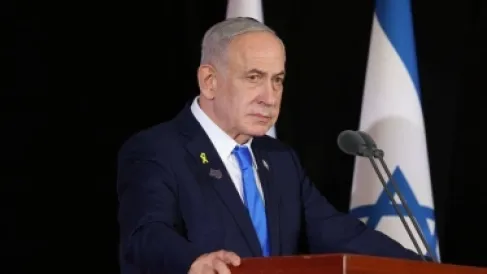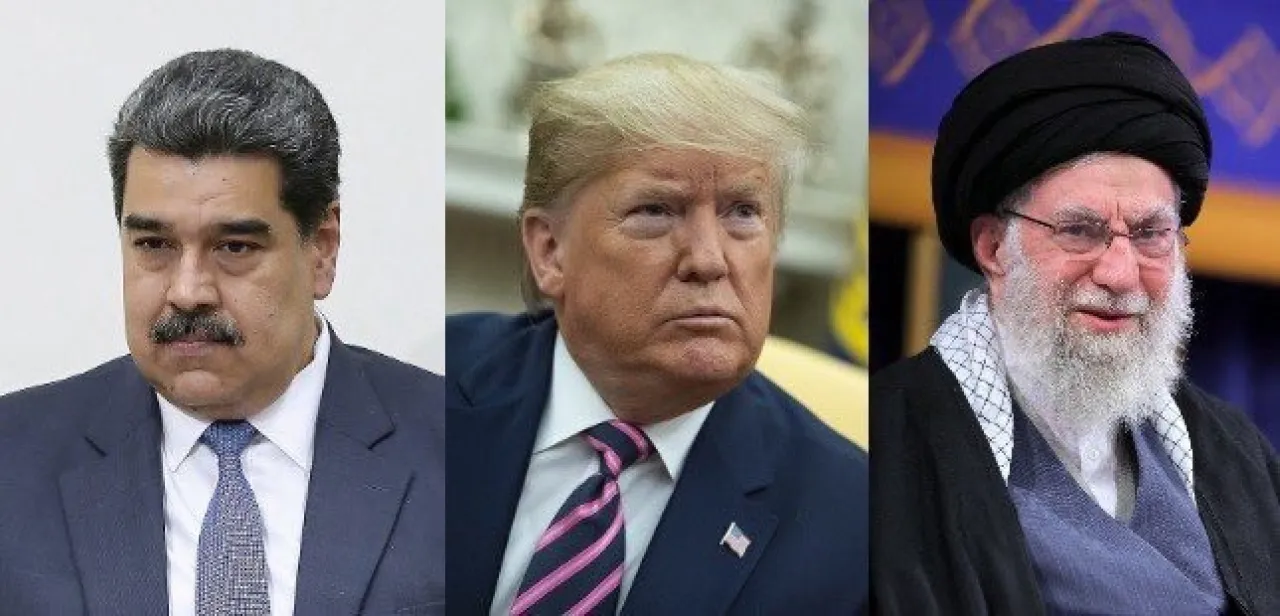
Khaberni - Within less than a year, the United States waged 3 decisive military rounds against both Iran and Venezuela, following a security and military strategy aimed at “decapitating the pyramid” to disrupt the opponent’s defenses. Each time, Washington succeeded in landing the initial, surprising blow, effectively removing political leaders from the scene, whether through arrests as seen in Caracas, or via direct targeting operations.
The military evidence extending from Tehran to Venezuela points to a recurrent scene where within the first twenty-four hours from the onset of the confrontation, Washington would have already achieved its primary objective by neutralizing the top leadership.
This early “hunting” plunges the other side into chaos, forcing them to catch their breath and reorganize their leadership rather than focusing on military response mechanisms or handling accumulated crises in the field.
“Rapid hunting”
In the first war against Iran, dubbed the 12-day war, Washington, along with Israel, managed to eliminate the top military leaders and target a group of elite nuclear scientists through precise military operations in Tehran and other major Iranian cities and provinces.
In Venezuela, Washington did not need much time to "hunt" President Nicolas Maduro from his presidential compound in the capital, Caracas, in a swift military operation. The details of the night Maduro was caught on January 3 are not fully known to the Venezuelan and international public.
In Iran, Washington began its extensive military operation against Iran in the last dawn of February, by killing their Supreme Leader Ali Khamenei. American fighter jets targeted Ali Khamenei’s home and office in the Iranian capital, Tehran.
Iranian television announced late on the night of March 1, 2026, the assassination of Khamenei, also declaring a 40-day mourning period and a full week-long holiday.
American strategic vision
Although the operations of hunting down Maduro and Khamenei coincide with the current American military and strategic vision, which is represented in changing hostile regimes through the dual-pressure of economic sanctions and decapitating the regime, without waging long wars or deploying American forces on the ground. The effectiveness of the American forces in directing precise strikes to the heads of the regimes, and the ease of overcoming defense systems and intelligence and logistical infrastructures, remain truly questionable, especially as the opposing sides often promote a narrative of readiness for war and learning lessons from previous American wars.
At this juncture, the clear effectiveness of the American approach in hunting down “big heads” comes back to six major reasons.
Six major reasons
The first reason lies in absolute technological and cyber dominance, where Washington relies in the initial attacks on a fleet of technological strikes that paralyzes the air defenses of the opponent, making them an “open book” in front of its advanced fighters.
Before arresting Maduro, the S300 air defense networks were paralyzed, and before assassinating Khamenei, the Ba’wer systems were disabled allowing the stealth fighters “F-35” and “F22” to fly at medium altitudes and read the Iranian and Venezuelan geographies almost microscopically.
The second reason is real-time space reconnaissance, whereby Washington employs a sophisticated network of Pentagon satellites in all its wars. These satellites provided precise intelligence information about every movement of the Iranian and Venezuelan leaders by the second, presenting geographic data on the terrain changes near nuclear facilities, which facilitated the task of reaching the big heads of the regimes.
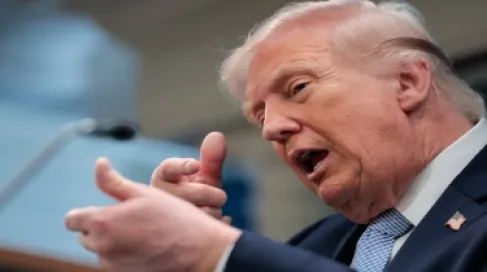
President Donald Trump commented on this matter, saying “Khamenei could not escape our advanced intelligence devices and tracking systems.”
The third reason is embodied in the silent penetrations and defections occurring in the leadership structures, providing very accurate information about Maduro’s location during the night of January 3, 2026, and in Iran it seems that years of economic pressure had resulted in sleeper cells within sensitive joints in Tehran, enabling the American side to know the timing and presence of Khamenei and other military leaders – where some sources speak of the assassination of first-line military leaders – at specific locations at the moment of the attack on the dawn of February 28.
Giant aircraft carriers
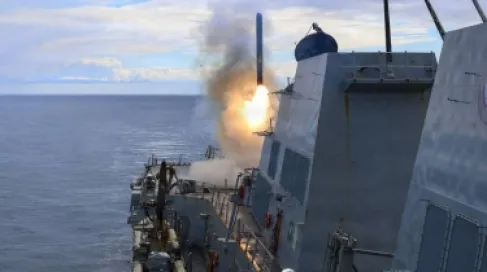
The fourth factor embodies great ships and American giant aircraft carriers stationed along the coasts of “Venezuela” and “Iran”. These are great vessels that not only carry “Tomahawk” missiles, but also feature advanced electronic warfare units capable of jamming communications between the political and military command centers on the one hand, and the military bases and units in Iran and Venezuela.
In addition, their military importance in reducing "warning time", as a missile, drone, or fighter jet launched from a submarine close to the coast can reach its target before the opponent is able to activate the “leadership evacuation” protocol.
The fifth factor is the knowledge of the geography of Iranian radars, where Washington realized that they are primarily located on the Iraqi and Afghan land borders, and do not spread significantly on the coasts, which helped it to launch strikes from the “blind spot”, where it circles around the land radars from the sea.
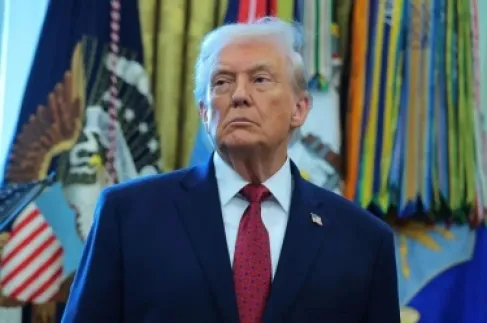
The last factor embodies the United States deploying political and rhetorical gray areas, giving the illusion that the war hypothesis is unlikely and that it favors the peace and negotiation scenario, while at the same time the Pentagon is putting the final touches on plans for decisive military action. This gives Trump’s and his political team's soothing talks create an "illusion" of calmness and stability, generating "relaxation" militarily and intelligence-wise on the opponent’s part, which Washington exploits in launching the first strike, which is typically the "turning point" of the war's course.