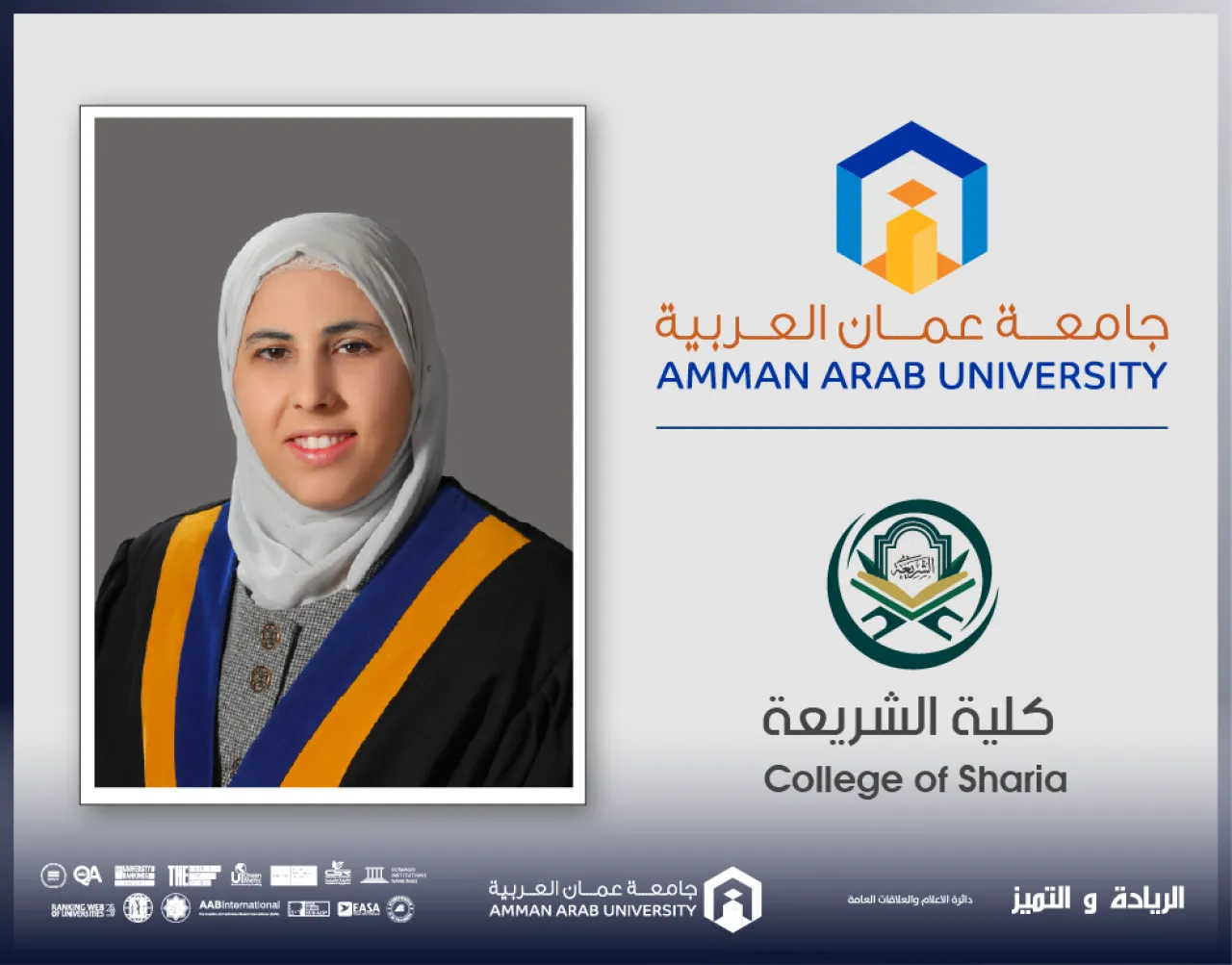
Khaberni - In line with Amman Arab University's commitment to supporting scientific research and enhancing its academic presence in scientific forums, Dr. Alaa Al-Boreini, the head of the Sharia and Islamic Studies Department at the Faculty of Sharia at the university, participated in the first refereed international scientific conference, under the title: "Contemporary Challenges for Arab Societies and Strategies to Address Them in Light of Modern Technology," with the participation of a selection of researchers and experts from various universities and academic institutions.
During the conference, Dr. Al-Boreini presented a research paper titled: "The Impact of Artificial Intelligence on Islamic Thought," aiming to create a roadmap for leveraging modern technologies in the service of Sharia sciences. She focused on the mechanisms for employing artificial intelligence applications to enhance Islamic thought, with a detailed analysis of the "pros and cons" balance presented by this significant digital transformation. Al-Boreini emphasized that artificial intelligence represents a golden opportunity for disseminating sound Islamic thought and enhancing its global spread, provided that there is a conscious handling of the accompanying intellectual and technical challenges. She emphasized the necessity of conducting a precise scientific review of the sources relied upon by artificial intelligence algorithms to ensure the protection of legitimate concepts from any distortion or misuse, confirming the importance of building an effective partnership between Sharia specialists and technical experts.
Dr. Al-Boreini presented a set of strategic recommendations notably: enhancing community awareness of the risks of unregulated use of artificial intelligence in religious matters; working on producing comprehensive and reliable digital scientific content in various Sharia fields; and forming a specialized team that combines technical and Sharia expertise, tasked with monitoring, evaluating, and scientifically supervising the digital religious content, ensuring its accuracy and reliability, and limiting the spread of inaccurate information or unregulated interpretations. She also stressed the importance of enhancing collaboration between academic institutions and research centers to develop joint initiatives that employ artificial intelligence technologies in the service of Sharia sciences, contributing to keeping pace with the rapid digital transformations and enhancing the role of scientific research in providing scientific solutions to contemporary challenges.
The participation of the Faculty of Sharia at Amman Arab University in the conference highlights that Islamic thought, with its spirituality that manifests in every era, is capable of harnessing the tools of the modern age to serve humanity and protect the Arab identity from contemporary challenges.