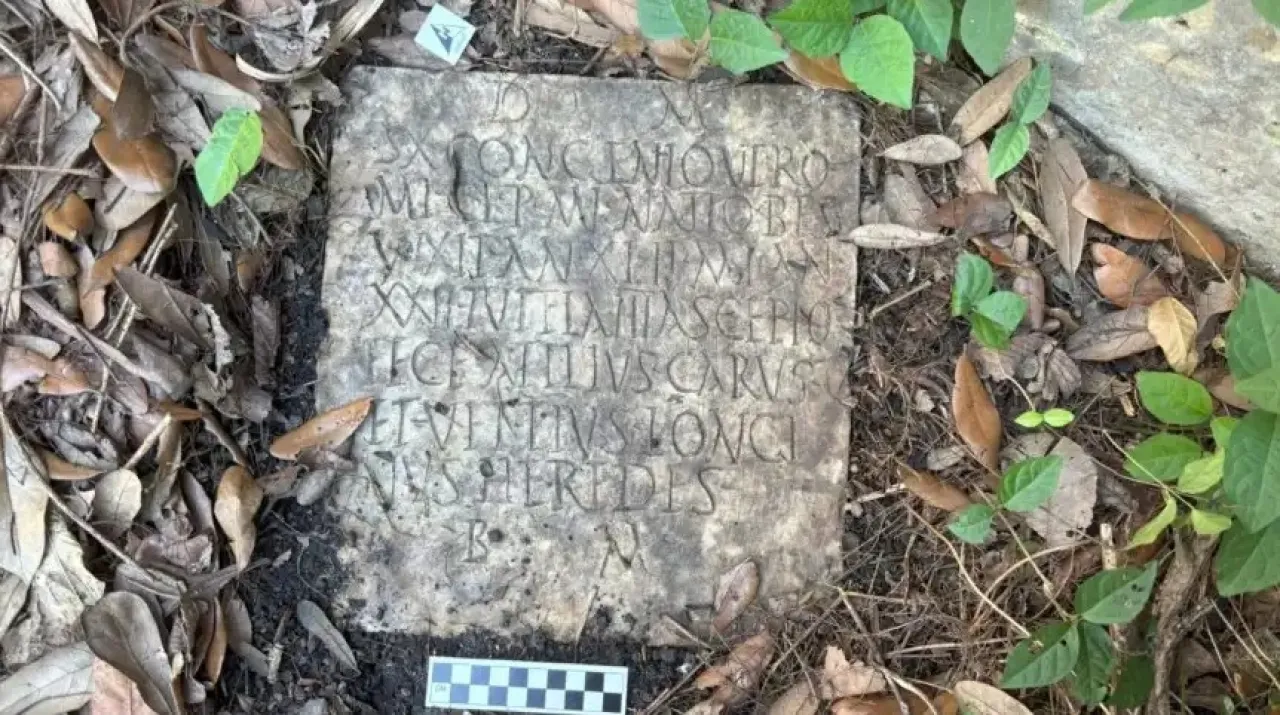
Khaberni - A home garden renovation in the Carrollton district, New Orleans in America, turned into a true archaeological discovery after a couple found a partially buried Latin-inscribed marble slab between the bushes, bearing the phrase "Dis Manibus" meaning "To the spirits of the deceased".
Initially, the couple, Daniela Santoro and Aaron Lopez, thought the slab was just a decorative piece, but its Latin text raised their suspicions, prompting them to consult archaeology and anthropology experts to confirm its true nature.
Grave of a Roman soldier
The experts clarified that the slab commemorates a Roman soldier named Sextus Congenius Verus, who died at the age of 42 after 22 years of military service, about 1900 years ago. His heirs, Atilius Carus and Vetius Longinus, engraved this piece as his grave marker.
The slab had been listed in the early 20th century among the collections of the National Archaeological Museum in Civitavecchia, Italy, but it was lost after the museum was partially destroyed during the Second World War, and remained unknown for almost eighty years.
According to subsequent investigations, the slab reached the couple's home through a series of inheritances, after being displayed in the house of Charles Paddock Jr., an American soldier stationed in Italy during the war, before later moving to Eileen Scott O'Brien, who placed it in her garden in New Orleans, mistakenly thinking it was just an ordinary art piece.
The FBI's Art Crime Team is currently working to return the slab to the National Archaeological Museum in Civitavecchia, finally returning it to its original homeland in the Roman Empire where the soldier Sextus Congenius Verus served.