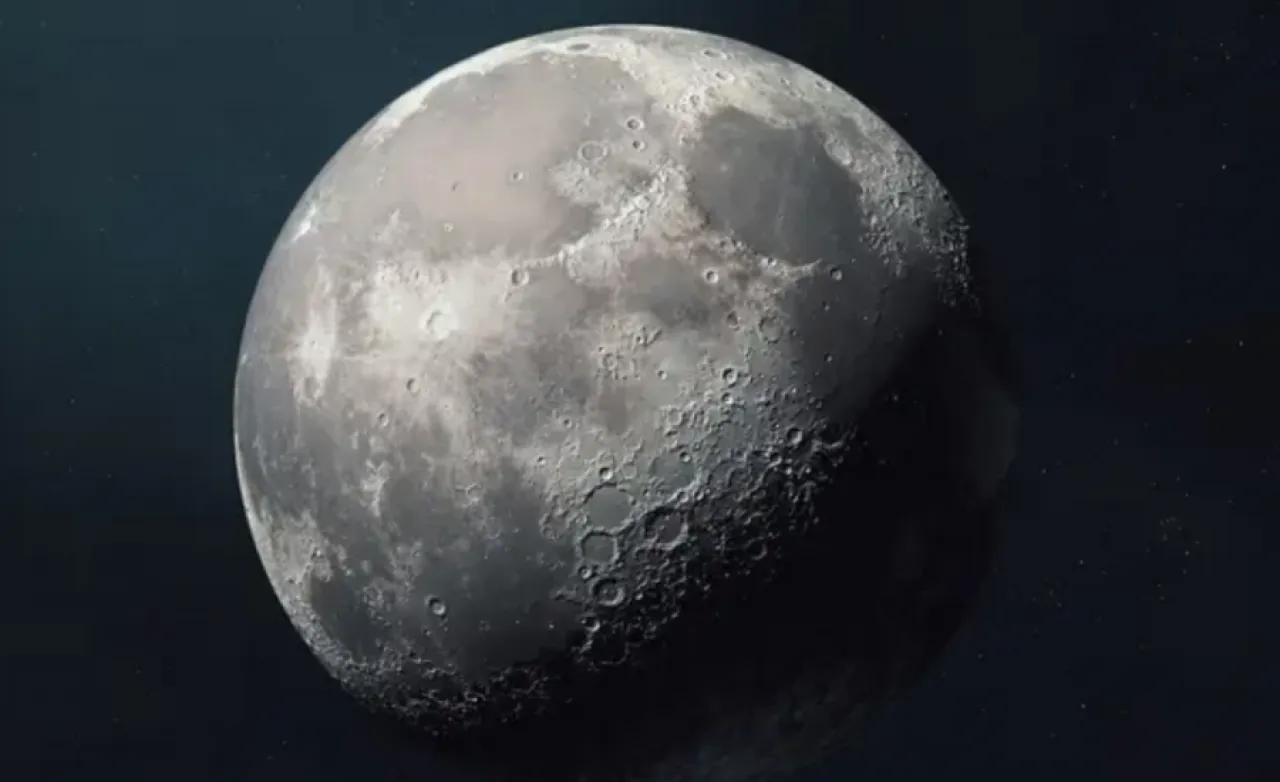
Khaberni - In a scene that seems constant through the ages, the Moon continues to change quietly, away from human eyes. A recent scientific study revealed that our neighbor is still shrinking gradually, leaving behind an increasing network of fissures that may have significant implications for future exploration plans.
Scientists from the Earth and Planetary Studies Center at the National Air and Space Museum discovered over a thousand previously unknown cracks on the Moon's surface, reinforcing evidence that the Moon continues to shrink and reform its geological structure.
The researchers believe that this phenomenon is due to the cooling of the Moon's interior over time, which gradually causes it to shrink and contract its crust, according to a report published by "Daily Mail".
Distinctive geological formations
Since 2010, scientists have observed distinctive geological formations known as "lobate scarps" in the lunar highlands, formed when the crust compresses and rock masses thrust over each other along faults, forming elevated edges.
However, the novelty of this study lies in the observation of similar cracks in the "lunar maria," the vast dark plains on the Moon's surface, where researchers have dubbed these formations as "Small Mare Ridges" (SMRs).
The lead researcher in the study, Cole Naibafer, mentioned that upcoming lunar exploration programs, such as the "Artemis" program, will provide crucial information for understanding the Moon's tectonic and seismic activity, which directly reflects on the safety of future missions.
He added that documenting this widespread spread of cracks in the lunar maria gives scientists a broader view of recent tectonic activity on the Moon, aiding in understanding its thermal and seismic history and the possibility of future "moonquakes".
Over a thousand new fractures
The team identified 1,114 new small ridges, increasing the total number discovered to 2,634. The estimated average age of these formations is about 124 million years, while the lobate scarps date back to about 105 million years, making them among the most recent geological features on the Moon's surface.
Researcher Tom Waters, who had discovered the first of these cracks in 2010, noted that the new findings complete the global picture of a dynamic Moon that is still changing.
Despite the scientific importance of the discovery, researchers warn that the prevalence of these edges could pose a risk to the infrastructure of any long-term human presence on the Moon, as shallow moonquakes could potentially affect structures and equipment.
These warnings gain special significance in light of NASA's plans to return astronauts to the Moon's surface by 2028 as part of the "Artemis 3" mission, making understanding lunar seismic activity a matter of safety as much as it is a scientific matter.