Khaberni - The Hashemite University achieved a remarkable global accomplishment by securing the first and second positions in the "International Gaza Reconstruction" competition, within the category of architectural design projects, demonstrating its leadership and the creativity of its students in the fields of engineering and architecture.
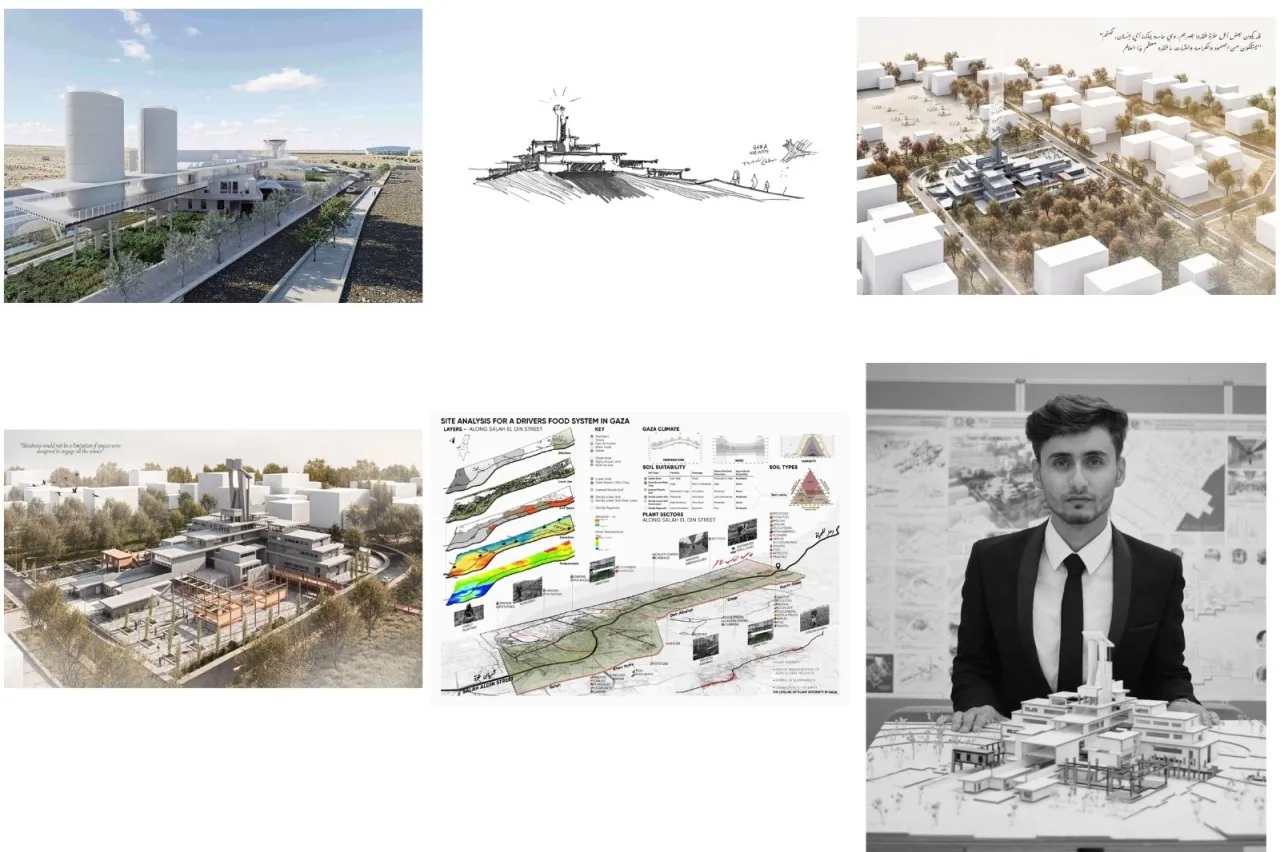
The Agricultural Academy and Seed Bank project in Gaza won the first place and was designed by student Heba Sadeq Al-Lwama under the supervision of Dr. Shaher Rababa (may God have mercy on him) and Dr. Rama Al-Rabdi. The project received a monetary prize of 1750 euros, where the jury praised the idea and described the project as a "resistance line".
The second place went to the project of the Center for the Visually Impaired, designed by student Marwan Yousif Abu Murar under the supervision of Dr. Ahlam Sherif. The project won a monetary prize of 1000 euros, and the jury described the project as "light after war" in appreciation of its humanitarian message and future vision.
Student Al-Lwama's project stood out with its ambitious multilayered architectural approach integrating food security, biodiversity conservation, and community education into a comprehensive vertical system, utilizing multiple basements to establish a climatically controlled seed bank. The upper levels host innovative agricultural and aquatic systems that transform the arid climate into a productive resource. Additionally, the design demonstrated exceptional technical and strategic maturity through precise geophysical analysis that guides architectural formation, creating a symbolic and actual resistance line linking genetic resource conservation, groundwater collection, and the educational/community axis in a linear spatial journey that embodies the intertwined narratives of resilience, survival, and renewal.
Student Abu Murar's project is distinguished by a high sensitivity to design that meets the needs of war victims with visual disabilities through a graded spatial sequence and a multidimensional sensory design relying on texture, sound, and kinesthetic experience rather than just sight, with a graded architectural mass creating a series of courtyards and diverse outdoor spaces offering multiple therapeutic environments. The design also shows a deep understanding of comprehensive rehabilitation through clear axonometric dismantling that clarifies the thoughtful functional division between therapy spaces, vocational training, housing, and community facilities, creating a dignified and enabling environment that supports the recovery journey and social reintegration of survivors".