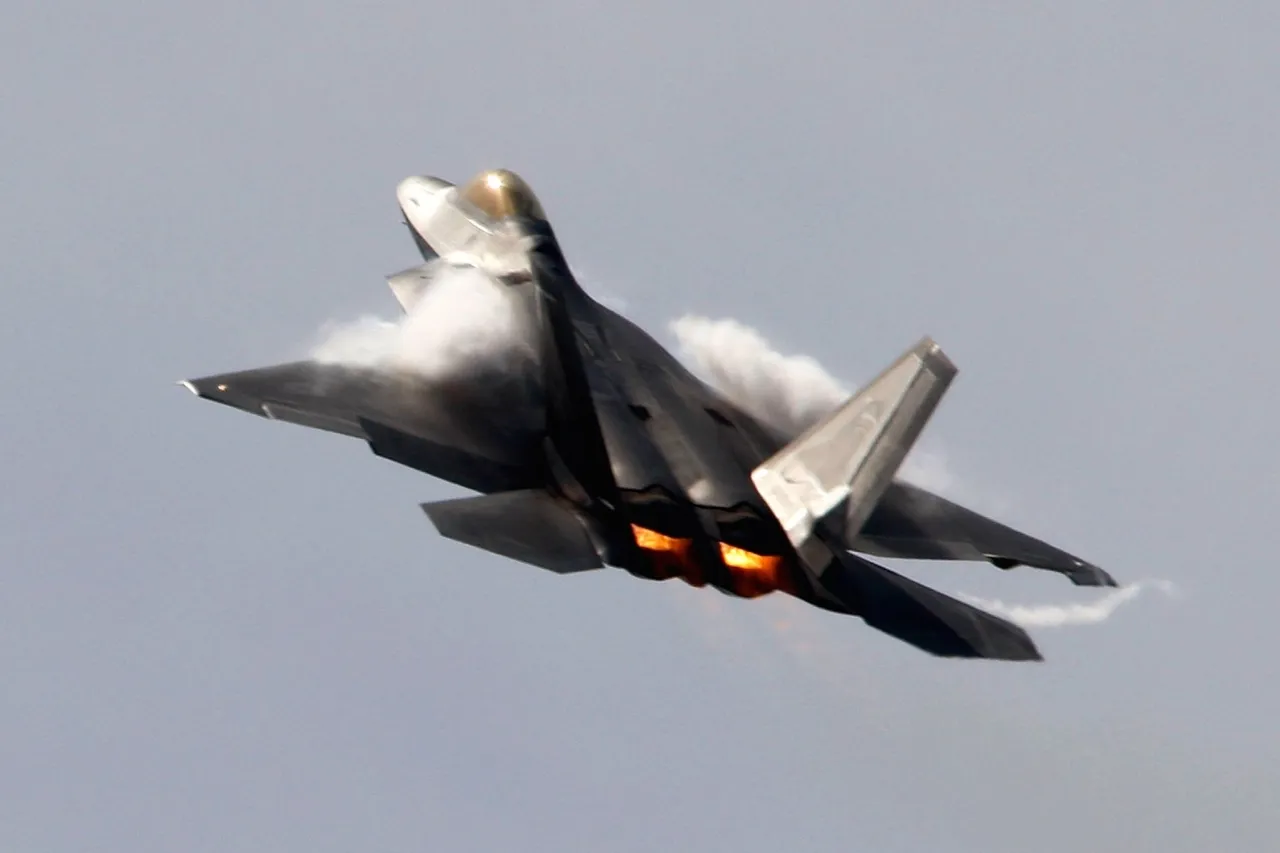
Khaberni - The "F-22 Raptor" is among the foremost pillars of American air superiority due to its advanced stealth capabilities and its ability to fly at speeds exceeding the sound barrier, alongside advanced sensor systems. American legislative restrictions on its export have been imposed to preserve the United States' qualitative military superiority.
The United States has sent a clear military signal to the region by deploying twelve F-22 Raptors at an Israeli Air Force base, paralleling rising tensions with Iran and an intensified American military presence in the Middle East. The event was not merely a logistical move but part of a broader scenario in which Washington reinforces its naval and aerial presence and repositions its combat capabilities in anticipation of all scenarios.
This step gains additional significance considering the role the same fighter played in the "Midnight Hammer" operation, in June 2025, when it escorted B-2 bombers targeting the Iranian nuclear program, and undertook air space security and protection of strategic bombers during the strike.
In recent weeks, it has become clear that the United States is not satisfied with managing the diplomatic path alone, but complements it by showcasing the most advanced instruments of power in its arsenal. In this context, the arrival of a complete squadron of "F-22s" takes on special significance, given that this aircraft represents the spearhead in the American aerial superiority system, and it is a platform that Washington prohibits exporting to any other country to maintain its qualitative superiority.
Choosing this particular model raises more than one question. What do we know about the fighter that remains exclusive to the U.S. Air Force? Why is its deployment outside American territory such a notably significant event? What are the capabilities that make its presence in any tension area a strategic message that goes beyond military dimensions to equations of deterrence and aerial dominance?
"F-22 Raptor".. Engineering Absolute Air Superiority
The "F-22 Raptor" is not merely a fifth-generation fighter; it represents a complete military philosophy that has redefined the concept of air sovereignty in the twenty-first century. It is not a traditional combat platform relying on a single element for superiority but a system designed to merge speed, stealth, maneuverability, and sensor systems into one equation aimed at imposing control over the airspace from the very first moment of any encounter.
Within this framework, understanding the fighter's design philosophy is crucial to grasp why it’s considered the highest standard in the world of modern fighters.
Design Philosophy: Control Before Engagement
According to the official U.S. Air Force site, the "F-22" represents a comprehensive blend of stealth, supersonic flight without engaging afterburners, extreme maneuverability, and integrated avionics. The Air Force describes it as "a huge leap in combat capabilities", because it is designed to assert air superiority swiftly and over long distances, to eliminate any threat that tries to prevent U.S. forces from accessing the theater of operations.
This concept revolves around deciding the battle before it actually begins, through detecting, tracking, and targeting the threat before the fighter itself is detected.
Stealth and Engagement Range Reduction
The U.S. Air Force mentions that the stealth technologies in the "F-22" significantly reduce the engagement envelopes of ground-to-air missiles and limit opponents’ ability to track or target it. Stealth here is not limited to radar detection difficulty but also includes reducing the enemy's reaction time, providing it with an advantage of initiative.
The combination of stealth and continuous supersonic flight also reduces engagement ranges for hostile systems and enhances the tactical surprise element in defensively protected environments.
"Supercruise".. Supersonic Speed without Depletion
The aircraft is equipped with two "Pratt & Whitney F119-PW-100" engines, each generating a thrust in the 35,000-pound class. This allows it to fly at speeds exceeding Mach 1.5 without using afterburners, a feature known as "Supercruise".
According to the U.S. Air Force, this capability expands the operational range in terms of speed and distance, and gives the plane faster deployment and longer endurance compared to fighters that need to engage afterburners to reach supersonic speeds, leading to high fuel consumption and reduced operational range.
Maneuverability and Kinetic Superiority
The design of the "F-22" relies on advanced aerodynamic engineering, high thrust-to-weight ratio, and two-dimensional thrust vectoring technology. The U.S. Air Force confirms that this combination provides it with maneuverability that surpasses all current and expected aircraft.
The design underwent extensive testing during the development stages to ensure achieving the highest possible performance, which makes it capable of excelling in close engagements as well as in long-range battles, while retaining its stealth advantage.
Avionics and the First Strike Opportunity
Lockheed Martin, the manufacturer of the aircraft in collaboration with Boeing, explains that the core of the "F-22's" superiority lies in integrating advanced sensor systems with aviation electronics and an armament system in one integrated system.
The company notes that this integration provides the pilot with the "first strike" opportunity, i.e., the ability to detect, track, and target a threat before it is detected. Displaying data in a unified operational image reduces the pilot's cognitive load and increases decision-making speed, transferring the battle from a reactive phase to a proactive phase.
Multiple Combat Capabilities
In air superiority missions, the "F-22" internally carries six "AIM-120" radar-guided missiles and two "AIM-9" infrared-guided missiles, in addition to a "M61A2" 20mm cannon with 480 rounds. Carrying weapons internally preserves its low radar signature and ensures continuing stealth characteristics while prepared for engagement.
In air-to-ground missions, the U.S. Air Force confirms that the aircraft holds significant capability in attacking surface targets, as it can carry two internally "GBU-32" 1,000-pound precision-guided bombs, with its electronics supporting navigation and precise weapon delivery, with future capabilities expandable through radar updates and adding small-diameter bombs.
Relying on Operational readiness
The U.S. Air Force indicates that the "F-22" was designed to be more reliable and easier to maintain than any other fighter in history, reducing the need for personnel in maintenance tasks and increasing operational efficiency.
The aircraft entered operational service for the first time in December 2005, and as of August 2022, there are 183 aircraft in service, with a cost estimated at about 143 million dollars per unit.
Export Ban and Preserving Qualitative Superiority
The United States prohibits exporting the "F-22" to any other country, including its closest allies, under a legislative amendment known as the "Obey Amendment", included in the Defense Department Appropriations Act of 1998, which prevents the use of any federal funds to approve sales of the aircraft or license its export.
The production line for the aircraft was closed in 2011 after manufacturing a total of 195 aircraft, including 187 operational aircraft, a decision linked to the high cost and shift towards other programs like the "F-35".
The export ban is not only linked to cost but also the sensitivity of the technology involved in the aircraft, especially stealth technologies, integration of sensor systems, and advanced propulsion engines.
In this sense, the "F-22" is not just an advanced fighter aircraft but an integrated system designed to impose comprehensive air control and reduce the opponent's ability to respond from the very first moment. When Washington chooses to deploy it in a tense region, the message is not only technical but also a top-tier strategic one.