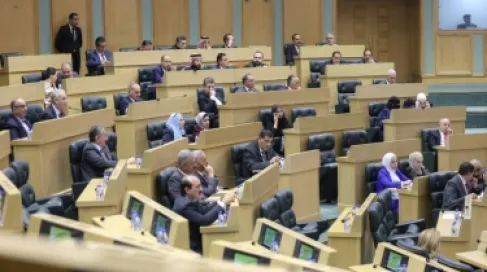
Khaberni - The House of Representatives approved, by a majority of votes, thirteen articles from the draft insurance contracts bill for the year 2025, as submitted by the government, out of a total of 101 articles in the project.
The council also approved, during a legislative session held on Wednesday under the chairmanship of the council's president Mazen Al-Qadi and the attendance of members of the government team, the articles from the thirteenth to the twenty-fifth.
The House of Representatives had previously approved, during a session held last Monday, twelve articles (from the first to the twelfth) of the bill.
During the session, the House of Representatives approved a proposal made by MP Zaki Bani Melhem concerning the thirteenth article of the bill, which states: "If the insured fails to pay the insurance premium and 30 days have passed since the notification of payment due, the insurer may request the cancellation of the contract with compensation if warranted."
The council also approved an amendment made by the Parliamentary Economic and Investment Committee to paragraph (d) of this article, where it approved "after adding the phrase (completely or partially, as appropriate) after the word (compensation)," thus approving the article in the form presented by the government, thereby aligning with the decision of its parliamentary committee.
The Minister of State for Political and Parliamentary Affairs, Abdulmunem Al-Oudat, emphasized that achieving justice and balance between the parties of the insurance contract is everyone's duty, stating, "This article is an important core in the law, establishing the principle of balance and rights between the parties."
He explained that "we do not legislate in favor of one part at the expense of another, nor do we favor one part over another," noting the obligations of the insured and what is required of them before and after the occurrence of the case when the damage occurs, and what is needed from them to avoid the realization of the damage.
Al-Oudat confirmed "the judiciary is the decider in proving the damage and on it the compensation is based," pointing out that the bill "represents an important regulatory shift in the insurance sector, as it enhances contractual stability, justice between contract parties, consumer insurance protection, clarity of obligations and responsibilities, and the updating of the legal environment for the insurance sector in line with modern standards and minimizing judicial disputes resulting from text ambiguities."
This article, as stated in the bill, provides: "a- It is incumbent upon the insured, before the realization of the insured risk, to take reasonable and appropriate precautions to preserve the insured goods and protect them from loss or damage, and to act towards those goods as if they were uninsured. b- The insured or the beneficiary must, upon the realization of the insured risk, do the following: 1- Take necessary actions and precautions to prevent exacerbation of the loss or damage. 2- Enable the insurer or any person authorized by them to inspect the insured goods and examine them. 3- Provide the necessary samples to calculate the value of the losses. c- The insured, or insured party or the beneficiary, in accordance with the case, must comply with all explicit and implicit terms and conditions and warranties of the insurance contract. d- Non-compliance with the provisions of paragraphs (a) and (b) of this article results in the loss of the right to compensation, unless the insured or the beneficiary proves that such non-compliance had no effect on the occurrence of the risk or on the exacerbation of it or in determining the amount of damage."
Regarding the fourteenth article, as included in the bill, it was approved by the council as received from the government, thus complying with the decision of the "Parliamentary Investment Committee."
This article states: "a- It is incumbent upon the insured, the insured party, or the beneficiary, as appropriate, to notify the insurer of the realization of the insured risk and provide him with the documents within the period agreed upon in the insurance contract. b- Non-compliance with the terms of paragraph (a) of this article does not result in the loss of the insured, insured party, or beneficiary's right to compensation under the insurance contract. c- If damage is incurred by the insurer due to non-compliance with the terms of paragraph (a) of this article, they may claim compensation commensurate with the damage inflicted."
About the fifteenth article, as included in the draft bill, it was approved by the House of Representatives as it came from the government, thus supporting its parliamentary committee's view.
This article states: "The insured must relinquish ownership of the insured goods to the insurer in exchange for receiving compensation in the event of the total loss of the damaged goods."
Regarding the sixteenth article, included in the draft bill, it was approved by the council as received from the government, thus aligning with the decision of the "Parliamentary Investment Committee."
This article states: "The insurer must pay the insured or the beneficiary the financial compensation or benefit agreed upon when the insured risk is realized or the specified event occurs, even if it is caused by the non-intentional error of the insured or the beneficiary or those under the control of the insured or their dependents."
Concerning the articles from the seventeenth onwards, they were approved by the House of Representatives as received from the government, thus aligning with its parliamentary committee's decision.
The seventeenth article states: "a- The insured is not obligated to disclose to the insurer at the time of contracting the insurance any information or data that: 1- Reduces the likelihood of the insured risk occurring. 2- The insurer should know by virtue of their business or had previously known. 3- The insurer waives their right to know, whether explicitly or implicitly. 4- Relates to risks excluded from the insurance contract unless explicitly inquired about by the insurer. 5- The insured is unaware of. b- All actions taken by a person conducting insurance work on behalf of the insurer are binding on the insurer even if the agent exceeds the limits of the agency contract concluded with them, and the insurer has the right to recoup any damages incurred from the agent."
The eighteenth article states: "The insured, insured party, or the beneficiary may not make or execute a settlement with a third party responsible for the loss or damage without the insurer's consent, unless it is in the insurer's interest."
The nineteenth article states: "The insurance interest must be legitimate and must be proven to benefit the insured or the beneficiary or both together at the time of contracting the insurance or upon the realization of the insured risk, as the case may be, otherwise the contract is void."
The twentieth article states: "The insurance interest for the insured in personal insurance contracts involves not exposing the insured to the insured risk, and it is required to be present at the time of the contract's inception, and it is not required to be present when the risk is realized."
The twenty-first article states: "The creditor has an insurable interest in the life insurance of their debtor up to the amount of the debt."
The twenty-second article states: "a- The insurance interest for the insured or the beneficiary in property insurance and liability insurance involves not exposing the subject of insurance to the insured risk, and it must be present both at the time of the contract's inception and at the realization of the insured risk; its dissolution results in the automatic annulment of the insurance contract. b- It is permissible for the insurance interest to include the insured's interest in lost earnings resulting from the realization of the insured risk provided this is stipulated in the insurance contract. c- The insurance interest is transferred to the general successor unless otherwise agreed."
The twenty-third article states: "In the insurance of goods, the insured may enter into the insurance contract for the account of whoever has an insurable interest in those goods, whether they are designated in the contract or eligible to be designated at the time the insured risk is realized."
The twenty-fourth article states: "a- The owner of the goods has an insurable interest in insuring what they own of goods, even if a third party holds a real or personal right over them. b- The holder of the real or personal right has an insurable interest in insuring the item or money to which that right relates."
The twenty-fifth article states: "a- Insurance is not permissible unless the insured risk is likely to occur. b- In the event of multiple or successive risks resulting in the realization of the loss, the risk considered most impactful in causing the loss is recognized, even if it was not direct unless agreed otherwise."
It should be noted that the House of Representatives approved on November 24th last year the referral of the draft insurance contracts bill for the year 2025 to the Parliamentary Economic and Investment Committee, which in turn approved it on the 4th of this month.
The cabinet had approved, on November 5th last year, the draft law aimed at enhancing transparency and justice in the relationship between insurance companies and citizens, in addition to protecting the rights of the insured by obliging insurance companies to respond to requests within only 10 days and prohibiting the imposition of unfair or vague terms.
It contributes to stimulating investment and supporting the national economy by providing a developed legislative environment, alongside combating negative phenomena such as purchasing "crutches" and legally criminalizing them, and imposing clear penalties.
The draft law aims to enhance confidence in the insurance sector and achieve the principle of fair compensation that protects the rights of all parties, ensuring that the terms of contracts are clear, simple, and interpreted in favor of the insured in any ambiguity.
It also emphasizes the right to fair compensation that equals the actual loss, with a maximum limit of the agreed insurance amount, while prohibiting the imposition of vague or unfair terms that lead to the denial of compensation to the citizen.
"Insurance Contracts" establishes clear rules that regulate the stages of the insurance process, beginning from the stage of submitting the insurance application to the conclusion and execution of the contract, emphasizing the disclosure of general and specific terms and conditions, coverages and exclusions, and the essential data in the insurance contract as a minimum, such as the insured interest, the nature of the insured or insured against risks, the insurance amount and premium, and the date of contract conclusion, its effective date, time, and duration.
Under the draft law, legal provisions are laid down that take into account the specific nature of the insurance contract in general, and the specificity of some types of contracts in particular, such as insurance contracts on persons, property, life, against fire and other property damages, medical insurance, marine insurance, and reinsurance contracts.
"Insurance Contracts" specifies the obligations arising for both parties of the insurance contract and clarifies the legal provisions resultant from its termination based on justified reasons before the expiration of its duration and the obligations that ensue.
It also determines the statute of limitations that prevents hearing of lawsuits arising from the insurance contract, the instances in which this statute of limitations is interrupted, and the date on which the right for the insurer and the third party to initiate lawsuits arises.