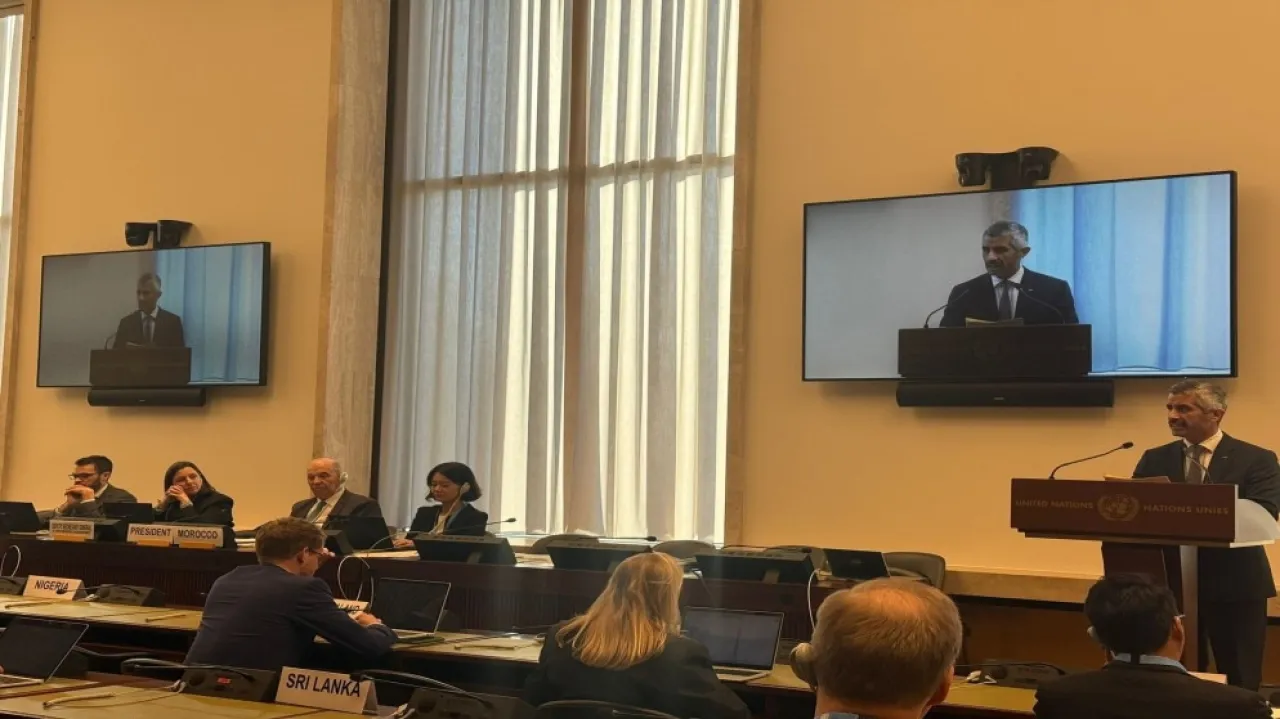
Khaberni - The permanent representative of Jordan to the United Nations in Geneva, Ambassador Akram Harahsheh, confirmed that "the security of the region is indivisible, and that any escalation in any area reflects negatively on regional and international peace", emphasizing that military solutions will not achieve the desired security, and that the only way lies in comprehensive political solutions based on dialogue, negotiation, and respect for the sovereignty of states and the integrity of their territories.
This was stated during a speech delivered by Harahsheh at the high-level segment of the Disarmament Conference currently held at the Palais des Nations in Geneva, where he considered the conference as a fundamental platform for enhancing international peace and security, especially at a "critical moment the world is experiencing deep geopolitical shifts", which calls for a commitment to collective efforts to achieve a safer world.
The Ambassador stated that the Middle East faces complex geopolitical challenges threatening regional and international stability, amid increasing tensions that indicate a deterioration in stability, ongoing armed conflicts, and expanding humanitarian crises.
In this context, he emphasized that the Palestinian issue remains the core of the conflict in the region, and that achieving fair and comprehensive peace requires the establishment of an independent sovereign Palestinian state along the lines of June 4, 1967, with East Jerusalem as its capital, emphasizing the necessity to implement President Trump’s plan regarding Gaza in accordance with Security Council Resolution 2803.
* A zone free of weapons of mass destruction
Harahsheh affirmed that Jordan is committed to peace and stability, strongly supporting all efforts aimed at establishing a zone free from weapons of mass destruction in the Middle East, urging the countries of the region to join the Treaty on the Non-Proliferation of Nuclear Weapons and subject their nuclear facilities to the comprehensive safeguards system of the International Atomic Energy Agency, which enhances transparency and mutual trust.
He noted that this commitment was demonstrated in the Kingdom’s steadfast support for the conference on the establishment of a Middle East zone free from nuclear weapons and other weapons of mass destruction, where the Kingdom chaired the first session of the conference in 2019, and subsequently hosted the meetings of the working committee in Amman in 2025, reflecting its leading role in advancing this process despite challenges.
He added that the Kingdom reaffirmed, through its active participation, the implementation of the 1995 resolution as an integral part of the indefinite extension of the Non-Proliferation Treaty, calling for the participation of all regional countries, including Israel, in the international process with good faith to achieve security for all.
Regional consultations and enhancing the pillars of the treaty
Harahsheh revealed that the Kingdom hosted last month in Amman regional consultations for the parties in the region, with broad participation from Arab and regional countries, alongside officials from the United Nations and the International Atomic Energy Agency and international experts, where the consultations focused on coordinating positions ahead of the 2026 Review Conference, and enhancing the three pillars of the treaty: disarmament, non-proliferation, and peaceful uses.
Jordan's delegation emphasized the inalienable right of all countries to develop nuclear research, production, and technology for peaceful purposes under Article IV of the Non-Proliferation Treaty, stressing that the exercise of this right must be fully compliant with legal obligations and agreements concluded with the Agency. He warned that the existence of any undeclared nuclear facility or unregulated materials in the Middle East poses a threat to regional peace and security, fuels an arms race, and undermines trust-building efforts.
* Aqaba meetings and humanitarian initiatives
In facing contemporary security challenges, Harahsheh mentioned that the Kingdom continues to lead the "Aqaba meetings" launched by His Majesty King Abdullah II in 2015, explaining that their most recent meeting was held at the Royal Sandhurst Military Academy in the United Kingdom, focusing on airspace management and the use of drones, with an emphasis on enhancing international cooperation, exchanging expertise, updating legislation, and ensuring safe and effective use of these technologies in facing shared security challenges.
He also stated that the Kingdom leads, in cooperation with Brazil, France, China, Kazakhstan, South Africa, and the International Committee of the Red Cross, the global initiative to renew the political commitment to international humanitarian law, with plans to hold a high-level conference on humanity in war in Jordan in 2026.
Harahsheh confirmed that the Disarmament Conference remains a vital tool to address the current stalemate in multilateral negotiations, calling for the adoption of a balanced work program, commitment to international treaties, such as the Nuclear Non-Proliferation Treaty, the Chemical and Biological Weapons Convention, and ensuring the protection of civilians in accordance with international humanitarian law.
He noted that Jordan participated with Australia and a group of countries in presenting the ministerial declaration on the protection of humanitarian workers and the unimpeded delivery of humanitarian aid.
He concluded by affirming that the current geopolitical tensions have revealed the interconnectedness of security interests and the importance of multilateral action, renewing that Jordan will remain an active partner in these efforts, committed to the principles of peace and international cooperation, supporting all initiatives that enhance regional and global security, urging all parties to prioritize the interests of the people above narrow considerations and work together towards a world free from nuclear threats and mass destruction.