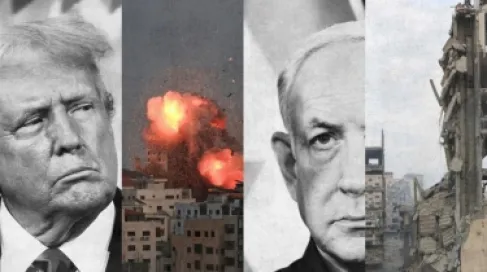
Khaberni - While optimism increases about the possibility of the United States and Iran reaching an agreement regarding the nuclear program, experts see that the chances of war still strongly exist with Israel's insistence on thwarting the ongoing negotiations.
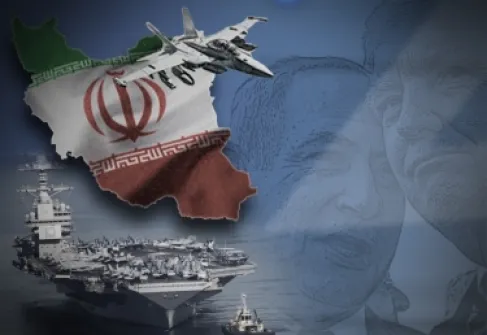
US and Iranian officials have confirmed progress during the latest round of negotiations, which may end with reaching a deal, but this has not prevented the United States from continuing to mobilize its forces in the region.
Statements from both sides do not hide the possibility of negotiations failing at any moment, as Americans continue to talk about red lines set by President Donald Trump, while Iranians repeatedly affirm that they will not accept discussing certain matters.
During the negotiation round held in Geneva this week, both parties reached what the Iranian Foreign Minister Abbas Araghchi called principal guiding principles that may soon allow the drafting of a potential deal.
However, a US official told "AP News" that the negotiations have made tangible progress, and that Tehran has proposed suspending uranium enrichment, which does "not meet Trump's ambitions who wants a complete zeroing of enrichment."
The official said - it could be possible to reach an agreement if Iran sets specific mechanisms to monitor its nuclear activity, despite another US official confirming to "Axios" that the likelihood of military action against Iran in the coming weeks stands at 90%.
Trump felt frustrated, although those around him warned him of the dangers of war, which the official said was "widely imminent."
Unsolvable Disputes
Currently, the dispute revolves around the level of enrichment that can be agreed upon after both parties agreed to surpass the issue of zeroing enrichment, as stated by the head of the Iranian Journalists Union, Ma Shaa Allah Shams al-Waezin, who sees that Tehran may accept the percentage desired by Washington, which ranges between 1.6 to 3.6.
Nevertheless, pessimism still prevails in Iran due to the United States continuing to mobilize its forces in the region because this makes it negotiate on the brink of war, reducing the trust in statements from Washington, as confirmed by Shams al-Waezin on the program "Course of Events."
The positive results achieved by the latest round of negotiations do not deny the truth of the dispute regarding zeroing enrichment, which former Deputy Assistant Secretary of Defense Haino Klink says Washington is committed to.
In addition to zeroing the enrichment, Klink says the United States is committed to discussing Tehran's missile program and its support for proxies in the region, because they are red lines set by Trump.
These red lines will be the subject of long debate between the parties -in the opinion of the former US official- and reaching an agreement on them will be difficult, meaning that resorting to the option of war is possible, especially with the continued military mobilization in the region, specifically the air forces.
Perhaps these red lines are what make Israel convinced that the war is inevitable, and that these negotiations will ultimately fail because Washington has made the decision for war, which has become a matter of time, as said by the Israeli affairs expert Muhannad Mustafa.
Israeli preparations for the possibility of a joint attack on Iran are in full swing, and some Israelis fear that Tehran might preempt this attack by striking Israel, a step Benjamin Netanyahu wants, according to Mustafa.
Netanyahu - called for by the International Criminal Court – sees war as the only option, and refuses to reach an agreement even if it includes dismantling Iran's nuclear and missile programs, as stated by the spokesperson.
This is what drives Netanyahu towards thwarting these negotiations by convincing Americans that Iranians cannot be trusted and are only trying to buy time, as Mustafa says, confirming that Israel is convinced that the war is coming inevitably, and that the disagreement revolves around its scale and comprehensiveness compared to the previous war.
Shams al-Waezin did not disagree with this argument, affirming that Iranian leaders know that the United States is doing all these things on behalf of Tel Aviv, but he believes that the United States will ease its red lines, as the outbreak of war might end the achievements it made in the region during the past two years, as Netanyahu wants to enhance them.
Thwarting Israeli Plans
Dr. Mahjoub al-Zuweiri, an expert on Middle East policies, differs from the previous narrative by saying that Iran is prepared to make greater concessions than those it offered to Barack Obama, because it knows that destroying its regime is the goal of all this.
Even Washington's talk about supporting proxies in the region is just a form of stubbornness, because these proxies have become weak and Iran is no longer able to support them as before, as al-Zuweiri says.
It is possible -according to the speaker- that Iran will accept transferring enriched uranium abroad, but the problem will be raised regarding the location where this uranium will go and the timeframe for its retrieval.
Despite this high readiness of Iran to offer concessions, it is still laying many alternative plans, because it is trying to thwart the opportunity for Israel to preserve its political existence in the region, according to al-Zuweiri.
The Iranian government spokeswoman Fatema Mahjarani assured that Iran follows the path of negotiation and defense readiness simultaneously, aiming to protect the country's interests and national security, and continues the negotiations with its armed forces in full readiness, taking necessary measures.