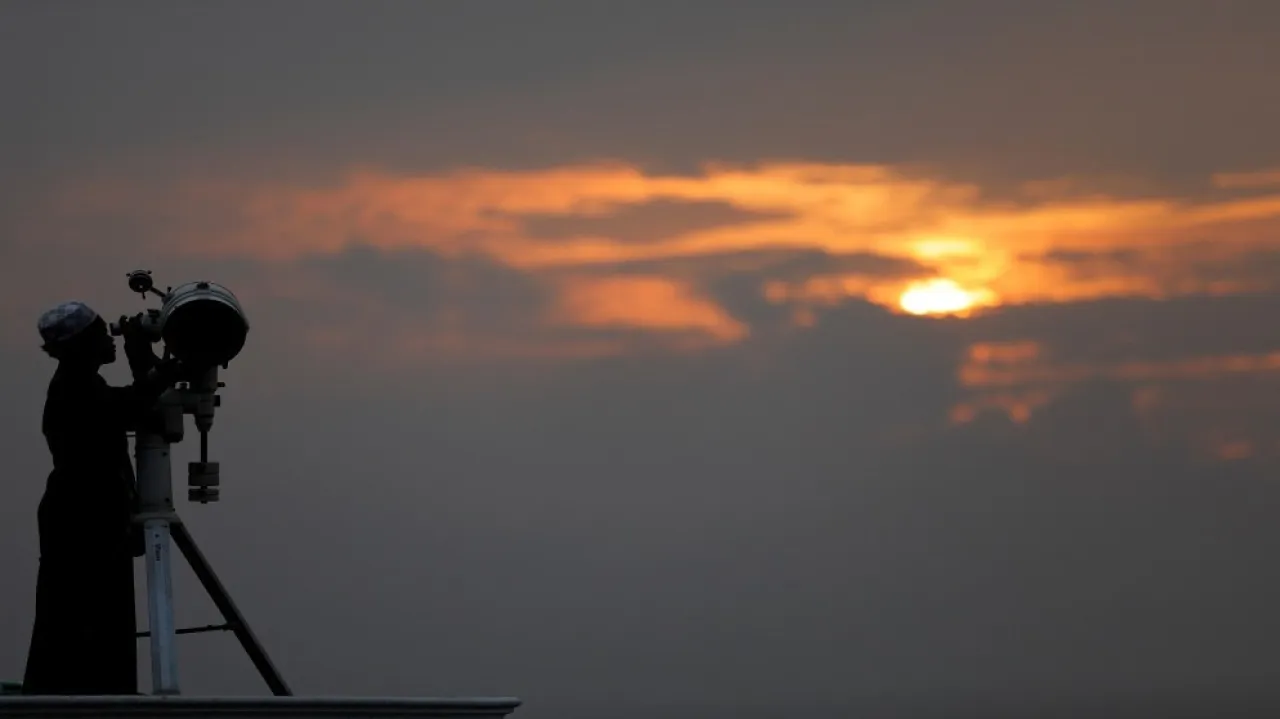
Khaberni - Ammar Al-Sakaji, president of the Jordanian Astronomical Society, confirmed the inability to sight the crescent of Ramadan in Jordan and most of the Arab and Islamic world on Tuesday evening, explaining that "no properly documented image of the crescent had been recorded after sunset on Tuesday," which was fully in line with astronomical calculations and approved observational standards.
Al-Sakaji clarified that this inability means that Wednesday is the last day of Sha'ban, making Thursday the first day of Ramadan for more than 90% of the Islamic world, including: Jordan, Egypt, Syria, Oman, Algeria, Tunisia, Libya, the majority of Iraq, Turkey, Iran, Malaysia, Singapore, Brunei, Indonesia, Japan, Azerbaijan, Europe, Thailand, Kazakhstan, Kyrgyzstan, most regions of the United States, along with Morocco, Pakistan, India, and Bangladesh, where the sighting of the crescent will be attempted on Wednesday evening, making Thursday the first day of the holy month.
The Jordanian Astronomical Society will observe the crescent on Wednesday evening from the Arab University of Amman, where it will be photographed, documented, and published. The crescent appears thicker as its lunar age after conjunction increases, moving the moon further anglewise from the sun and increasing its illumination percentage, after the sighting night on Tuesday, which had an elongation of about one degree, the moon moved to an angle greater than the sun (about 13 degrees).
Al-Sakaji explained that "technically, this means that the crescent surpassed what is known as ('Danjon Limit') estimated at about 7 degrees, which is the theoretical minimum for the formation of a visible crescent due to the effects of lunar surface topography and light scattering, thus making a wider part of its illuminated hemisphere visible."
He added, "As elongation increases, the surface brightness intensity of the crescent increases and its arc width widens, visually transforming within just 24 hours from a barely visible thin thread to a clearer, thicker arc."
Al-Sakaji pointed out that "the moon stays longer after sunset and rises further above the western horizon, gradually emerging from the twilight glow and from the scattering effect in the lower layers of the atmosphere," noting that the decrease in light scattering intensity and improved contrast against the sky background make the crescent appear visually clearer and thicker, even though the illumination percentage remains relatively small.
He clarified that "the difference between Tuesday evening and Wednesday evening might appear significant to observers, although the physical change in illumination occurs gradually and systematically based on the Earth-Sun-Moon dynamic system and its regular movements."
Al-Sakaji confirmed that "the criterion for establishing the beginning of the month is not always linked to the appearance of the crescent or its apparent thickness, but by establishing its sighting on the evening of the 29th of the Hijri month. If the crescent values that day are below the limits that allow for its sighting, and it is not seen, then the following day completes the month, and the crescent appears elevated and relatively larger, as will occur on Wednesday evening."