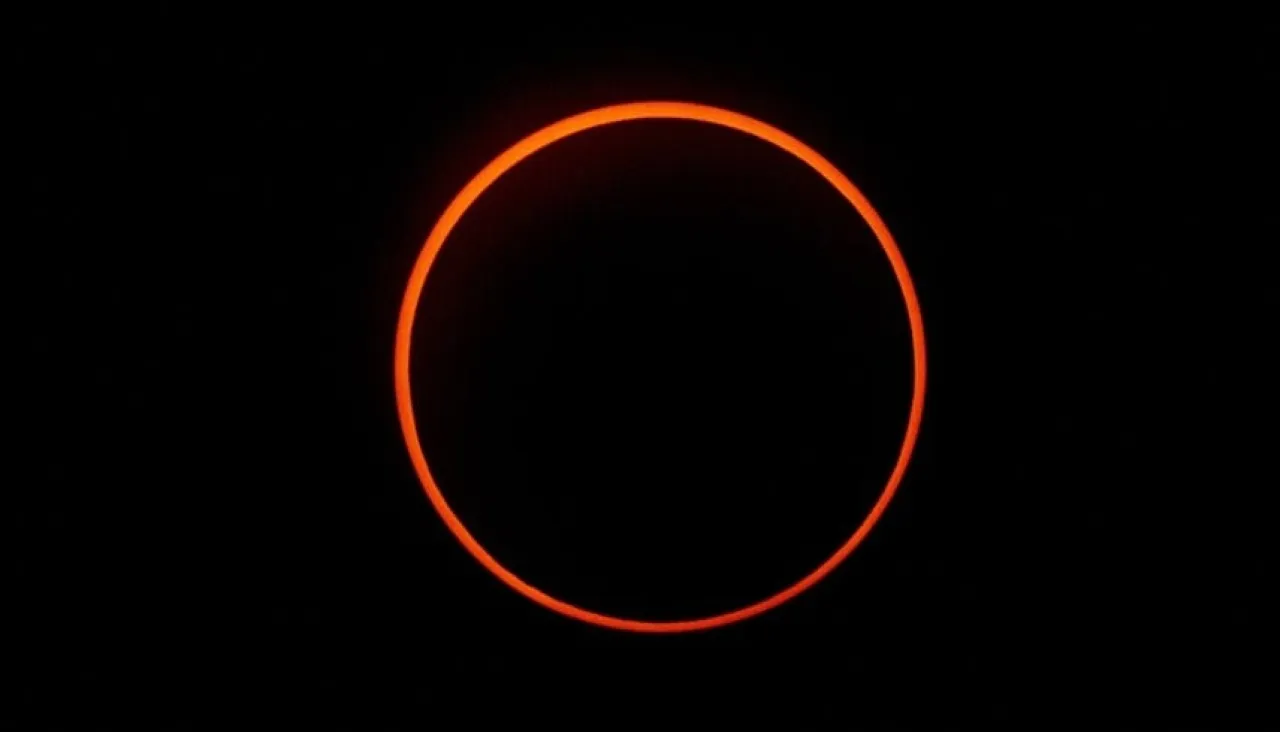
Khaberni - The eyes of millions of people in various parts of the world today, Tuesday, February 17 (February), turned to the sky that embraces an exciting astronomical phenomenon called the annular eclipse or what is known as the "ring of fire," which is considered the first in the year 2026.
In this context, scientists believe that a solar eclipse represents not only an exceptional astronomical event for humans but also a rare environmental experience for living creatures. The passage of the moon between the sun and the earth leads to a sudden change in light and temperature, creating conditions that temporarily mimic the onset of darkness, according to "Times of India".
Animals stop moving
Experts at the "US Fish & Wildlife Service" confirm that animals rely heavily on natural light to regulate their daily activity patterns. Therefore, the sudden decrease in lighting during the eclipse may prompt them to switch to nocturnal behaviors, such as stopping movement or getting ready to sleep.
Researchers note that the eclipse provides scientists with a rare opportunity to study wildlife in unusual environmental conditions. Changes in movement, sounds, and feeding behavior have been recorded in many species during previous eclipses, helping to understand how living creatures adapt to sudden changes in their environment.
The response of animals to the eclipse varies based on several factors, most notably the type of eclipse (total or annular), the natural environment, and the type of the living creature itself.
While the total eclipse usually causes the most noticeable effects due to the complete disappearance of sunlight, the annular or partial eclipse can also affect animals sensitive to light.
Changing birds' chirping patterns
Recent studies have shown that some birds, for example, may change their chirping patterns during the eclipse. It was noted that a number of species began to emit sounds similar to the "dawn chorus" as the light returned after the temporary darkness, reflecting the extent of animals' connection to natural light cycles.
Nighttime animal activity
Scientists have also documented other behaviors, including some diurnal animals returning to resting places as if night had fallen, while some nocturnal creatures may become active due to the sudden darkness. Signs of stress or anxiety, such as clustering or repetitive movement, have also been observed in some species.
Scientific reports clarify that the effects include a wide spectrum of creatures, ranging from mammals and fish to amphibians and reptiles, with recorded changes such as decreased or increased activity or changes in sound and movement patterns, reflecting the sensitivity of living creatures to environmental signals like light and temperature.
Scientists affirm that studying these phenomena not only helps understand the animals' response to the eclipse but also opens broader perspectives for studying the biological clocks of living creatures.
It should be noted that the eclipse happening today is called the "annular eclipse"; because it draws a bright fiery ring around the moon's disk; this ring is nothing but the edges of the sun's disk that refuse to appear visibly despite the moon's interception. An eclipse, in general, occurs when the moon blocks the path between the sun and the earth, temporarily obstructing sunlight.