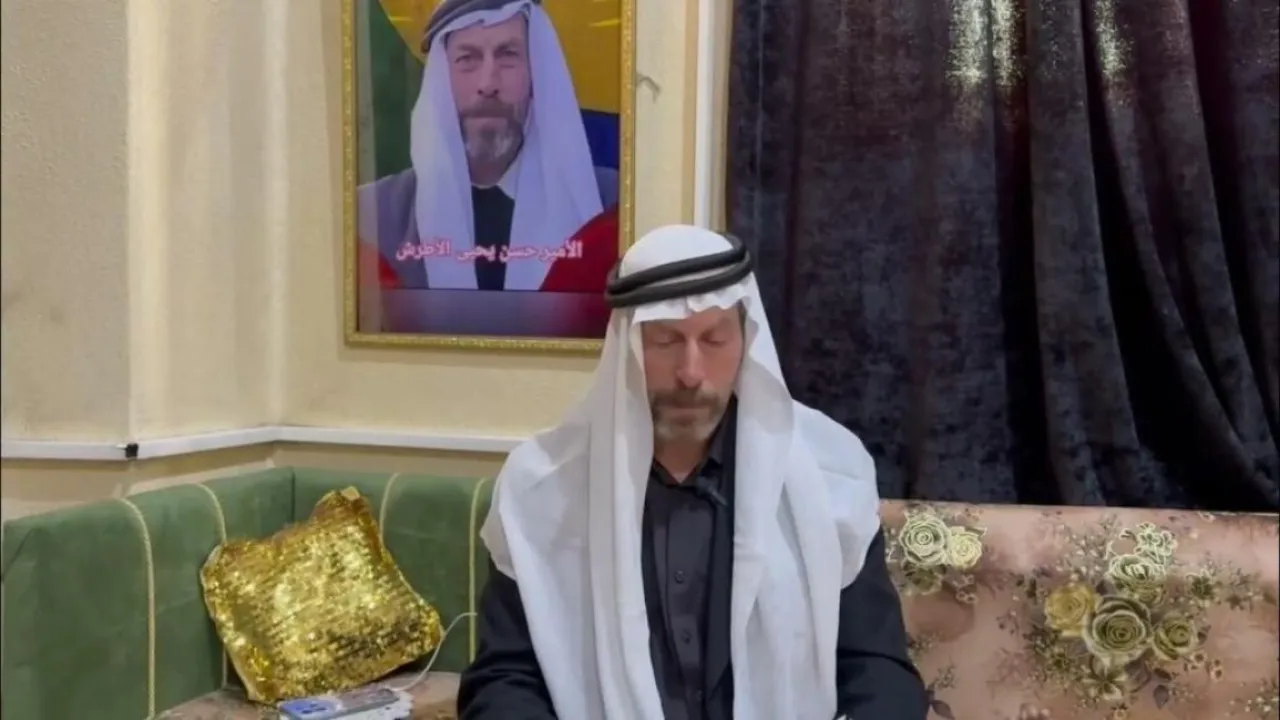
Khaberni - Prince Hassan Al-Atrash, a prominent social figure in As-Suwayda province and a traditional leader among the Syrian Druze, has arrived in the neighboring province of Daraa, in the south of the country, in a move described as "defection," potentially changing the political equation in southern Syria and pushing towards bridging the gap between Damascus and As-Suwayda to find political solutions to a crisis that has been intractable since July last year.
According to local news networks, "The departure of Prince Abu Yahya Hassan Al-Atrash, the Prince of Dar Ayya and the prominent social and traditional figure in As-Suwayda province, was secured from the southwestern As-Suwayda countryside," noting that he arrived in the neighboring province of Daraa yesterday, Monday, "in a unique precedent concerning a social figure of this magnitude from As-Suwayda."
As-Suwayda province, with a Druze majority, has been experiencing exceptional circumstances since July 2025, being outside the control of the Syrian state following widespread clashes that led to the deaths of many civilians and severe violations and displacement of others within and outside the province. Practically, the province is managed by security and military bodies associated with Sheikh Hikmat Al-Hajri, one of the Druze Sheikhs Aql, who is pushing towards severing ties with Damascus and advocates for "complete independence" of the province.
Hassan Al-Atrash is a continuation of the Al-Atrash family leadership which has played a significant role in the political scene, both in the sect and in Syria since the state was formed in 1920, and he is one of the grandsons of Sultan Pasha Al-Atrash who led the Syrian Revolt against the French about a century ago, and he holds a prominent position in the local national memory. Dar Ayya holds significant symbolism for the Syrian Druze, as it is the guesthouse of the Al-Atrash family in the village of Ayya located southwest of the city of As-Suwayda. Al-Atrash's departure from As-Suwayda is seen as a "defection" from the de facto authority represented by Sheikh Al-Hajri in the province.
Journalist and author Nours Aziz, in a conversation with "Al-Arabi Al-Jadeed," downplays the significance of Prince Hassan Al-Atrash's departure from As-Suwayda, considering this step "a media bubble nothing more," and says his departure will not change the political equation in the province, adding: "he holds no political or popular value among the Druze." In his opinion, the Syrian province has decided its relationship with Damascus, indicating that "arrangements are underway for As-Suwayda to become independent, especially in terms of security, within the framework of the Syrian state," dismissing any possibility of future military confrontations like those that occurred in July.
In this context, journalist Rayan Marouf, talking to "Al-Arabi Al-Jadeed," says that the marketing of Al-Atrash's departure is "greatly exaggerated," adding: "he is not in an official institution to describe his departure as a defection, and he was not detained or stopped in As-Suwayda for his release to be secured; instead, he left As-Suwayda for Daraa naturally," believing that Al-Atrash's departure "was coordinated with the Syrian government which has been trying for a while to demonstrate the presence of pro-government figures in As-Suwayda." He continues: "Hassan Al-Atrash may be utilized in this context, but with his departure from As-Suwayda, he lost his ability to influence within the province."
The departure of Al-Atrash from As-Suwayda comes at a time when no political solutions to the ongoing crisis in the Syrian province are feasible, as data indicates a sharp division between two currents; the first seeks to bridge the gap with Damascus represented by multiple political streams, and the second is led by Sheikh Al-Hajri who refuses any understanding with Damascus and publicly demands Israeli support for separating As-Suwayda from the Syrian homeland.
In September last year in the Jordanian capital, Amman, a regional agreement was signed to resolve the crisis in As-Suwayda, which included clauses calling for an investigation into the events of July and the prosecution of those accused of committing violations and crimes, the delivery of sufficient quantities of humanitarian and medical aid to the province, in cooperation with United Nations agencies. It also stipulated that the Syrian government deploy qualified and trained forces belonging to the Ministry of Interior along the As-Suwayda-Damascus road to ensure the safe movement of citizens and trade and to rebuild villages and properties damaged. However, Sheikh Al-Hajri rejected this agreement, as well as the investigation committee formed by the Syrian government.
Since then, the residents of As-Suwayda province have been living under difficult humanitarian conditions, with services at their minimum, in addition to unstable security conditions. Public security forces left As-Suwayda in the middle of last year, except for villages in the western and northern countryside controlled by local factions affiliated with the Syrian state. Commenting on Al-Atrash's departure from As-Suwayda, researcher Adham Masoud Al-Qaq, in a conversation with "Al-Arabi Al-Jadeed," hopes that Hassan Al-Atrash's return to Damascus will positively reflect on the general scene in As-Suwayda, adding: "the full contours of the event have not yet become clear," and points out that As-Suwayda province is experiencing a division between two currents: the first represented by Al-Hajri who has relations with Israel and with remnants of Assad's regime and drug dealers,” adding: "This current has a significant influence due to the support provided to it from Israel and other countries. He continued: The second current is the national current that is growing significantly in As-Suwayda and believes in Syrian unity and rejects all calls for partition."
In the opinion of political analyst Bassam Sulaiman, speaking to "Al-Arabi Al-Jadeed," the departure of Al-Atrash "is a result of the situation prevailing in As-Suwayda today, which is homogeneous and involves rebellion against traditional norms that brought together remnants of Assad and drug dealers," adding that "Al-Hajri broke all the traditional systems of political consensus in As-Suwayda." Sulaiman sees Al-Atrash's departure as "a shock to the separatist proponents and may encourage others," adding: "Al-Hajri's project has begun to fail popularly."