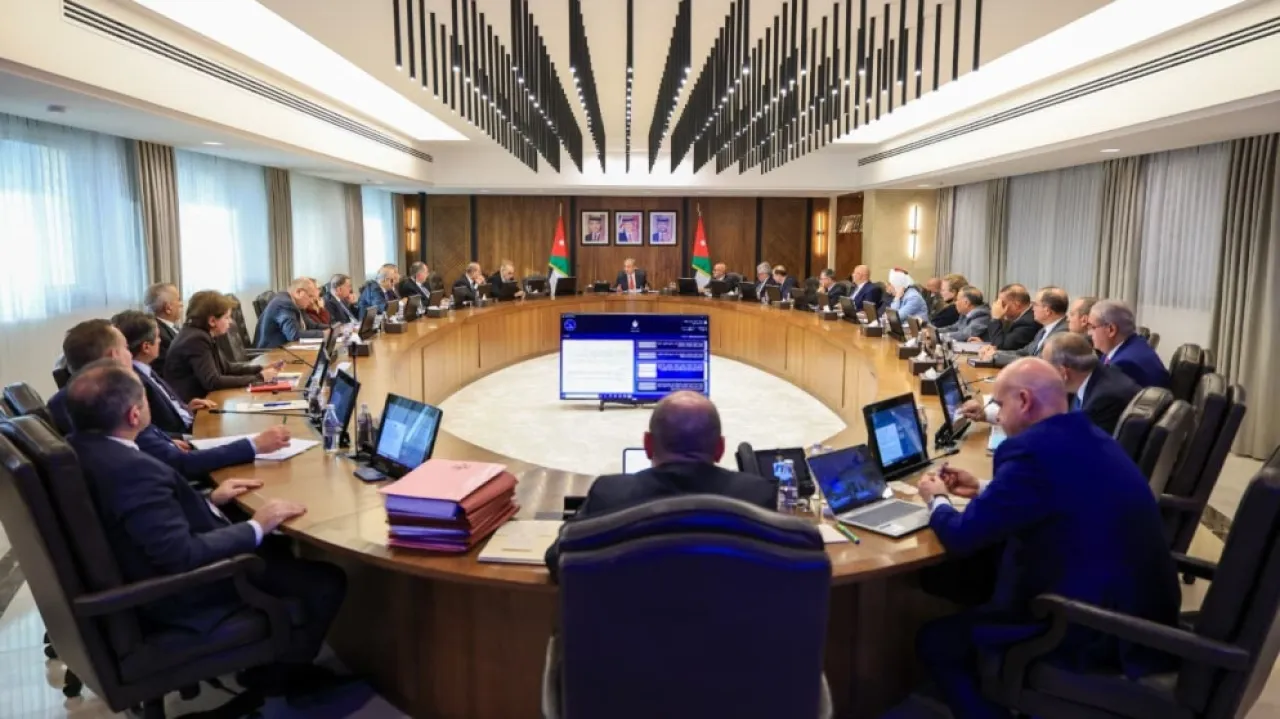
Khaberni - The Council of Ministers decided in its session held today, Sunday, chaired by Prime Minister Dr. Jafar Hassan, to pay arrears totaling 125 million dinars for the benefit of several entities, bringing the total amount paid by the government over the past weeks to approximately 275 million dinars; within the framework of the government plan to settle accumulated arrears from previous years.
The decision taken by the Council of Ministers today included paying accumulated arrears of five years on ministries and official government institutions in favor of electricity distribution companies, totaling approximately 60 million dinars.
The decision also included paying overdue amounts owed by Yarmouk Water Company amounting to 10 million dinars and by the Water Authority to pay 25 million dinars, in favor of electricity distribution companies; with the Authority committing to paying its due bills in monthly installments.
The Council also decided to pay accumulated arrears over the years amounting to 30 million dinars for the benefit of printing presses tasked with printing textbooks and curriculum for the Ministry of Education.
Last week, the Council of Ministers decided to pay dues and arrears to public universities exceeding the value of 100 million dinars, preceded also by the settlement of debt of King Abdullah University Hospital worth 40 million dinars, and the University of Jordan Hospital worth 10 million dinars.
* Approval of the draft law amending the real estate ownership law that will contribute to resolving outstanding issues from years involving thousands of properties.
Within the framework of the legislation and decisions relating to improving services provided to citizens, the Council of Ministers approved the draft law amending the Real Property Ownership Law for the year 2026; in preparation for sending it to the House of Representatives to proceed with the approval procedures according to the constitutional principles.
The draft law addresses issues of partitioning by simplifying and speeding up its procedures, which is likely to resolve many longstanding issues concerning thousands of properties and bring unused properties into the economic cycle.
The draft law included provisions that permit online sales, and the adoption of electronic signatures, along with the digitalization of all procedures and transactions, including payment, partitioning, and sales; making all procedures electronic in accordance with the provisions of the notary law, while easing the financial and procedural burdens associated with paper publishing; to facilitate the process for citizens and reduce cost, time, and effort.
The amendments allow for the sale and partitioning of the plan before starting the construction of the property, providing that a bank-approved allocation certificate is issued; contributing to encourage investment and real estate development.
The draft law also included replacing the condition of unanimous agreement of co-owners in the partition of properties that have buildings, to the condition of the consent of three-quarters of the property owners, without undermining the rights of the other co-owners.
The draft law obliges the government, municipalities, and the Greater Amman Municipality to pay compensation within a maximum period of five years, with a late payment fee for each year, in addition to addressing conflicts between the provisions for partitioning and legislation concerning agricultural units, and ensuring compatibility with the provisions of the Jordan Valley Development Law to prevent dual application.
The draft law included several steps to facilitate citizens' access to services and simplify procedures related to their transactions, through delegating powers to directors in various governorates and regions to reduce centralization.
The new amendments are likely to contribute to achieving legislative stability and having a positive economic impact, by enhancing confidence in the real estate system, supporting the goals of the economic modernization vision.
* The Council of Ministers approves the rationale for the draft law amending the Civil Status Law to introduce the concept of digital identity as an official identification method.
The Council of Ministers approved the rationale for the draft law amending the Civil Status Law for the year 2026; in preparation for sending it to the Legislation and Opinion Bureau to complete the approval procedures.
The draft law is in line with the government's direction to support the development of the public administration and the implementation of digital transformation programs by incorporating the concept of digital identity within the regulatory framework governing the work of the Civil Status and Passports Department.
The draft law aims to provide a clear legal standing for digital identity; as an officially approved means of identification, alongside the personal ID issued by the department, granting it the same legal effect in proving and adopting the information contained in it, and obligating governmental and private entities to adopt it according to the provisions of the law and the regulations and instructions issued under it.
This amendment aims to enable citizens to carry out their transactions electronically in a secure, reliable, and legal manner; ensuring the protection of personal data and its integrity and confidentiality.
This project also aims to establish a legal basis for regulating the format, content, mechanism of issuance, and use of digital identity, achieving integration between traditional and electronic means, and keeping pace with technological developments and international best practices in the field of digital identity and electronic transactions.
Approval of the administrative organization system for the Ministry of Labor for the year 2026.
The Council of Ministers approved the administrative organization system for the Ministry of Labor for the year 2026; for the purposes of developing the ministry's work and enhancing the performance of its administrative units, and ensuring their full performance of tasks.
The Council of Ministers also decided to complete the necessary procedures for transferring all matters related to the project of constructing a gas pipeline connecting the Risha field with the Arab gas line, to the National Petroleum Company, and handing over all studies related to the project.
The decision comes in light of the National Petroleum Company's role in implementing the project in partnership with local companies, with the opening of investment opportunities to participate in the project; thus aligning field development plans and increasing production with infrastructure development; contributing to maximizing national gains.
* The Council of Ministers reviews the plans of the Ministry of Awqaf for the blessed month of Ramadan.
In other news, the Council of Ministers reviewed the plans of the Ministry of Awqaf, Islamic Affairs, and Holy Sites, in preparation for the upcoming holy month of Ramadan; including the Islamic Awqaf Department and the affairs of the Al-Aqsa Mosque, and the Zakat Fund.
The plan aims to launch integrated advocacy, scientific, and media programs, and a wide range of initiatives, aiming to highlight the religious message, enhance values of solidarity and compassion, and consolidate the scientific and preaching role during the blessed month of Ramadan, in addition to serving worshippers in Jordan and the Holy City of Jerusalem.
The plan includes holding weekly Hashemite scientific councils with the participation of a group of scholars from inside the kingdom and abroad, organizing the 33rd international Hashemite competition for males with participation from 60 countries, and the local Hashemite competition for females with 167 contestants.
The ministry has allocated within the plan daily programs and religious lessons in the main mosques (King Hussein bin Talal Mosque and the Martyr King Founder Mosque) and broadcasting them in cooperation with the Jordanian Radio and Television Corporation, Jordan Radio, and the Quran Radio.
The plan also includes launching a campaign for the Zakat Fund that involves distributing aid through Zakat committees, delivering production projects, renovating homes for needy families, paying off debts for a number of indebted women, organizing charitable forums, free medical days, and supporting orphans across various governorates.
* Al-Swairer as the Chairman of the Board of Commissioners of the Petra Development and Tourism Region Authority.
On another note, the Council of Ministers decided to appoint Engineer Adnan Khalaf Al-Swairer as Chairman of the Board of Commissioners of the Petra Development and Tourism Region Authority, following the end of Dr. Fares Al-Barizat's tenure.
The Council also decided to renew the appointment of Dr. Shaker Al-Adwan, Dr. Fatima AlHilalat, Engineer Yazan Al-Muhadin, and Engineer Mohammad Al-Habarna as members of the Board of Commissioners.