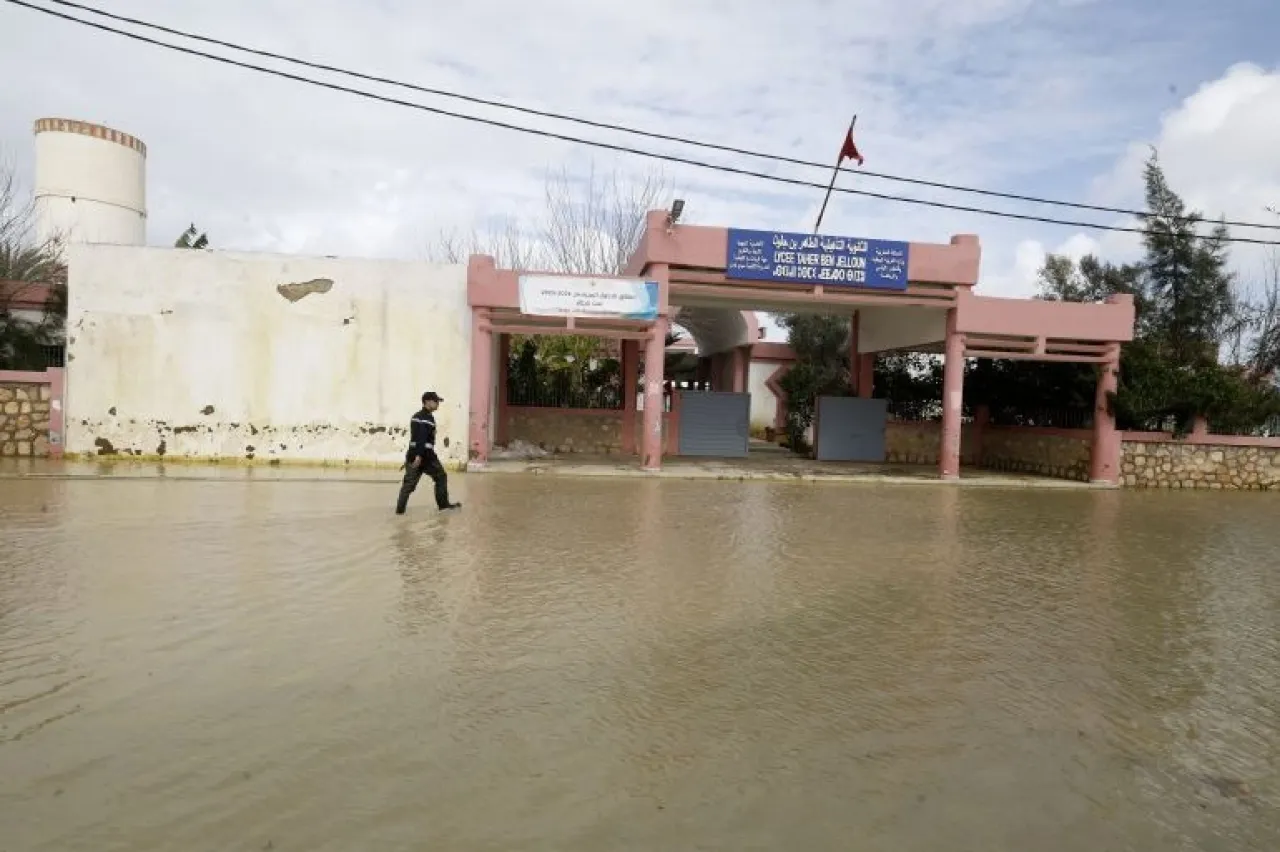
Khaberni - The Moroccan government announced on Friday the allocation of financial compensations for the families affected by the floods that ravaged 4 provinces in the north of the country, in parallel with the launch of a program to support farmers and livestock breeders in the affected areas.
These actions come after the "Oued El Makhazine" dam recorded a historic fill level of 156% of its capacity, causing it to overflow and flood vast areas.
Authorities have approved the disbursement of $14,000 for the reconstruction of each collapsed house, and $600 for each affected family, according to the Moroccan news agency.
The head of the government confirmed that specialized local committees will take care of conducting a precise field survey of the affected premises to ensure "transparency and fairness," with a dedicated phone number and a method of communication for obtaining assistance starting from next week.
It added that the affected farmers will be supported through the launch of a program that suits the specifics of the affected areas, by supporting the purchase of seeds and fertilizers, to accelerate the pace of recovering the season.
On Thursday, the government decided to allocate $300 million to help and support areas affected by the floods resulting from rains that caused human and material losses and a wave of population evacuations.
Massive Evacuation
Since January 28th, the provinces of Kenitra, Larache, Sidi Kacem, and Sidi Slimane have been experiencing floods in several cities and villages, especially in the city of El Kasr el Kebir in Larache Province.
The government reported that the floods led to the evacuation of about 188,000 people from the four provinces, after water submerged more than 110,000 hectares of land.
The evacuation did not only affect residents but also livestock; farmer Ibrahim Barnoos (32 years old) told the French Press Agency, "We moved the livestock towards the forest, we have no grains or hay left.. the water took everything away."
In the village of "Ouled Salama," farms turned into vast lakes that submerged barley and clover fields.
Rashid Benali, president of the Moroccan Confederation of Agriculture and Rural Development explains that according to preliminary data, livestock breeding "is among the most affected, waiting for the water to recede for a more accurate assessment of the losses."
He adds that other agricultural sectors were also affected, including sugar beet farms, citrus fruits, and vegetables. These fertile areas combine lands dedicated to the production of vegetables and fruits for export and other subsistence areas mostly dedicated to grain cultivation.
Diverse Economic Impact
The dams of the kingdom - in just one month - recorded nearly 8.82 billion cubic meters, a figure that nearly equals the total recorded over the past two years.
Despite the losses, the International Monetary Fund predicts a growth of 4.9% this year, supported by strong agricultural production.
The agricultural sector represents about 12% of Morocco's Gross Domestic Product and employs a third of the active population, while the authorities are betting on expanding local irrigation and desalinating seawater to ensure the sector's resilience against climate fluctuations.