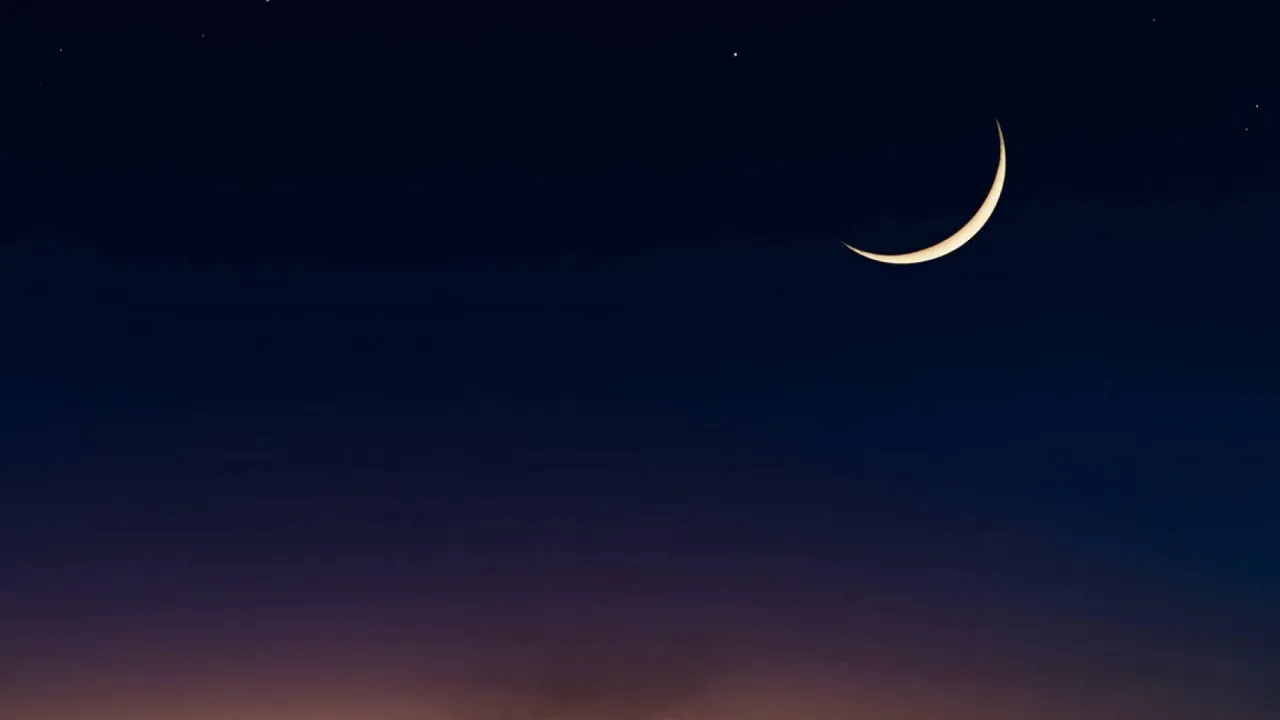
Khaberni - Astronomical data for next Tuesday indicates that the angular elongation between the moon and the sun will be approximately one degree or less in some areas, which is an extremely low value that makes the moon very close to the sun apparently, and completely submerged in its intense glow, according to the president of the Jordanian Astronomical Society, Ammar Al-Sakaji.
Al-Sakaji mentioned that under these conditions, the moon is practically within the strong solar radiation range, which means that observing the moon is not possible either with the naked eye, nor with traditional telescopes, nor even with professional astronomical photography, as the slight angular difference does not allow separating the faint light of the crescent from the bright background of the sky near the solar disk.
He stated that attempting to search for the moon under these conditions, especially by directly looking through the eyepiece of the telescope or using "the naateur" or any conventional optical enlargement device, represents a real risk to eye safety.
Al-Sakaji explained that the telescope gathers and focuses light, and if it is near the direction of the sun, the amount of concentrated radiation could cause burns to the retina, permanent damage to the visual cells, partial or total vision loss, and the retina does not contain pain receptors, meaning that the damage can occur without immediate sensation and be discovered too late.
He noted that "those who want to experiment driven by research or scientific documentation must fully adhere to safety measures, and the most important of which are using computerized telescopes with precise aiming or connecting them to digital cameras to capture images without looking through the eyepiece, avoiding any direct view through the telescope towards an area close to the sun, ensuring the presence of approved solar filters if working in conditions close to the sun's direction, or using eclipse glasses, and taking safety measures."
Al-Sakaji reaffirmed according to astronomical calculations, that the chances of observation in this case are not possible and most importantly the very slight elongation, and other data reconfirm that seeing the crescent is absolutely not possible according to astronomical calculations; due to the trivial elongation, urging observers to prioritize general safety, as preserving the gift of sight is more important than any unplanned observation attempt, and eye safety comes before any risky attempt.