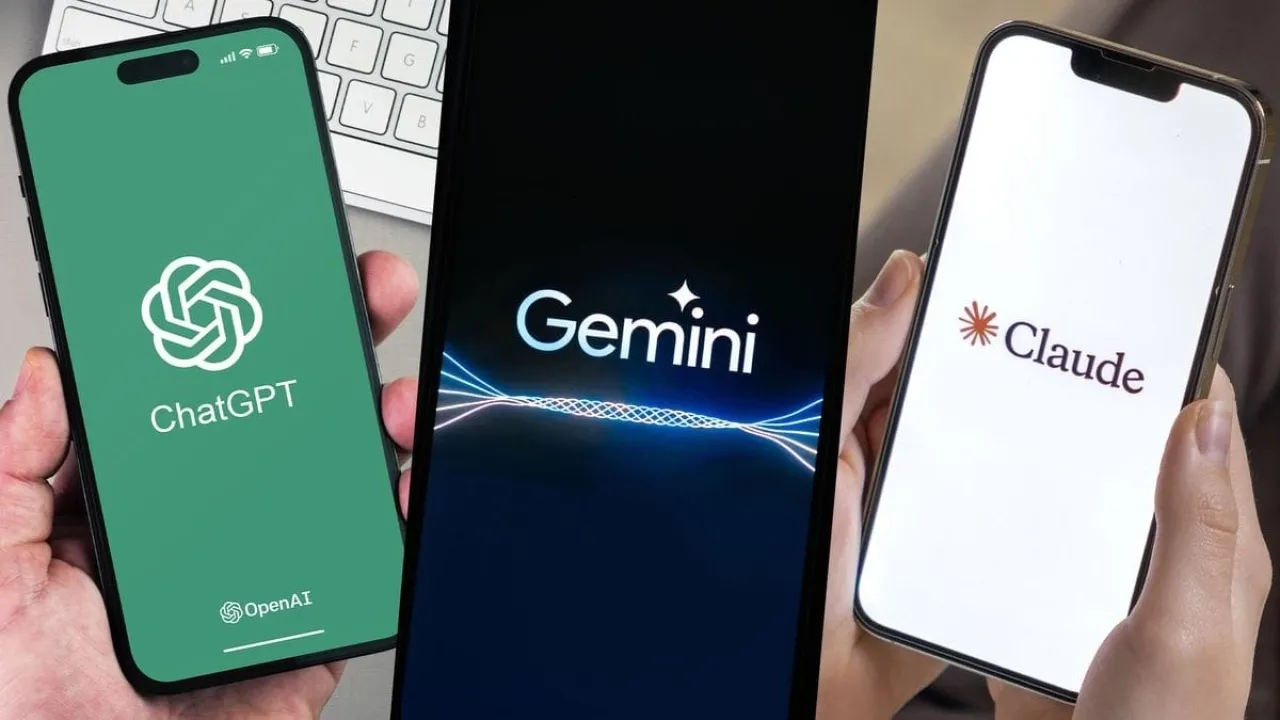
Khaberni - Throughout 2025, competition for the title of the world's best conversational robot is confined between "Chat GPT" and "Gemini", where Google succeeded in making a significant leap with the launch "Gemini 3 Flash", granting it a clear advance in the AI race.
However, away from the limelight, "Anthropic" was silently working on its model "Claude", surprising the market with the launch of "Claude Opus 4.6", which not only improved performance but also managed to outperform "Gemini" in the most critical aspects for professional and practical usages, according to "Thomas Jade".
Today, the equation has changed; choosing the best model is no longer based only on speed or multimedia capabilities, but on the true ability to think deeply and execute complex tasks with precision and reliability.
The Upturn of Scales
One cannot deny the power of "Gemini 3 Flash", as it offers an advanced model with striking technical capabilities that include a huge contextual window of up to a million symbols, and comprehensive support for texts, images, audio, video, and "PDF" files, besides a processing speed significantly exceeding its previous versions.
However, competition in the AI market has surpassed the mere technical performance limits, for with the launch of "Claude Opus 4.6", "Anthropic" focused on transforming AI from an advanced conversation tool to a system capable of executing real tasks with high efficiency.
A Window of a Million Symbols Used More Intelligently
Although "Gemini" and "Claude" offer similar-sized contextual windows, the real difference lies in how this data is managed, where "Anthropic" adopted a new technology known as "contextual compression", allowing the model to automatically summarize data over long-term tasks, thus enabling it to maintain higher intellectual coherence and continuity in complex projects, like multi-stage research or extended programming operations.
"Opus 4.6" also focused on improving long-term planning and automating tasks over longer time periods, in addition to its ability to self-detect and correct errors within complex programming codes.
The numerical indicators support this superiority, registering advanced results in agent and operating system programming tests, which reinforces its status as one of the most efficient models in practical applications.
Figures confirm that these improvements have transformed artificial intelligence into a conversational robot that actually behaves like a junior engineer or analyst, where statistics from the leading platform "Terminal-Bench 2.0" indicate that "Claude Opus 4.6" outperforms all other models by 65.4%, while the model achieved a 72.7% recognition rate on the "OSWorld" platform, making it the best overall.
Claude Excels in Real Cognitive Work
The superiority is more apparent in professional productivity benchmarks, where "Claude Opus 4.6" showed advanced performance in tests measuring the ability to execute economic tasks in fields like law, finance, and professional consulting, exceeding competing models by a noticeable margin.
The model also topped the tests for advanced internet research and interdisciplinary thinking tests, which are among the toughest criteria for evaluating AI capabilities.
In the "GDPval-AA" index - a measure designed to assess economically valuable work in financial, legal, and professional fields - the "Claude Opus 4.6" program surpassed "Chat GPT", especially its latest model "GPT-5.2" by about 144 points, leading the ranking with a score of (1606).
It also excelled over its predecessor (Opus 4.5) by 190 points, and topped the scale of leading models in the "Humanity's Last Exam", a rigorous interdisciplinary thought test.
Yet, "Gemini" still retains some strengths, particularly in response speed, advanced multimedia handling, and deep integration with the Google service ecosystem, in addition to its capabilities in image creation, a feature still absent in "Claude". However, the latter imposes its superiority when it comes to complex analysis, long-term planning, professional programming, and executing multi-step tasks with high accuracy.
Features That Make the Difference
Alongside the developments in the "Opus 4.6" model, "Anthropic" introduced a new set of tools that enhanced the professional use of AI, including the "agent squads" feature within "Claude Code", which allows collaboration among several AI agents in executing complex tasks, along with improvements in adaptive thinking systems, and tools designed for use within programs like "Excel" and "PowerPoint".
These features reflect a strategic shift in development philosophy; while Google aims to offer broad solutions for all users, "Anthropic" focuses more on developing tools targeted at professionals and specialized work environments.
As for cost, Google offers the "Gemini 3 Flash" model for free to users, while accessing "Opus 4.6" requires a subscription to "Claude Pro" service for $20 per month, a factor that might influence user decisions despite the technical superiority of the model.
The Best Choice
By making a final comparison, "Gemini 3" represents one of the most advanced and widespread AI models; however, the launch of "Claude Opus 4.6" has redrawn the competitive landscape in this rapidly evolving sector.
If the priority is speed, multimedia variety, and integration with daily applications, "Gemini" remains a strong choice. However, if the goal is deep analytical thinking, precise programming, and long-term project execution, then "Claude Opus 4.6" establishes itself as one of the most prominent models currently available.
In the AI race of 2026, it seems that the crown of the strongest and best has - at least for now - shifted to "Claude", supported by test results and performance standards that reflect a clear shift in the global competition scales in its favor.