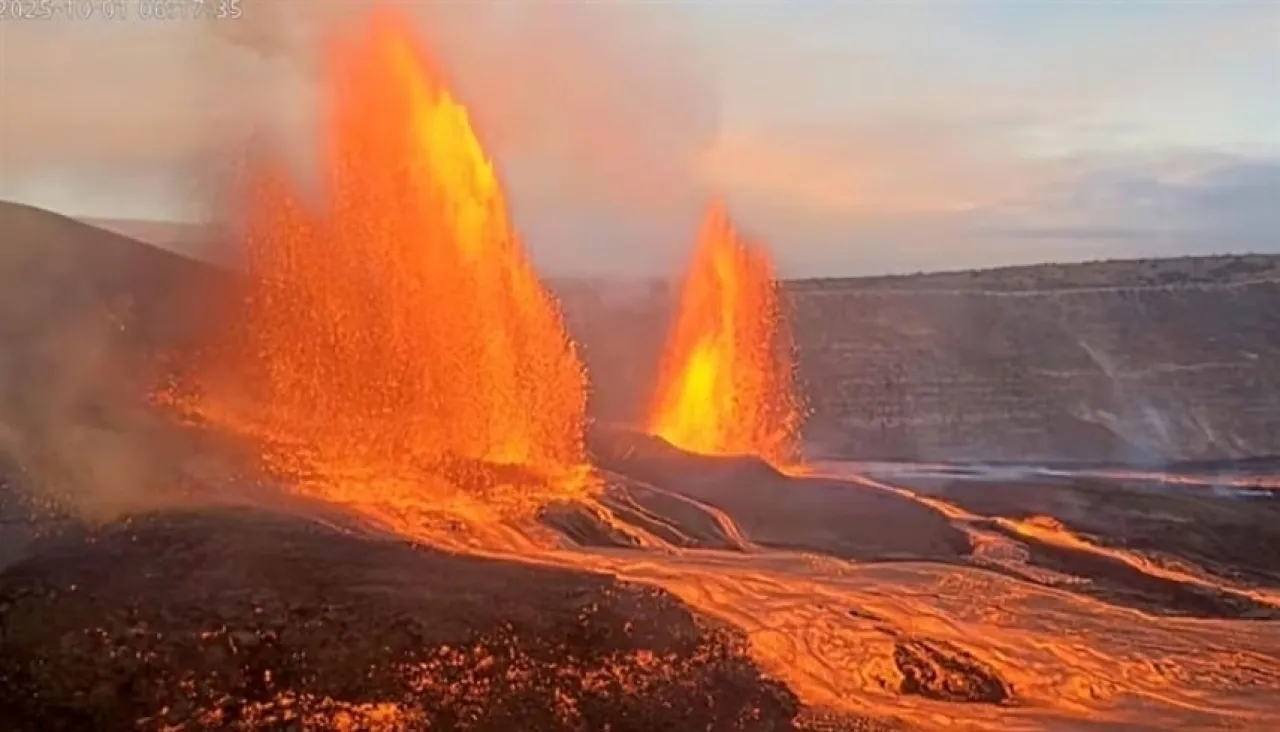
Khaberni - Researchers have observed unprecedented signs of activity inside the Mexican volcano El Chichón, also known as Chichonal, after more than 4 decades of complete dormancy.
Scientists from the National Autonomous University of Mexico have recorded a rise in temperature, the emergence of bubbling gases, and unusual sulfur formations during monitoring from June to December 2025.
Previous eruption & hundreds of victims
The last eruption occurred in 1982, killing at least 2000 people in one of the deadliest volcanic disasters in Mexico's history.
The series of explosions began on March 28 of that year and continued until April, sending high clouds of ash and releasing devastating volcanic flows.
Entire villages were destroyed, agricultural lands were buried under ash and debris, and thousands of people were forced to flee, while coffee farms, livestock, and infrastructure suffered long-term economic and environmental damage.
Recently, scientists have noted an increase in temperature, changes in the chemistry of the crater lake, and gaseous emissions including hydrogen sulfide and carbon dioxide, which can be dangerous at high concentrations.
The team also documented unusual hollow sulfur spheres forming inside pools of liquid sulfur in the crater, according to the "Daily Mail".
The crater lake, which is usually green and dominated by algae, has turned gray, indicating high levels of sulfates and silica in the water.
Thermal measurements showed that the temperatures at the bottom of the lake and the surrounding crater floor have risen above typical background levels.
Scientific explanations rule out an imminent eruption
Volcanologist Dr. Patricia Jacome Paz from the National Autonomous University explained that the unusual activity is likely due to interactions of intensely hot groundwater with hot rocks and not from molten magma rising to the surface, stating in a recent lecture: "The observed behavior is consistent with hydrothermal processes or minor steam explosions".
Gas sampling revealed accumulations of hydrogen sulfide and carbon dioxide near the crater, gases that could pose risks to humans and animals if accumulated in enclosed or low-lying areas, but scientists emphasized that such emissions are common in active hydrothermal systems and do not necessarily indicate an imminent eruption.
Ongoing monitoring with advanced techniques
Researchers are using drones, remote sensing via satellites, and on-site tools to monitor thermal anomalies, gas columns, and land deformation.
Seismic data collected in the area show low levels of seismic activity, further indicating that magma is not currently moving underneath the volcano.
Experts say that the current activity does not resemble conditions that preceded the 1982 eruption, but warn that volcanoes can remain dynamic for decades, even centuries, after a major event.
It is noteworthy that slight changes in temperature, gas emissions, and water chemistry can provide early clues about how the underground volcanic system is evolving, making ongoing monitoring crucial for public safety.