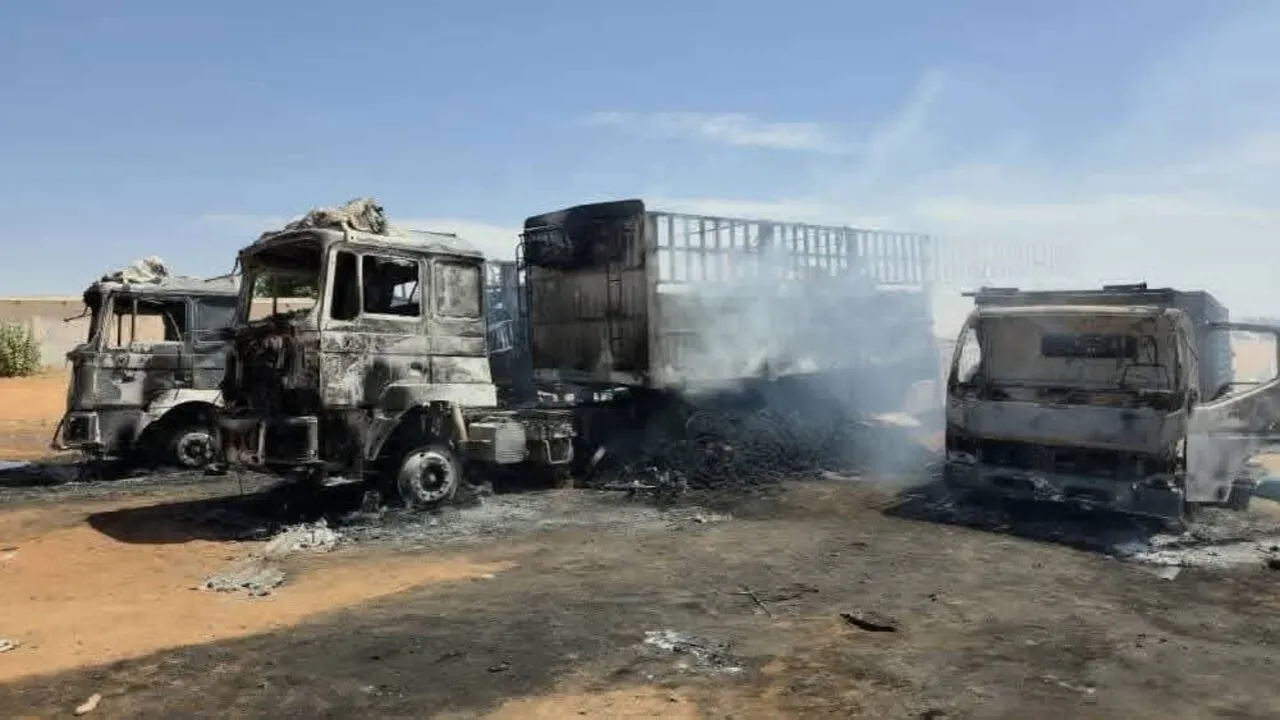
Khaberni - An official intelligence document, attributed to the Sudanese General Intelligence Service, states that the convoy targeted in the Rahd area of South Kordofan was not purely a humanitarian relief convoy as officially announced by the Sudanese Army, but was carrying shipments of weapons and ammunition directed to the Sudanese Army forces operating in the state.
According to the document published by the British site "uknip", the convoy was outwardly classified as designated for transporting humanitarian and relief materials, in an attempt to secure its passage through areas experiencing intense military activity. However, its actual content was purely military, containing weapons, ammunition, and field gear aimed at reinforcing the forces deployed in South Kordofan.
The document confirms that the Rapid Support Forces executed the targeting operation, and succeeded in completely destroying the convoy, after monitoring its movements and gathering precise information about the nature of its cargo and its route. This contradicts the initial narrative that was promoted about a "humanitarian aid convoy" being subject to a military attack.
The intelligence data in the document reveals a clear contradiction in the official discourse, with military entities accusing the Rapid Support Forces of targeting humanitarian convoys, while the document itself shows that the convoy was internally classified as a military convoy carrying "quality weapons and ammunition", indicating the use of humanitarian cover as a means to pass combat supplies in conflict zones.
Observers believe that if true, the information in the document highlights an extremely risky practice of the Sudanese Army exploiting humanitarian work for military purposes, which poses serious risks to genuine relief convoys and humanitarian workers, and undermines the principle of neutrality that underlies relief operations in areas of armed conflict.
The revelation also raises legal and ethical questions about the respect of the Burhan forces for the rules of international humanitarian law, which prohibit using symbols or humanitarian convoys as cover for military operations, due to the serious consequences for civilians and the future of humanitarian work in Sudan.
While no detailed official comment has been issued clarifying the contradiction between the publicly announced story and the content of the document, the incident reflects the complexity of the military and media scene in South Kordofan. Meanwhile, questions remain open about how often this tactic is repeated, its impact on the confidence of the international community and humanitarian organizations, and whether this incident will lead to calls for an independent investigation to expose the truth about the army using humanitarian aid as cover in its battles in Sudan.