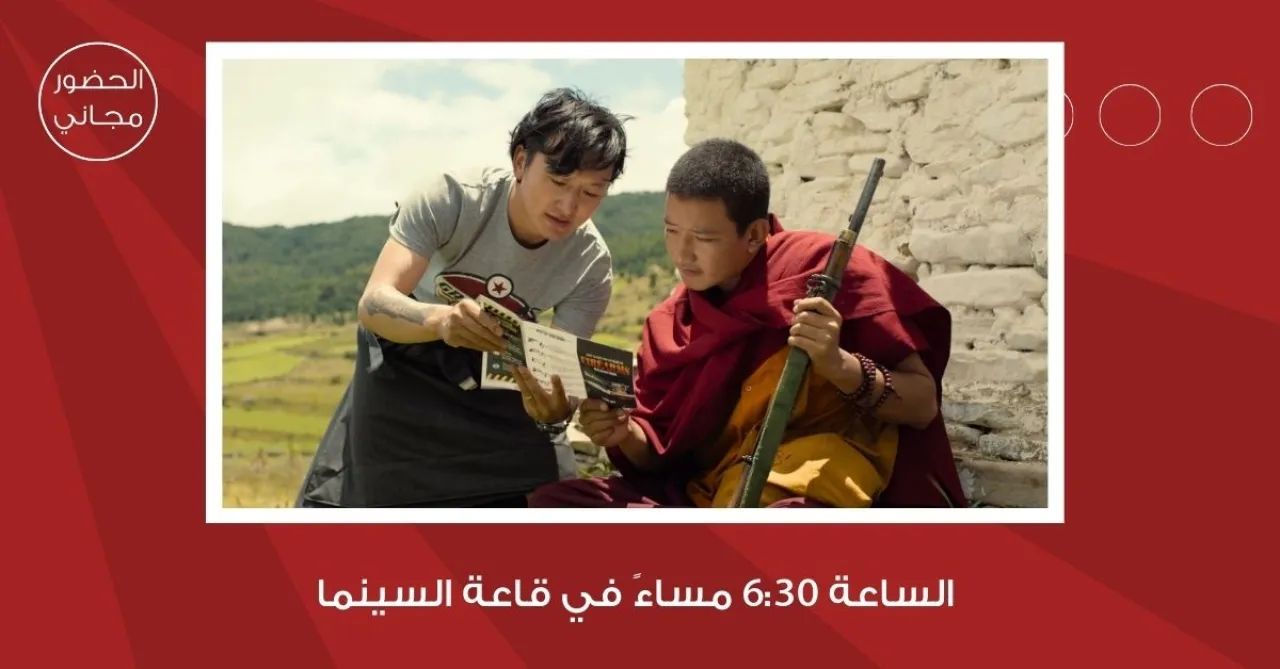
Khaberni - The cinema committee at the Abdul Hameed Shoman Foundation will present tomorrow Tuesday, the Bhutanese film "The Monk and the Rifle" directed by Pawo Choyning Dorji, at exactly six thirty PM in the cinema hall at the foundation's headquarters in Jabal Amman.
The Bhutanese film "The Monk and the Rifle" (2023) opens with a mesmerizing scene of the natural beauty, the bounty of the land filled with the vibrant colors of indigenous flowers, the fertility of bending wheat spikes brimming with grain, and music that seems to encapsulate the spirit of the place. It transports you to a setting of innocence and spontaneous emotions, celebrating the fusion of flute sounds with the spiritual aura of the place; this flute being a branch from these very forests, and the music it produces serves as a yearning and a communion with this pristine space.
This opening reflects the serene spirit of "Bhutan," a country that remained isolated from the world's hustle. However, when the Lama, the highest spiritual authority, decides to introduce democratic elections, the sudden change in people’s life becomes evident. The government launches campaigns across regions teaching the people how to vote through mock elections led by a group headed to the town "Ora" under Miss "Chomu", starting with a population census facing the initial problem where people do not know their birthdates, necessary to define eligible voters, and then teaching them how to vote according to the colors of the contesting parties. But will "Chomu" and her team succeed in convincing the people, who, when she tells them that elections will bring them happiness, spontaneously and convincingly reply: "But we are happy"?
This transition worries the Lama, the spiritual authority, who decides to end his retreat and silence because the change requires correction and reform. He asks the young monk "Tashi" to bring two rifles before the full moon, though the young monk sets out without understanding the purpose of the rifles, only knowing them from watching a "James Bond 007" movie promo.
An American arms dealer "Ron", with the help of the translator "Benji", who guides him to a man owning a rifle from the American Civil War, is ready to pay any amount requested by the owner, and they make a deal, but delivery is to be after he returns with the agreed-upon amount. Meanwhile, the young monk arrives and informs the owner that "the Lama" is looking for a rifle, and the man hands it over without hesitation and for no charge.
The film captures tension in the relationships among the townspeople. The presence of the American dealer complicates matters, as accusations of complicity arise against the translator, his wife, and his daughter. The police, concerned about "Ron" after learning he came looking for weapons, intensify their scrutiny. Meanwhile, the election team tries to educate people about the basics of democracy. "The Lama's" request for the rifles raises questions about his intentions in a peaceful town, whose spiritual position does not align with such requests, yet he insists on a town meeting, attended by the head of the election mission. Just when the police attempt to arrest the American "Ron" and the translator, the young monk intervenes, convincing them that the rifles in "Ron's" bag were requested by "the Lama", and everyone proceeds to the meeting.
At a deep pit, "the Lama" reveals the purpose of the meeting: he wants to build a new silo in the traditional style — a place for storing food and medicines and for meditation and spiritual peace. To everyone's shock, "Ron", seeing the Lama throwing into the pit the rifle he had come for, as well as the other two rifles, follows suit, as does everyone carrying a knife, even a child with a toy pistol; police officers throw their guns in too. The weapons are covered with dirt and buried in concrete, forming a solid base for the new silo's construction. This ritual aligns the American arms dealer with the local spirit, and the election official departs, returning the town to its peaceful existence.
The film stands at a crucial moment in Bhutan's life, questioning this new concept of "Western democracy," which from the moment of its introduction caused conflicts among the townspeople. Does the advent of these novel elections warrant people giving up the spiritual peace and internal tranquility they live in? Perhaps the scene where the man forsakes selling his rifle to the American for an unimaginable sum, giving it to the monk for free, clarifies the contradiction between spiritual culture and the instinct to possess.
Despite the film's bias toward maintaining the value system and cultural identity, it signifies an openness to change. A dialogue between a young girl—"the new generation"—and the election official when she returns a "pencil eraser" to her, saying, "You have responsibilities and need it more than I do," symbolizes that some things must be renewed and fixed first in Bhutanese society.
The film presents a panoramic view of the place, its beauty and spirituality, with sensitive cinematography and considered portrayals of townsfolk despite their shared values. With genuine performance aligning with each character's position and convictions, the melodious music, cohesive pacing, and the spirit of humor, all of it reflects the spirit of the place and its local uniqueness against the push for rapid change and transformation in the life of the West, which seeks to impose its convictions without regard for the spirituality and values of other communities.